For most of my career, outsourcing was treated as a solved problem.
You needed scale. You needed flexibility. You needed cost relief.
Outsourcing was the obvious answer.
And for a long time, it worked.
But somewhere along the way, the model quietly drifted—so slowly that many of us didn’t notice it happening in real time.
Today, outsourcing still exists everywhere. But it rarely feels like it’s delivering what it once promised.
The Promise That Made Sense – Once
Outsourcing was never just about cheap labor. It was about focus.
The idea was simple: move repeatable, operational work to capable teams elsewhere, so core teams could focus on growth, customers, and strategy. Cost savings were a benefit—but not the only one.
Early models were lean. Teams were close to the work. Decision-making was fast. Accountability was clear.
Then scale arrived.
And with scale came layers.
One Layer at a Time
No one set out to build bloated outsourcing models.
Each new layer had a rationale:
- A manager to coordinate teams
- A reviewer to ensure quality
- A governance role to manage risk
- A reporting layer to keep everyone informed
Individually, these decisions made sense. Collectively, they changed the economics.
What was once a direct extension of the business became a multi-step system where work passed through hands that didn’t create value—only oversight.
The distance between the customer and the work quietly widened.
Follow the Dollar
Here’s where the story becomes uncomfortable.
In many traditional outsourcing models today, only 20–30% of what a customer pays reaches the people actually doing the work.
The rest funds the system around them:
- Management hierarchies
- Internal escalations
- Reporting structures
- Vendor margins
This isn’t about greed. It’s about structure.
Large delivery models are optimized for managing scale, not precision. And scale requires supervision. Supervision requires layers. Layers cost money.
The irony is that customers believe they’re paying for talent—but most of the spend is underwriting complexity.
The Human Cost of Structural Inefficiency
Underpaid frontline talent isn’t just a workforce issue. It’s an operational one.
When capable professionals are consistently paid at the lower end of the market, three things follow almost immediately:
- They leave
- Knowledge walks out with them
- Teams never stabilize
High attrition becomes normalized. Relearning becomes routine. Quality fluctuates. Supervision increases. And costs quietly rise.
Replacing someone isn’t just about filling a seat. It’s about replacing context—how systems actually work, how exceptions are handled, where things break.
Low pay doesn’t eliminate cost.
It defers it. And then multiplies it.
Why the Model Resists Change
If these problems are so visible, why do they persist?
Because incentives matter more than intentions.
Traditional outsourcing economics reward:
- Bigger teams over better teams
- Longer contracts over better outcomes
- Dependency over transparency
Efficiency, simplification, and automation threaten predictable revenue. Lean teams disrupt models designed to grow through volume.
This doesn’t mean people inside the system are acting in bad faith. It means the system behaves exactly as it’s designed to.
Expecting a fundamentally different outcome without changing incentives is wishful thinking.
Rethinking the Model from First Principles
Imagine designing outsourcing today—without legacy assumptions.
You might ask:
- What if fewer, better-paid people outperformed larger, cheaper teams?
- What if clients stayed closer to the work instead of managing through layers?
- What if efficiency benefited everyone, not just one side of the contract?
At its core, outsourcing should be about capability access, not labor abstraction. About proximity to outcomes, not distance from them.
The future of outsourcing isn’t about geography.
It’s about alignment—between cost, talent, incentives, and ownership.
A Quiet Reset Is Already Underway
Across industries, leaders are beginning to question what they once accepted as “industry standard.”
They’re asking where their dollars go.
They’re asking why teams churn so quickly.
They’re asking whether complexity is being added for them—or for someone else.
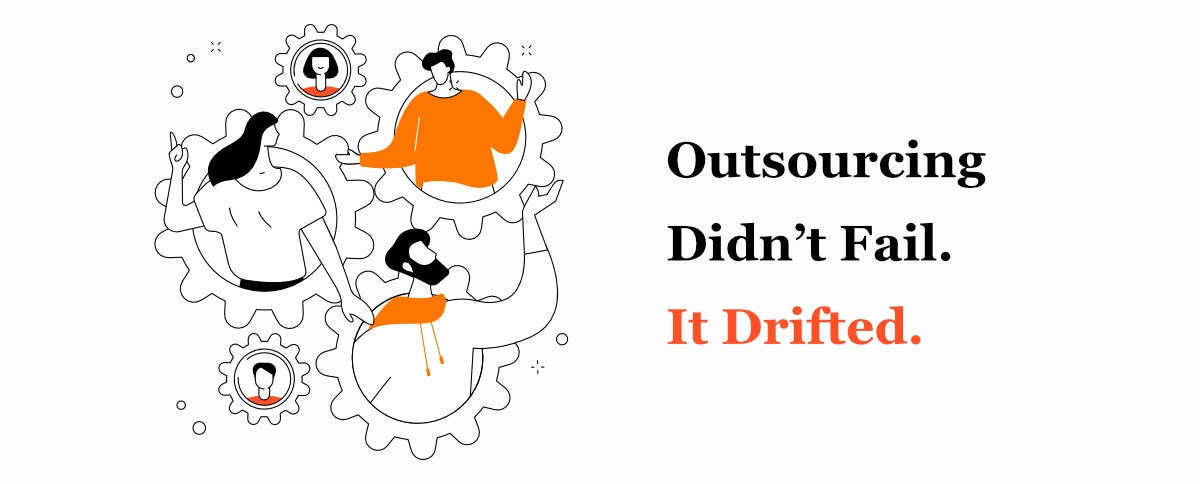
Outsourcing didn’t fail.
It drifted.
And like most course corrections, fixing it doesn’t require radical ideas. It requires returning to first principles—and being willing to let go of structures that no longer serve the people paying for them, or the people doing the work.
That’s where the real reset begins.