This guide cuts through that noise. It covers how GCC consulting firms are categorized, what criteria actually matter in selection, and which mistakes consistently derail GCC setups in the first two years.
Key Takeaways
- Four distinct firm types exist — match the category to your growth stage, not just the firm's reputation
- Ownership clarity over team, contracts, and IP is the single most consequential question to ask
- Domain expertise in your specific industry accelerates productivity ramp-up and reduces governance risk
- The center head hire should happen before infrastructure decisions, not after
- Nearly half of new GCC setups involve a consulting partner; your engagement model choice matters as much as your firm choice
What Is GCC Consulting and Why It Matters
GCC consulting refers to advisory and operational services that help enterprises design, build, staff, and operate Global Capability Centers — offshore or nearshore units that deliver real business functions (technology, finance, operations, compliance) under the parent company's direct governance. Unlike outsourcing, the enterprise owns the center throughout.
According to IBEF, India had 1,580 GCCs as of 2023, expected to cross 1,900 by 2025 and 2,400 by 2030 — accounting for 55% of global GCCs. The Zinnov-NASSCOM India GCC Landscape Report pegs India GCC revenue at $64.6B in FY2024, projected to reach $99B–$105B by 2030.
Enterprises are choosing GCCs for three compounding reasons:
- Talent ownership — teams work under the parent company's direction, not a vendor's
- IP protection — proprietary processes and data stay within the enterprise's governance boundary
- Operational transparency — cost structures, productivity, and quality are directly visible
As Everest Group notes, outsourcing can accelerate execution — but GCCs offer greater control and a closer operating boundary. That tradeoff shapes every decision covered in this guide.
Types of GCC Consulting Firms: Know What You're Evaluating
GCC consulting firms are not a monolith. Choosing the wrong category wastes time before a single hire is made.
Here's a quick reference before diving into each category:
| Firm Type | Best For | Watch Out For |
|---|---|---|
| Tier-1 Global Consultancies | Strategy, business case, C-suite alignment | No operational execution capability |
| Big Four Advisory | Legal entity, tax structure, compliance | Limited talent and culture design capability |
| India/Offshore Market Specialists | Benchmarking, location strategy, BOT execution | Execution depth varies; verify before committing |
| Domain-Specific / Mid-Market | Industry-specific GCCs, mid-sized enterprises | Fewer brand-name references; evaluate track record carefully |
Tier-1 Global Consultancies (McKinsey, BCG, Bain)
Best for: executive-level business case development, org design, C-suite alignment, pre-entry market analysis.
These firms are strong at GCC strategy — McKinsey frames GCCs as innovation centers that build talent pipelines; BCG published a three-step playbook for accelerating GCC maturity in 2025. What they don't provide is operational execution. Don't hire a Tier-1 strategy firm to run your talent sourcing or governance design.
Big Four Advisory (Deloitte, PwC, EY, KPMG)
Best for: legal entity formation, transfer pricing, tax structure, and regulatory compliance.
Deloitte, EY, and PwC all have dedicated GCC practices in India. KPMG was recognized as a Leader in the ISG Provider Lens GCC Services 2025. Their strength is in regulated industries — financial services, healthcare, insurance — where compliance architecture is non-negotiable. Once the legal and tax structure is in place, you'll need a separate operational partner to handle team management, hiring, and cultural integration.
India/Offshore Market Specialists (Zinnov, ANSR, Avasant)
Best for: benchmarking, location strategy, talent pool analysis, and BOT model execution.
Zinnov claims 20+ years of GCC setup expertise and states its approach reduces setup time by 50%. ANSR describes having established 150+ centers and hired 140,000+ professionals. Avasant's 2025 RadarView covers providers across the full GCC lifecycle. These firms excel at data-driven pre-entry decisions — ask for client references specific to your industry before signing.
Domain-Specific and Mid-Market GCC Specialists
These firms build capability centers for mid-sized enterprises that don't need a 500-person center on day one. Rather than generic setup playbooks, they arrive with hiring profiles, workflows, and governance frameworks already calibrated to your industry — mortgage, insurance, fintech, healthcare, or logistics.
What separates them from generalist firms:
- Faster setup timelines with less discovery friction
- Hiring profiles built around industry-specific workflows from day one
- Transparent cost structures rather than complex fee hierarchies
- Ownership-first models where the enterprise holds direct employment relationships
OwnGCC operates in this category, combining 29+ years of domain experience across mortgage, insurance, fintech, and healthcare with a GCC-as-a-Service model. The core premise: you own your team and direct their work — OwnGCC handles the operational infrastructure to make that viable from week one.
Key Criteria for Selecting the Right GCC Consulting Partner
Regardless of firm type, these criteria determine whether a GCC consulting partner delivers value or just a slide deck.
Domain and Industry Expertise
Most enterprises underweight this one. A firm with deep mortgage or insurance knowledge builds fundamentally different hiring profiles, governance frameworks, and compliance controls than a generalist applying the same playbook across verticals.
Zinnov's case study with a $70B+ healthcare services company illustrates the point: a domain-specific GCC maturity framework and a two-year transformation roadmap converted a resource center into a strategic partner — an outcome that requires knowing the industry's talent profiles and operational rhythms from day one.
Ask any prospective firm: What specific workflows have you built hiring profiles for in our industry?
Ownership Model Clarity
The most consequential question in any GCC evaluation: who ultimately controls the team, the contracts, and the IP — the enterprise or the consulting partner?
Everest Group warns that in BOT arrangements, knowledge, tooling, and leadership may not transfer as cleanly as expected. Opaque outsourcing structures create vendor lock-in — and in practice, that means cultural misalignment, attrition at transfer, and disputes over IP and asset valuation.
Ownership-first models — where the enterprise holds direct employment relationships and full visibility into cost structures — eliminate this risk entirely. OwnGCC's model is built on this: zero vendor lock-in, transparent pricing, and teams that operate as an extension of the client's organization.
Post-Setup Support and Governance
Firms that exit at operational launch leave enterprises exposed. Governance frameworks, talent retention programs, and leadership development don't end at go-live.
Ask prospective partners:
- Do you offer ongoing compliance monitoring after the center launches?
- What does performance management look like in year two?
- Is there a platform or system that gives us visibility into operational KPIs?
OwnGCC's post-setup model includes ongoing compliance retainers covering FEMA, RBI, transfer pricing, and GST; the NOVA platform for unified GCC operational visibility; and Lean Six Sigma DMAIC programs for continuous improvement. Each of these is built into the engagement from day one, not offered as an optional upgrade later.
Cost Transparency and Commercial Flexibility
The difference between a locked-in, fee-heavy consulting contract and a flexible engagement model compounds over three to five years. Zinnov-NASSCOM data shows Tier II and Tier III cities can offer 25–30% cost reductions versus Tier I cities — a variable that only appears in your favor when the commercial model aligns to your growth goals, not the vendor's margins.
GCC-as-a-Service models, like the one OwnGCC offers, eliminate heavy upfront capital requirements by operating on a subscription or per-FTE basis. Enterprises start lean and scale as operations mature.
Track Record With Comparable Enterprises
A partner's relevant reference base matters more than their total client count. A firm that has built centers for 100+ mortgage lenders or global insurance carriers understands regulatory constraints, staffing profiles, and operational cadences that a generalist simply hasn't encountered.
During evaluation, ask for industry-specific case studies and request reference calls with enterprises of similar size, function, and regulatory profile.
Engagement Models: Which One Fits Your Business?
Three models dominate the GCC market, and each suits a different stage and risk appetite.
| Model | Best For | Key Risk |
|---|---|---|
| Strategy Advisory Only | Enterprises 12–18 months from commitment; pre-decision benchmarking | No operational follow-through |
| Build-Operate-Transfer (BOT) | Large-scale 500+ seat centers where speed matters | Transfer friction — culture, IP, and leadership may not transfer cleanly |
| GCC-as-a-Service / Embedded Partnership | Mid-market enterprises needing domain expertise, full ownership, and minimal upfront capital | Requires a partner with genuine domain depth |
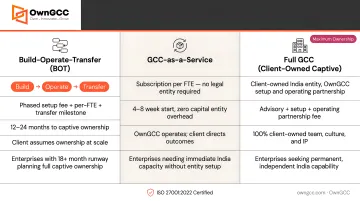
Everest Group reports that nearly half of new GCC setups involve a consulting or service provider — reflecting how few enterprises have the internal capability to execute setup independently. The engagement model you choose determines how much of that execution stays in your hands.
That ownership question is especially consequential for mid-market US enterprises in mortgage, insurance, or fintech — and for them, the embedded partnership model consistently delivers better outcomes than BOT. The Zinnov-NASSCOM mid-market GCC report notes that 35% of mid-market GCCs in India were set up in just two years — a timeline that requires a partner who moves fast without sacrificing ownership design.
Best Practices and Mistakes to Avoid
Align Consulting Partner Selection to GCC Maturity Stage
Enterprises frequently hire the wrong firm type for where they actually are. A quick self-diagnosis:
- You need a strategy advisor if: You haven't decided on a location, don't have a business case, and are 12+ months from commitment
- You need a BOT provider if: You're building a 500+ person center and speed outweighs cultural alignment in year one
- Embedded domain specialists fit best when: You're a mid-market enterprise, have specific industry workflows to replicate, and want ownership from day one
Hiring a Tier-1 strategy firm when you're ready to execute wastes 6–12 months. A large BOT provider brought in when ownership clarity matters most creates a 3-year problem.
Avoid Optimizing for Consulting Fee Cost Over Execution Quality
Low consulting fees often correlate with under-investment in talent sourcing quality, governance design, and domain expertise. The consequences show up 18 months in:
- Attrition spikes across high-performer roles
- Cultural misalignment between HQ and the India center
- Centers operating at 60–70% of designed capacity
Zinnov reports 16.5% high-performer attrition in India GCCs — a baseline that worsens when the setup partner never built retention into the governance model from day one.
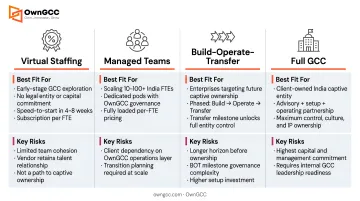
OwnGCC's progressive model is designed around this risk: enterprises start with a managed structure where OwnGCC handles workforce infrastructure while the client directs the team, then transition into full captive ownership as scale stabilizes. The result is lower upfront risk without locking in permanent vendor dependency.
Treat the GCC Center Head as a First Hire, Not an Afterthought
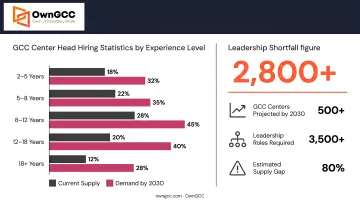
The center head should be among the first three decisions in any GCC setup, not someone hired after infrastructure is in place. Their judgment shapes city selection, employer brand, talent sourcing strategy, and culture — all of which compound with every subsequent hire.
Zinnov's 2025 GCC Head report found that heads of India's top 50 GCCs average 30 years of total experience, including roughly 23 years in the GCC ecosystem. The same report identifies a potential shortfall of 23,000 global leadership roles by 2030 — making early identification of the right center head a genuine competitive advantage, not just a hiring task.
Frequently Asked Questions
What is GCC in consulting?
GCC consulting refers to advisory and operational services that help enterprises design, establish, and scale Global Capability Centers — offshore or nearshore units that own specific business functions under the parent company's direct governance. It's distinct from outsourcing, where a third-party vendor controls delivery.
How do I choose the right GCC consulting firm for my business?
Prioritize five factors: domain and industry expertise, ownership model clarity, post-setup governance support, commercial flexibility, and a track record with comparable enterprises in your sector. Firm size and brand recognition matter less than relevant reference cases.
What is the difference between a GCC consulting firm and a BOT provider?
A GCC consulting firm advises and supports setup with the enterprise owning the center throughout. A BOT provider runs the center under their umbrella for 2–4 years before transferring ownership. This arrangement shapes culture, talent identity, and how cleanly IP and leadership transfer at handover.
How much does it cost to set up a GCC with a consulting partner?
Setup costs depend heavily on engagement model, location, and function. Talent compensation dominates Year 1 costs regardless of model. GCC-as-a-Service structures reduce capital requirements by replacing large upfront commitments with per-FTE or subscription-based fees. Tier II/III cities can reduce ongoing costs by 25–30% versus Tier I locations.
What is GCC-as-a-Service and how does it differ from traditional GCC consulting?
GCC-as-a-Service is a subscription-based model where the enterprise gets full team ownership and governance support without large upfront infrastructure investment. Traditional consulting engagements require significant capital commitment before the first hire. GCC-as-a-Service scales the commercial commitment in line with operational growth instead.
What are the most common mistakes companies make when choosing a GCC consulting partner?
Three mistakes dominate: selecting the wrong firm type for the current maturity stage, optimizing for low consulting fees over execution quality, and delaying the center head hire until after infrastructure and city decisions are already made.