
In an increasingly digital and borderless economy, access to high-quality tech talent is one of the biggest competitive differentiators for global companies. Offshore hiring is no longer just about cost savings—it’s about building scalable, high-performance teams that can drive innovation, accelerate product development, and support global operations.
However, choosing the right country for offshore tech talent is a complex, high-stakes decision. A misstep can lead to operational inefficiencies, talent gaps, compliance issues, and long-term strategic setbacks. This guide by OwnGCC outlines a structured approach to selecting the right offshore destination for your technology needs.
Why Offshore Tech Talent Matters Today
The global shortage of skilled tech professionals has pushed organizations to look beyond their domestic markets. Offshore locations offer access to a broader talent pool, specialized expertise, and the ability to scale quickly.
Key drivers include:
- Rapid digital transformation initiatives
- Increasing demand for AI, data, and cloud expertise
- Cost optimization without compromising quality
- 24/7 development cycles through distributed teams
Offshoring is no longer a tactical decision—it is a core part of enterprise growth strategy.
Key Factors to Consider When Choosing a Country
Selecting the right country requires a multi-dimensional evaluation. Below are the critical factors every organization must assess:
1. Talent Availability and Skill Depth
The primary reason for offshoring is access to talent. Evaluate:
- Number of tech graduates entering the workforce annually
- Availability of niche skills (AI, cybersecurity, cloud, DevOps)
- Experience levels (junior vs. senior professionals)
- English proficiency and communication skills
Countries like India, Poland, and the Philippines have established strong reputations for tech talent, but each offers different strengths depending on your requirements.
2. Cost vs. Value Equation
While cost arbitrage remains important, focusing solely on low costs can be short-sighted. Instead, assess:
- Average salary benchmarks for key roles
- Infrastructure and operational costs
- Productivity and output quality
The goal is to achieve the best value—not just the lowest cost.
3. Time Zone Compatibility
Time zone alignment plays a critical role in collaboration and productivity.
- Nearshore locations offer better overlap for real-time collaboration
- Offshore locations enable round-the-clock operations
For example, companies in the US often leverage India for overnight development cycles, while European firms may prefer Eastern Europe for closer time alignment.
4. Legal and Regulatory Environment
Understanding the legal framework is essential to avoid compliance risks.
Key considerations:
- Ease of setting up a legal entity
- Labor laws and employment regulations
- Data protection and privacy laws
- Intellectual property (IP) protection
Countries with transparent and business-friendly regulations reduce operational friction.
5. Infrastructure and Technology Ecosystem
A strong digital and physical infrastructure is critical for seamless operations.
Evaluate:
- Internet reliability and bandwidth
- Availability of office spaces and tech parks
- Cloud adoption and digital maturity
- Presence of global tech companies and startups
A mature ecosystem fosters innovation and collaboration.
6. Political and Economic Stability
Long-term investments like GCCs require stable environments.
Assess:
- Political stability and governance
- Economic growth trends
- Currency stability
- Risk of policy changes
Unstable environments can disrupt operations and increase risk exposure.
7. Cultural Compatibility
Cultural alignment often determines the success of offshore teams.
Consider:
- Work culture and business practices
- Communication styles
- Adaptability to global work environments
Countries with strong exposure to global clients tend to integrate more seamlessly.
8. Scalability Potential
Your offshore strategy should support long-term growth.
Evaluate:
- Ability to scale teams quickly
- Availability of leadership talent
- Expansion opportunities in multiple cities
A country that supports scalability ensures your offshore operations can evolve with your business.
Top Offshore Destinations for Tech Talent
While the right choice depends on your specific needs, some countries consistently stand out:
India
- Large and diverse talent pool
- Strong expertise in IT, AI, and software development
- Cost-effective with high value
- Mature GCC ecosystem
Poland
- Highly skilled engineers
- Strong presence in fintech and product development
- Proximity to Western Europe
Philippines
- Excellent English proficiency
- Strong in support and service-oriented roles
- Growing IT capabilities
Vietnam
- Emerging tech hub
- Competitive costs
- Strong focus on software development
Mexico
- Nearshore advantage for US companies
- Growing tech talent pool
- Strong collaboration due to time zone alignment
Offshore Models to Consider
Choosing a country also depends on the operating model you adopt:
1. Outsourcing
Partner with a third-party vendor to manage operations.
2. Global Capability Center (GCC)
Establish your own captive center for greater control and long-term value.
3. Hybrid Model
Combine in-house teams with outsourced services for flexibility.
Each model has different implications for location selection, investment, and control.
Common Mistakes to Avoid
Many organizations make critical errors when selecting offshore destinations:
- Choosing based solely on cost
- Ignoring cultural and communication barriers
- Underestimating legal complexities
- Failing to plan for scalability
- Lack of clear governance frameworks
Avoiding these pitfalls requires a strategic and data-driven approach.
A Framework for Decision-Making
To simplify the selection process, organizations can use a weighted scoring model:
- Define key criteria (talent, cost, infrastructure, etc.)
- Assign weights based on business priorities
- Score each country against the criteria
- Compare total scores to identify the best fit
This structured approach ensures objective decision-making.
Role of GCCs in Offshore Talent Strategy
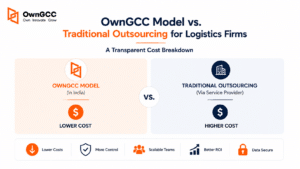
Global Capability Centers (GCCs) are becoming the preferred model for offshore talent management. Unlike outsourcing, GCCs offer:
- Full control over operations and talent
- Strong alignment with business goals
- Enhanced innovation capabilities
- Long-term cost efficiency
Choosing the right country is even more critical when setting up a GCC, as it involves long-term investment and strategic commitment.
Future Trends in Offshore Talent Strategy
Looking ahead, several trends will shape offshore decision-making:
- Increased demand for AI and data talent
- Rise of Tier-2 and Tier-3 cities
- Greater focus on employee experience and retention
- Adoption of remote-first and hybrid models
- Integration of automation to augment human talent
Companies must align their offshore strategies with these evolving trends to remain competitive.
How OwnGCC Can Help
At OwnGCC, we specialize in helping global companies make informed decisions about offshore talent and GCC setup.
Our services include:
- Country and location analysis
- Talent market assessment
- GCC strategy and setup
- Legal and compliance advisory
- Talent acquisition and scaling
We combine market intelligence with execution expertise to ensure your offshore strategy delivers measurable business outcomes.
Conclusion
Choosing the right country for offshore tech talent is a strategic decision that goes far beyond cost considerations. It requires a holistic evaluation of talent, infrastructure, legal frameworks, and long-term scalability.
With the right approach, offshore teams can become a powerful extension of your organization—driving innovation, efficiency, and global growth.
Partnering with experts like OwnGCC ensures that your offshore journey is not just successful, but transformative.