You’re paying vendor invoices, running sprints, and shipping product — yet the moment you stop paying, the talent walks. That’s not a team. That’s a subscription. Here’s the real math behind outsourcing’s hidden ownership problem.
There’s a quiet assumption embedded in every outsourcing contract: that because you’re paying for the work, you’re building something. A team. An asset. Capability.
You’re not.
What you’re building is a dependency. And like most dependencies, it feels invisible — right up until the moment it becomes catastrophic.
The Ownership Illusion
When businesses outsource their technology or operations teams, they typically gain three things: speed to hire, lower headline costs, and reduced administrative burden. These are real benefits. No one disputes them.
What gets buried in the fine print — and in the enthusiasm of early cost savings — is what you don’t get:
- The people are not yours. The engineers building your product are employed by a vendor. Their career growth, culture, loyalty, and long-term trajectory are shaped by that vendor — not you. When a better opportunity comes along (at your vendor’s next client), they leave.
- The IP lives in a grey zone. Depending on your contract, ownership of intellectual property can be ambiguous, especially with offshore vendors operating under different legal frameworks. “Work-for-hire” clauses are only as strong as the jurisdiction they’re enforced in.
- The knowledge disappears with the contract. When you switch vendors, you don’t transfer a team — you lose one. Every institutional memory, system quirk, and unwritten process walks out the door with the outgoing contractor. You start over.
- The culture is someone else’s. Outsourced teams belong, culturally, to their employer. They absorb that company’s values, rhythms, and norms. Getting them truly invested in your mission is an uphill battle you pay for every single sprint.
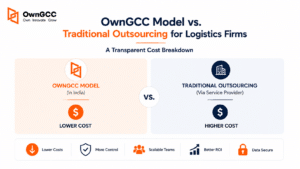
- The margin belongs to the vendor. Most outsourcing vendors charge a 40–60% markup over the actual cost of talent. That’s not a service fee — that’s the price of not owning your team.
Let’s Talk About the Real Numbers
Here’s what “cheaper” outsourcing actually looks like across a 3-year horizon for a team of 10 engineers:
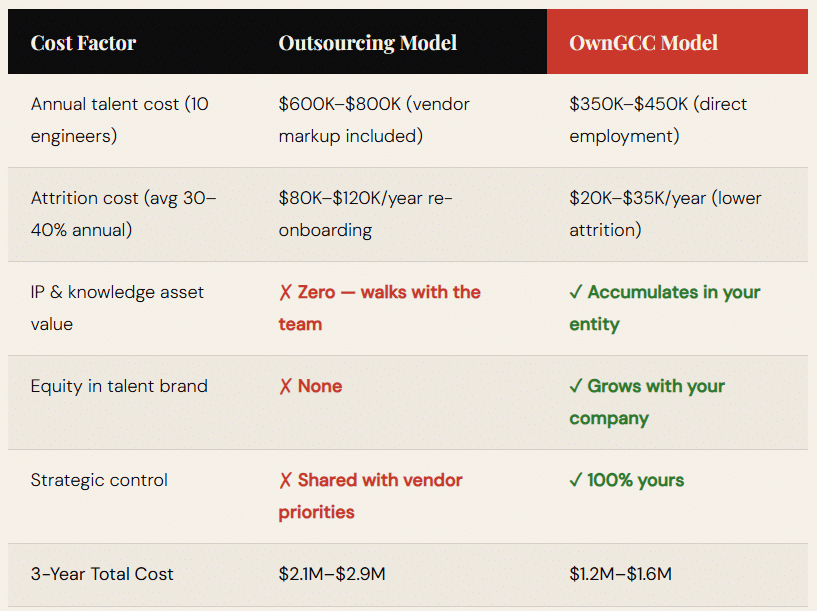
The numbers above don’t include the hardest-to-quantify cost: strategic opportunity cost. Every quarter you spend managing vendor relationships is a quarter you didn’t spend building your actual product capability.
Why Businesses Keep Outsourcing Anyway
If the math is this clear, why do companies keep choosing outsourcing? Three reasons:
1. The Setup Barrier
Building your own offshore entity historically required navigating foreign incorporation laws, payroll compliance, real estate, HR infrastructure, and local labour law — all before hiring a single person. For a company trying to move fast, the activation cost felt prohibitive.
2. The Headcount Illusion
Many CFOs and boards treat outsourced headcount as “off balance sheet” — it doesn’t show up as headcount, which looks good in a hiring freeze or down round. The problem is that off-balance-sheet talent builds off-balance-sheet capability. It doesn’t compound for you.
3. The Risk Aversion Trap
Outsourcing feels lower-risk because the vendor absorbs administrative complexity. But risk didn’t disappear — it was outsourced too. You’ve traded operational risk for strategic risk: the risk of never truly building the asset you’re paying to build.
The GCC Model: Ownership Without the Overhead
A Global Capability Centre (GCC) is the structural answer to the ownership problem. Instead of hiring through a vendor, you establish your own legal entity in a high-talent market — typically India — and hire engineers, analysts, or operators directly. They work for you. They are your company. Their IP, growth, and institutional knowledge belong to your organisation.
The traditional objection — that GCCs require enterprise-scale investment and 12–18 months of setup time — is no longer valid.
OwnGCC’s model compresses that barrier. We handle the legal entity, compliance, payroll, HR infrastructure, and office setup — so your first hire can be operational in 8–12 weeks. You get the ownership of a captive GCC with the speed of a managed service.
What you actually own with a GCC:
- Your people. Direct employment relationships. Your culture, your career paths, your retention strategy.
- Your IP. Everything built by your GCC team belongs to your company — no grey zones, no jurisdictional ambiguity.
- Your knowledge base. Institutional knowledge stays inside your organization. When a team member leaves, the next hire onboards into your culture — not a vendor’s.
- Your cost structure. No vendor markup. Direct employment costs at India market rates — 50–65% below equivalent US or UK salaries for comparable talent quality.
- Your strategic asset. A GCC that grows with your company is a moat. It’s something a competitor can’t easily copy in a quarter.
From Renting Talent to Building One
The best companies in the world — Google, Microsoft, JPMorgan, Goldman Sachs, Walmart — didn’t build their India capability through outsourcing vendors. They built GCCs. Not because they had unlimited capital, but because they understood something fundamental:
Talent is a compounding asset. You want to own the compounding, not rent it.
When you rent talent, you pay interest. When you own talent, you earn interest. The difference between those two positions, over a 5-year horizon, is often the difference between a company that scales and one that stays stuck in a perpetual vendor management loop.
The question for mid-market and growth-stage companies isn’t whether a GCC is right for you. It’s whether you can afford to keep outsourcing.
Frequently Asked Questions
What is the difference between outsourcing and a Global Capability Centre (GCC)?
Outsourcing means contracting a third-party vendor whose employees work on your project but remain permanently employed by — and loyal to — that vendor. A Global Capability Centre is your own wholly-owned offshore subsidiary. The team members are direct employees of your company, aligned to your culture, roadmap, and long-term interests. Simply put: outsourcing is renting; a GCC is owning.
Why is outsourcing more expensive long-term than building your own offshore team?
Outsourcing involves a 40–60% vendor markup above actual salary costs, significant attrition and re-onboarding expenses (industry average: 30–40% annual turnover), zero equity in the talent you develop, and IP that reverts to ambiguity when the contract ends. Over a 3–5 year period, a captive GCC typically costs 30–45% less in total expenditure while building genuine strategic value that compounds over time.
How long does it take to set up a GCC in India?
With a managed GCC partner like OwnGCC, your first hires can be operational within 2–3 weeks. Full legal entity incorporation, payroll compliance setup, and initial team scaling typically completes within 1–2 months. The traditional 12–18 month timeline was a function of going it alone — partnered GCC setups are significantly faster.
What does “owning your offshore team” actually mean in practice?
In practice it means: engineers, designers, and leaders report directly to your company hierarchy. You set the culture, growth paths, compensation structure, and incentives. All intellectual property created by the team belongs entirely to your company under a straightforward employment framework. There is no vendor in the middle filtering communication, managing performance, or taking a cut of every salary.
Is a GCC only viable for large enterprises?
No — this is the most common misconception. Historically, GCCs required enterprise-scale investment. Modern managed GCC providers have restructured the model to be accessible for growth-stage startups and mid-market companies starting with as few as 5–10 employees. OwnGCC specifically exists to serve companies at this scale, removing the infrastructure and compliance overhead that previously made GCCs inaccessible.
What is the cost of setting up a GCC in India vs. outsourcing?
Setup costs for a managed GCC (through a partner like OwnGCC) typically run $15K–$40K for entity formation, compliance, and initial infrastructure — a one-time investment. In contrast, outsourcing carries a permanent recurring premium of 40–60% above market salary costs for every hour of work. For a 10-person team, that premium alone often exceeds $150K–$250K per year, meaning the GCC setup cost is recovered within 2–3 months of operation.