
There is a conversation happening right now in the boardrooms of mid-market mortgage companies across the United States. It is not about rate cycles or GSE reform. It is about a much quieter strategic shift — one that a handful of lenders have already made, and one that their competitors have not noticed yet.
Mortgage lenders are setting up Global Capability Centers (GCCs) in India. Not outsourcing their work. Not handing files to a BPO. Owning their own teams, their own processes, and their own data — from 10,000 kilometers away, at a fraction of domestic operating cost.
This segment is growing fast. And almost no one in the GCC enablement space is talking about it.
Here is what is driving this shift, what functions are moving offshore, and why the lenders who act now will have a structural cost and talent advantage that will be very difficult for their peers to close.
The US Mortgage Market Is Under Margin Pressure — and Has Been for Years
The US mortgage lending industry is not a small market. It is projected to grow from $1.29 trillion in 2025 to over $2 trillion by 2029, at a compounded annual growth rate of 12.2%. Yet despite that scale, profitability has been razor thin.
Non-bank lenders, who now originate the majority of US home loans, operate in an environment of compressed margins, rising compliance costs, and intense competition from digital-first players like Rocket Mortgage and UWM. The Mortgage Bankers Association reported that the average lender earned $950 per loan originated in Q2 2025 — a good quarter by recent standards, but still a fraction of what the industry earned in the 2020–2021 refinance boom.
The fundamental problem is structural: too much cost locked into operations that do not need to happen in the US.
Loan processors in Dallas earn $55,000–$70,000 per year. The same role, filled by an equally qualified professional in Hyderabad or Pune, costs a third of that — and often delivers faster turnaround due to time zone overlap with overnight US processing cycles.
For a lender originating 500 loans per month, even modest operational savings per loan translate into millions of dollars annually. That arithmetic is impossible to ignore.
Why the Outsourcing Model Has Already Failed Mortgage Lenders
Many lenders tried outsourcing. Some are still doing it. But the results have been inconsistent — and the reasons are well understood.
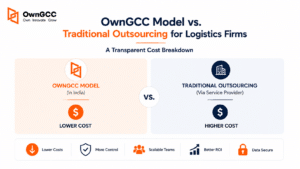
With traditional BPO, you hand your workflow to a vendor. That vendor controls the team, sets the culture, manages the quality, and charges a markup on everything. When loan volumes surge, they may deprioritize your account for a larger client. When they lose staff, your turnaround times suffer. And when regulations change — as they frequently do in mortgage — you are dependent on a third party to update processes they do not fully understand.
The loss of control is the critical failure. In a regulated industry like mortgage lending — where RESPA, TILA, HMDA, and GSE guidelines govern almost every touchpoint in the origination process — operational control is not optional. It is a compliance requirement.
This is precisely why the GCC model is gaining ground. A GCC is not a vendor. It is your team, operating under your brand, following your processes, trained on your systems, and aligned to your culture. The only difference is geography and cost.
What Mortgage Functions Are Moving to GCCs in India
The shift is not theoretical. A leading US mortgage platform serving over 3,000 lenders has already transformed its India GCC into an innovation hub, moving well beyond back-office support into product engineering and AI development.
Here are the functions that mortgage lenders are successfully offshoring to GCCs today:
Loan processing and document verification
Pre-underwriting document review, income verification, title searches, and stacking loan files are high-volume, rules-based functions that translate exceptionally well to offshore teams. Turnaround times can improve when India teams work through US nighttime hours, delivering completed files ready for underwriter review each morning.
Underwriting support and pre-approval analysis
While final credit decisions typically remain onshore, underwriting support — running AUS findings, preparing condition checklists, reviewing appraisal summaries — is being handled by GCC teams trained on Fannie Mae, Freddie Mac, FHA, and VA guidelines.
Compliance and quality control
Post-close QC reviews, HMDA data scrubbing, compliance audits, and regulatory reporting are growing areas for GCC teams. India produces a large pool of finance professionals familiar with US regulatory frameworks, particularly in cities like Hyderabad and Bengaluru with established BFSI talent pipelines.
Loan servicing operations
Payment processing, escrow analysis, loss mitigation support, and customer communications are all moving offshore. Servicers handling large portfolios are finding that a dedicated India team reduces cost-per-account significantly while maintaining SLA standards.
Technology and digital transformation
The most forward-thinking mortgage lenders are using their GCCs to build. AI-powered underwriting tools, automated document extraction, and customer-facing digital portals are being developed by India-based engineering teams that cost a fraction of their US equivalents.
The Numbers Make the Case
A 50-person GCC in India costs between $1.5 million and $2 million annually to operate — including salaries, workspace, compliance, IT, and management. The equivalent headcount in the US would cost $4 million to $6 million or more, depending on location and role mix.
That is a 40–60% reduction in operational cost, with no reduction in output quality when the team is properly set up, trained, and managed.
For a mid-market lender with $50 million in annual operating expenses, even a 15% shift of functions to a GCC represents $7.5 million in annual savings. At scale, that number becomes transformational.
And unlike outsourcing, where savings are offset by vendor margins and contract complexity, a GCC delivers those savings directly — with full visibility into every dollar spent.
Compliance Is Not an Obstacle — It Is an Advantage
The most common objection mortgage lenders raise about India operations is compliance. How do you maintain RESPA compliance when your processor is in Pune? How do you manage TILA disclosures from Hyderabad? What happens when the CFPB issues a new guidance?
These are legitimate questions. The answer is that compliance in a GCC is not harder than compliance in a domestic outsourcing arrangement — it is actually more controllable.
Because your GCC team works exclusively for you, under your policies and your systems, training is consistent. When regulations change, you update your own playbooks and retrain your own team. There is no vendor to inform, no contract to renegotiate, no delay in implementation.
ISO 27001:2022 certification — the international standard for information security management — is increasingly a baseline expectation for GCCs handling sensitive financial data. Lenders should ensure their GCC partner or enabler holds this certification before any loan data crosses a border.
Additionally, India’s Digital Personal Data Protection Act (DPDP), enacted in 2023, provides a robust framework that aligns well with US data handling expectations. When set up correctly, a mortgage GCC in India can be fully compliant with both Indian data law and US regulatory requirements simultaneously.
Why Mid-Market Mortgage Lenders Are the Ideal GCC Profile
Large bank-owned mortgage divisions have had India operations for years. JPMorgan, Wells Fargo, and Bank of America built their GCCs long ago. The opportunity they seized then is available to mid-market lenders now — with a much lower barrier to entry.
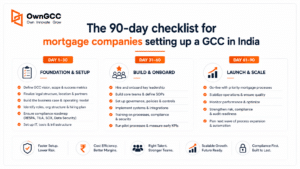
The sweet spot for a first-time mortgage GCC is a lender originating between 300 and 2,000 loans per month. At that volume, operational costs are significant enough to make a GCC financially compelling, but the organization is nimble enough to move quickly. A 20–50 person GCC can be operational within 16–20 weeks when the right setup partner is engaged.
Non-bank lenders — independent mortgage banks, mortgage companies, and credit unions — are particularly well positioned. They operate without the compliance overhead of a bank charter, they move faster than depositories, and they are under intense pressure to compete on cost and technology with publicly traded originators. A GCC is a structural advantage that belongs on the balance sheet.
The Ownership Model Changes Everything
Here is the critical distinction that separates a GCC from every outsourcing arrangement that came before it: you own the team.
The people processing your loans are your employees — hired for your company, trained on your systems, aligned to your values. They are not shared with other clients. They are not managed by a vendor whose interests may not align with yours. They work for you.
This matters enormously in mortgage. When a loan file is processed incorrectly, you need to be able to trace exactly what happened and fix the process immediately. When a new compliance requirement comes in, you need to be able to update your team’s workflow that week — not wait for a BPO’s change management cycle. When your best processor develops deep expertise in your proprietary systems, you need to be able to retain them.
A progressive GCC model — where you begin with a managed structure and progressively take ownership of the team and operations — is increasingly the preferred path for lenders entering India for the first time. It removes the upfront risk of a greenfield setup while ensuring you are building toward full ownership, not permanent dependency on a vendor.
What to Look for in a Mortgage GCC Partner
Not every GCC enabler understands the mortgage business. Most are built for technology companies, retail enterprises, or broad financial services — not for the specific workflow, compliance environment, and operational cadence of a US mortgage lender.
When evaluating a partner, ask these questions:
- Do they have dedicated mortgage vertical expertise, or is it one line item in a long industry list?
- Do they understand RESPA, TILA, HMDA, and GSE compliance requirements — or will you be educating them?
- Do they hold ISO 27001:2022 certification to protect your borrower data?
- Do they offer a progressive ownership model that lets you start lean and scale into full team ownership?
- Can they demonstrate a prior engagement with a financial services or mortgage client?
The answers will quickly distinguish partners who understand your business from those who simply want to fill seats.
The Window Is Open — But Not Forever
The conversation about GCCs has been dominated by technology companies for the past decade. Banking followed. Healthcare is accelerating. Logistics is emerging.
Mortgage is next.
The lenders who move in 2025 and 2026 will have two to three years of operational maturity before the rest of the industry catches up. They will have trained teams, refined processes, and structural cost advantages that cannot be replicated overnight.
The market conditions are favorable. India’s GCC ecosystem is at peak maturity, with Hyderabad and Pune offering deep BFSI talent pipelines, government incentives, and a regulatory environment that supports foreign-owned operations. Setup timelines have compressed dramatically. The risk of getting this wrong is lower than it has ever been.
Mortgage lenders in the US have spent years looking for the next efficiency lever. The GCC model is not a new idea — but applying it specifically and deliberately to mortgage operations is still rare enough to be a genuine competitive advantage.
The segment nobody is talking about is about to become the one everyone wishes they had entered earlier.
Ready to Explore a Mortgage GCC?
OwnGCC specializes in building Global Capability Centers for mortgage lenders and financial services companies. Our progressive ownership model means you start with a managed team and transition into full ownership — without the risk of a greenfield setup, and without the permanent dependency of traditional outsourcing.
We are ISO 27001:2022 certified, and we have helped lenders and financial services firms build compliant, high-performing India teams in under 20 weeks.