Global Capability Centers (GCCs) have been evolving as global enterprises see them as strategic drivers for innovations, digital transformations, and growing business resilience, rather than just offshoring cost-saving units. However, building a GCC from the ground up can be complicated, consuming a lot of resources, and pose various risks.
This is where the Build-Operate-Transfer (BOT) model acts as a powerful entry strategy.
In this guide, we will detail the BOT model, what it entails, the benefits, drawbacks, and what has caused it to become a favored path for global organizational, especially in collaboration with specialists such as OwnGCC.
What is the BOT Model in GCC?
The Build-Operate-Transfer (BOT) model is where a partner like OwnGCC, on a phased basis, helps a business to create and grow its GCC by building the center, then operating it to establish a stable environment, and finally transferring it to the parent company.
In its essence, the BOT model simplifies the challenges of entering a new market. Instead of having to deal with the legal, operational, and talent issues on their own, companies use a partner with the experience to create a fully operational GCC.
This model is particularly beneficial for organizations targeting India as their primary market, where it is imperative to have local expertise due to the intricacy of the regulatory, talent, and infrastructure compliance mechanisms. By utilizing BOT, organizations can considerably diminish the risks involved in the execution of their GCC.
Three Phases of the BOT Model
-
Build Phase: Beginning Construction
The BOT partner takes care of everything during the Build Phase. This includes anything from setting up the entity and ensuring regulatory compliance to establishing office infrastructure and acquiring the right talent.
Companies can take advantage of the local knowledge regarding site selection, hiring, and vendors. The primary focus is to customize the GCC to mesh with the parent company’s long term vision. This includes scalability and operational preparedness from the first day.
Also during this phase, the frameworks for organizational design, IT, and governance are established. A solid operational foundation is vital for ensuring the GCC is integrated with the company’s broad business strategies and goals.
-
Operate Phase: Ensuring Stability and Performance
The Operate phase of the BOT model is entered as soon as the GCC becomes operational. The BOT partner is responsible for the ongoing day to day operational management and process, performance, and team productivity optimization.
It is during this phase where the transformation of the GCC from an operational entity into an effective and efficient business unit takes place. The partner achieves operational excellence through the adoption of standard processes, effective KPI management, and the implementation of an ongoing improvement system.
The partner takes care of operational execution while the organization prioritizes its strategic goals. As time goes by, the GCC goes through a maturity continuum, acquires the required domain knowledge, and becomes fully integrated with the global organization, hence preparing it for a complete ownership transfer.
-
Transfer Phase: Complete and Utter Ownership Transfer
The last phase consists of the complete transfer of ownership and control of the GCC to the parent company. By this time, the GCC is fully functional, compliant, and operational to global standards.
The aim of the transition is to reduce as much disruption as possible. In order to maintain consistency governance alignment, as well as leadership transfer and knowledge transfer, are done with as little disruption as possible.
The BOT model of outsourcing is different from all the rest because it allows companies to maintain operational control over the business even after outsourcing. In fact, it allows companies to have a fully operational and owned business at a lesser risk because the business is fully operational.
Why the BOT Model is Gaining Popularity
The BOT model has gained popularity among many global companies, especially those venturing into India because of the reduced risk.
When venturing into a different market, there is a high level of uncertainty that is characterized by legal issues, the need to understand and fit into the local culture, the recruitment of personnel, and the inefficient carrying out of operations. The BOT model solves all these problems because it utilizes the local partner’s knowledge.
The model is also characterized by speed. The operational capacity of the company increases rather than waiting for the complete setup of the business. The model increases operational capacity to eliminate competitors, meaning that the time it takes to achieve commercial objectives is of high value.
The BOT model also enables companies to incur the least amount operational and financial risks.
Benefits of the BOT Model for GCCs
Before the months of value creation are over, this model allows the creation of all operational capacity.
Value creation also increases with the creation of positive customer value. The creation of compliance work reduces the amount of operational risk. This means that there is a reduced operational risk of recruitment and operational risks. The risk of the work that is done is less than the work that is done.
Local Knowledge Availability
Understanding local directives, talent markets, and business ecosystems is invaluable. Due to their extensive understanding, BOT partners enable firms to make insightful and beneficial decisions.
Scalability and Adaptability
With the BOT model, firms have the capability to adjust their operational scale in relation to their needs. The model enables advantageous augmentation of operational flow.
Ultimate Ownership in Perspective
Compared to other outsourcing models, BOT opts for eventual complete ownership of the GCC to the firms. This offers strategic flexibility and ensures value creation in the long run.
Difficulties Faced in the BOT Model (and Possible Solutions)
Despite the many benefits of the BOT model, there are challenges. The most prominent one, particularly in the early stages, is the reliance on the partner.
To address this, organizations need to select partners that are transparent in their operations, have strong governance and control, and have defined outlines for transitions. Audits and reviews of activities will ensure adherence to the set guidelines.
Cultural integration is an additional complication. It will require conscious effort to adapt the culture of the third-party operated GCC to that of the parent company. The culture integration challenge can be mitigated through the involvement of the company’s leaders, training and communication.
Finally, the transfer phase can be complex if not planned properly. A well-defined transition strategy, including knowledge transfer and leadership readiness, is essential for a smooth handover.
What is the BOT Model in Comparison to Traditional GCC Arrangement?
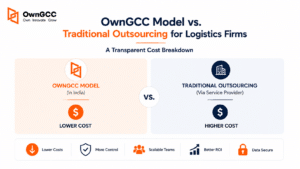
In a traditional GCC arrangement, everything has to be built from the ground up including creation of the legal entities, hiring, and operating. The upside to this is that the firm will have complete control from the start. The downside, however, is that this comes at a high operational risk, longer timeframes, and a substantial amount of money at the beginning.
At the same time, the BOT approach also adopts a more systematic and structured approach. While all of the initial critical phases are guided by experts, once the GCC is stabilized, you are able to gain full ownership.
For companies wanting to optimize speed, cost, and control, the BOT approach is a better proposition than all other options available.
Why India is the Perfect Location for BOT-based GCCs
India is the world’s fastest-growing GCCs market with 2000+ centres operating and thousands more projected to open every year until 2030. India combines a strong economy, skilled workforce, and advanced digital infrastructure.
The GCC’s top markets in India are Bangalore, Hyderbad, Chennai, and Pune, which are the most developed cities in India and provide top-end digital ecosystems and other world-class infrastructures.
The evolving business-friendly policies and supportive regulations in India also provide the BOT model advantages to foreign companies by facilitating the scaling of operations.
How OwnGCC Makes a BOT Journey Successful
OwnGCC employs a proven BOT framework to streamline and quicken the journey to GCC set up. In all phases of the journey, from strategy and build to operations, and final transfer, OwnGCC is the strategic partner.
The strategy is customized to the client’s business objectives in order to ensure that it is aligned with global goals. Across all levels, OwnGCC is committed to the creation of high-performing teams and the adaptation of processes to ensure significant business results.
OwnGCC is about speed, transparency, and building partnerships for sustained future value. The objective is building a GCC to be a strategic asset for fostering innovation and growth.
Most Important Steps to Follow for Successful Implementation of the BOT Model
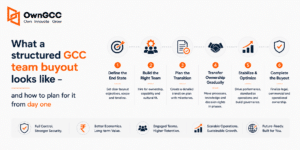
The success of implementation of the BOT model is dependent on having a good plan and the disciplined execution of that plan. The clear start point is for the organization to define the objectives it wants the GCC to achieve, the functionalities, level of complexity, and the expected end results, among others.
The choice of a good partner is essential. Companies need to determine their potential partners based on their experience, expertise in the field, and their proven success in the establishment of GCCs.
An effective governance structure can be maintained during the whole period of implementation, and this helps in the effective and
streamlined implementation. Shifting focus to governance, along with transparency, can be maintained through the implementation of a good review and communication system and the tracking of established KPIs.
The future state of the GCCs, in addition to the BOT model, allows for the fulfillment of both the need to establish a GCC with speed and the need to control, to a lesser degree, potential risks.
In the near future, it is anticipated that a large number of companies will be established in the high growth area of India. BOT is expected to be the point of entry for the majority of these companies.
The focus of the GCCs in the near future is expected to be largely centered on digital transformation, the adoption of AI, and on the global business strategy.
Conclusion
The Build-Operate-Transfer (BOT) model allows global firms to pioneer new ways to build and grow their GCCs. Using a combination of local knowledge, operational efficiency, and a safe structured transition, BOT allows firms to create high-performance GCCs with a low risk profile.
For firms with international ambitions, particularly in India, the BOT model provides a solid opportunity.
Along with GCC partners such as OwnGCC, firms can fast-track their GCC journey and create sustained value, innovation, and a differentiated advantage.