The insurance industry has always been a data business. But for most of its history, the volume, variety, and velocity of that data outpaced the industry’s ability to act on it intelligently.
That’s changing — and the engine driving that change, for an increasing number of global insurers, is a Global Capability Centre in India.
This isn’t a story about offshoring back-office grunt work. It’s a story about how forward-thinking insurance firms are building owned, AI-capable, deeply integrated teams in India — teams that are actively redesigning how claims get processed, how underwriting decisions get made, and how risk gets priced in near real time.
Why Insurance Is One of the Best-Suited Sectors for GCC Deployment
Insurance operations are, at their core, information-processing operations. Every policy, claim, risk assessment, fraud flag, and actuarial model runs on structured and unstructured data — documents, images, medical records, weather data, telematics feeds, and more.
This creates a natural fit with what GCCs in India do best: building and running large-scale analytical, automation, and AI engineering functions at costs that are structurally lower than US, UK, or European equivalents, without sacrificing the talent quality that complex insurance workflows demand.
India produces over 1.5 million engineering and technology graduates annually. It has deep actuarial talent pools, a growing cohort of machine learning engineers trained on financial and risk data, and a mature BPO ecosystem that has spent two decades processing insurance claims — creating a foundation of domain expertise that technology teams can build on.
The shift happening now is that insurers are no longer just using India’s talent through vendors. They’re owning it through captive GCCs — and the results are measurable.
The Core Use Cases: Where GCCs Are Driving Insurance Transformation
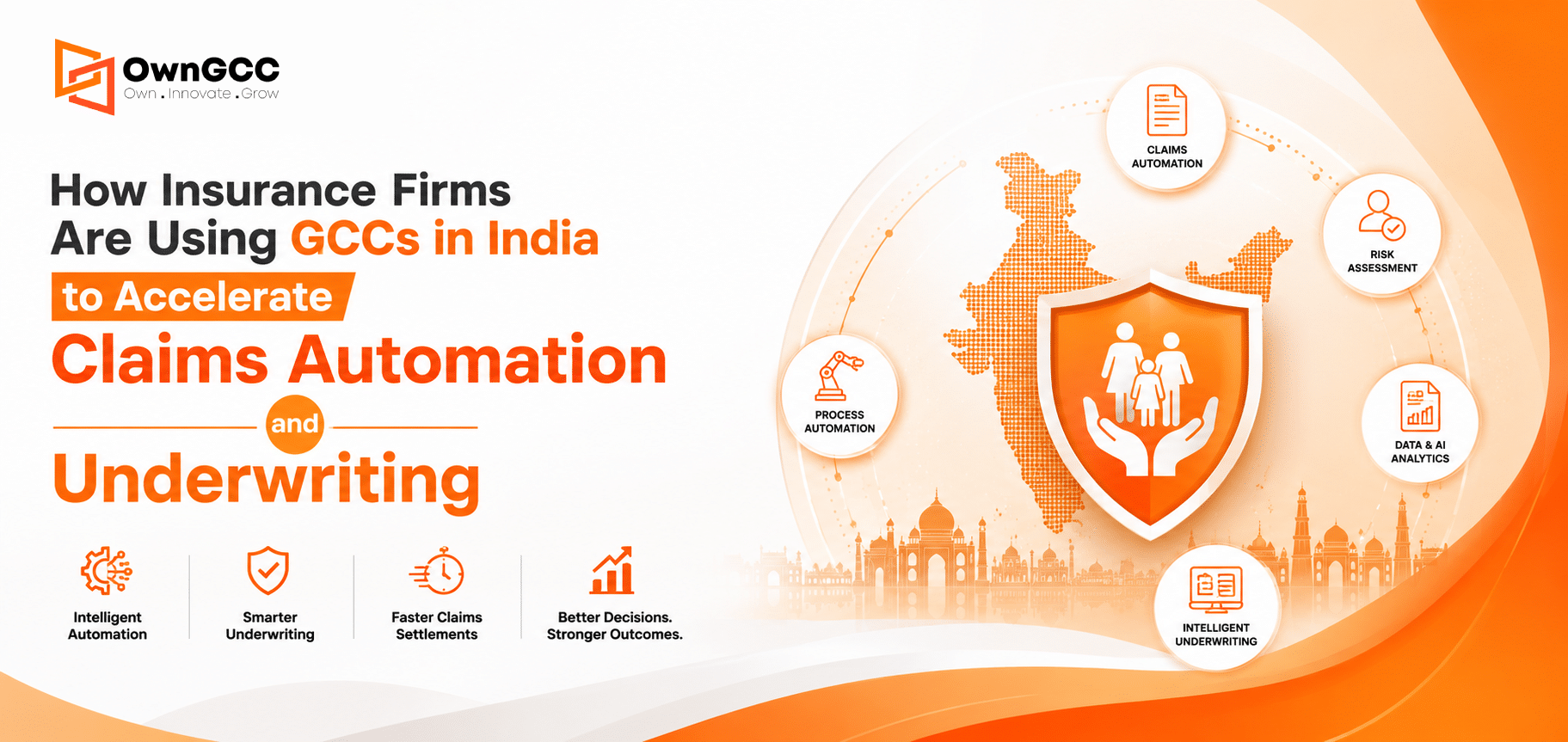
1. Claims Automation — From Weeks to Hours
Claims processing has historically been one of the most labour-intensive, error-prone, and customer-friction-heavy functions in insurance. A property claim that should take days routinely takes weeks. A health claim that should be straightforward gets caught in manual adjudication queues. The cost per claim in manual environments runs $15–$50 for simple cases, and far higher for complex ones.
Insurance GCCs in India are changing this through three layers of automation:
First Notification of Loss (FNOL) automation : GCC engineering teams build and maintain intelligent intake systems that accept claims via multiple channels — app, web, voice, image — and automatically classify, triage, and route them without human intervention for the majority of straightforward cases.
Document intelligence and extraction : Claims involve enormous volumes of unstructured documents: medical bills, repair estimates, police reports, satellite imagery, and more. GCC teams build and run OCR and NLP pipelines that extract structured data from these documents automatically — cutting manual review time by 60–80% on document-heavy claims.
Straight-through processing (STP) : For claims that meet defined parameters — low value, clean documentation, no fraud signals — GCC-built automation engines process and settle claims end-to-end without human touchpoints. Some insurers running mature STP programmes report 70–85% of eligible claims settling automatically.
The cumulative effect: average claims cycle times dropping from 10–15 days to under 48 hours for a majority of claim types. Customer satisfaction scores rising. Claims operations headcount holding flat or declining even as volume grows.
2. Underwriting Intelligence — From Intuition to Data
Traditional underwriting is part science, part art — experienced underwriters applying judgment to imperfect information to price risk they can’t fully see. It’s a function that has resisted automation not because it’s simple, but because it’s genuinely complex.
GCCs are not replacing underwriters. They’re building the data infrastructure and analytical tooling that makes underwriters dramatically more effective.
Risk data aggregation. GCC data engineering teams build pipelines that pull from dozens of external sources — satellite imagery, weather feeds, credit bureaus, telematics APIs, public property records, social signals — and synthesise them into underwriting workbenches that give human underwriters a complete risk picture in seconds rather than hours.
Predictive risk scoring. Machine learning engineers in insurance GCCs build and continuously retrain models that score risk on incoming submissions, flagging high-risk applications for senior review and fast-tracking low-risk ones. In personal lines, these models are increasingly doing the heavy lifting on pricing entirely.
Portfolio analytics. GCC analytics teams build real-time dashboards that let underwriting leaders see their book of business — exposure concentration, loss trends, pricing adequacy — at a granularity that was previously only possible after quarter-end. That means faster, more informed decisions on appetite and pricing.
The result is an underwriting function that is simultaneously faster (quotes in minutes rather than days for standard risks), more consistent (less reliance on individual underwriter judgment variation), and more accurate (models trained on larger, cleaner datasets than any individual could process).
3. Fraud Detection — Catching What Human Reviewers Miss
Insurance fraud costs the industry an estimated $80 billion annually in the United States alone. The traditional approach — rules-based flags reviewed by human investigators — catches perhaps 10–20% of fraudulent claims and generates enormous numbers of false positives that frustrate legitimate claimants.
GCC-based AI and data science teams are rebuilding fraud detection from the ground up.
Modern fraud detection built by insurance GCCs typically combines network analysis (identifying suspicious relationships between claimants, providers, and agents), anomaly detection (flagging claim patterns that deviate statistically from expected behaviour), computer vision (detecting doctored photos or inconsistencies in damage images), and NLP-driven inconsistency detection across claim narratives.
The improvement in detection rates when insurers move from rules-based to model-driven fraud detection is typically 30–50% — with simultaneous reductions in false positive rates that improve the experience for legitimate claimants.
These systems require ongoing model retraining, data quality monitoring, and feature engineering — exactly the kind of sustained technical investment that a captive GCC team, with deep context in the insurer’s book of business, is positioned to do continuously.
4. Actuarial Modernisation — From Annual Cycles to Continuous Pricing
Traditional actuarial work operates on long cycles: data is gathered, models are run, assumptions are updated — annually or semi-annually at best. In a world where risk landscapes can shift in weeks (pandemic, climate events, cyber threats), that cadence is increasingly untenable.
GCCs are helping insurers build the technical infrastructure for continuous actuarial intelligence. This includes cloud-based actuarial platforms that can run pricing scenarios in hours rather than weeks, data pipelines that feed live external signals into loss reserve models, and engineering teams that maintain and extend these platforms as the business evolves.
Critically, actuarial GCC functions are not just technical — they’re deeply domain-specific. Building an effective actuarial GCC requires hiring professionals who understand insurance mathematics, not just data engineering. India’s actuarial talent pool, while smaller than its software engineering pool, is growing and increasingly sophisticated.
The Primary Insurance GCCs in India: Who’s Already There
The largest global insurers have been building India capability for over a decade, but the scale and sophistication of their GCC operations has accelerated dramatically since 2020.
Zurich Insurance operates one of the most advanced insurance GCCs globally from Bangalore, with over 3,000 employees running analytics, claims technology, underwriting support, and AI development. Their India centre has been central to Zurich’s global digital transformation programme.
Prudential built its GCC in India to run data analytics, actuarial modelling, and digital operations across its Asia Pacific and global business. The centre has become a strategic capability hub, not a back-office function.
Chubb runs significant technology and analytics operations from India, including data science teams building risk models and claims automation systems used globally.
AXA has one of the largest insurance GCCs in India, spanning technology development, data science, actuarial analytics, and digital operations. Their India teams actively co-develop products and platforms with business units globally.
Swiss Re operates a Global Business Solutions centre in Bangalore that includes actuarial, analytics, and technology functions — contributing directly to the company’s reinsurance pricing and risk modelling capabilities.
The pattern across all of these is consistent: what started as cost-centre operations have evolved into capability centres that are genuinely co-leading innovation.
The Ownership Advantage in Insurance GCCs
The temptation for insurers entering India for the first time is to route through outsourcing vendors — BPO firms that offer insurance process capability at day one, without setup complexity.
The problem, as with any outsourcing arrangement, is that you don’t own what you build.
In insurance, this matters more than in almost any other sector for one specific reason: data.
An insurance company’s claims data, policy data, customer data, and loss history are among its most strategically sensitive assets. They’re what loss models train on. They’re what pricing algorithms optimise against. They’re what create competitive differentiation in risk selection.
Routing that data through a third-party vendor — even a well-governed one — creates exposure. Regulatory scrutiny around data residency and access is intensifying. And the institutional knowledge your vendor’s team builds about your book of business walks out the door when the contract ends or is repriced.
A captive GCC eliminates this. Your data stays in your entity. Your models stay in your infrastructure. Your engineers’ deep understanding of your loss patterns, your pricing logic, and your claims workflows stays in your organisation.
For a data-business like insurance, that’s not a nice-to-have. It’s a strategic imperative.
What OwnGCC Brings to Insurance Firms
Building a GCC from scratch in India has historically required navigating entity formation, payroll and compliance infrastructure, real estate, HR policy design, and talent acquisition — all before writing a single line of code or processing a single claim.
OwnGCC removes that barrier entirely.
We set up and operate the full GCC infrastructure — legal entity, employer-of-record framework, compliance, office, and HR systems — so insurance firms can focus on hiring the right talent and building the right capabilities, not on administrative setup.
For insurance firms specifically, we bring:
Domain-aligned talent acquisition : We understand the difference between a general data engineer and someone with insurance data experience. Our hiring frameworks are designed to find professionals with the domain context that insurance GCCs require.
Speed to first hire : Operational within 8–12 weeks. Your first claims automation engineer or underwriting data scientist can be active in under three months from decision.
Full ownership : Every person we help you hire is your employee — employed by your Indian entity, working in your culture, building your IP. No vendor markup. No vendor dependency.
Scalability. Start with five people and scale to fifty or five hundred. The infrastructure is designed to grow with your ambitions.
The Stakes: Why This Moment Matters for Insurance
The insurance industry is at an inflection point. Insurtech challengers with native digital architectures are pricing risk faster, settling claims in seconds, and delivering customer experiences that legacy carriers structurally cannot match — yet.
The response from established insurers has to be more than incremental. It requires building genuine technical and analytical capability, at scale, in a cost structure that doesn’t destroy underwriting margins.
India’s GCC ecosystem is the most credible answer to that challenge that currently exists. The talent is there. The infrastructure is maturing rapidly. The insurers who moved early — Zurich, AXA, Prudential — have built advantages that are now compounding.
The window for catching up is not permanently open.
The insurance firms that build owned capability in India over the next two to three years will have claims operations that are faster, fraud detection that is sharper, and underwriting models that are more accurate than those who continue routing through outsourcing vendors.
The ones that wait will find themselves paying vendors to maintain the status quo while their competitors’ captive teams quietly build the future.
OwnGCC helps insurance firms build their Global Capability Centre in India — with full ownership, domain-aligned hiring, and infrastructure that’s operational in weeks, not months.
Ready to talk about what an insurance GCC could look like for your firm?
Visit: www.owngcc.com/insurance or book a strategy call directly.
Frequently Asked Questions
What is an insurance GCC and how is it different from an outsourcing arrangement?
An insurance Global Capability Centre is a wholly-owned subsidiary of your firm, staffed by your direct employees, operating in India. Unlike outsourcing, where a vendor owns the team and the institutional knowledge, a GCC means the talent, data, IP, and accumulated expertise belong entirely to your organisation. For data-sensitive businesses like insurance, this distinction is particularly significant.
What insurance functions are best suited to a GCC in India?
The highest-value functions for insurance GCCs include claims automation and straight-through processing engineering, underwriting data analytics and risk modelling, fraud detection using machine learning, actuarial modernisation and pricing platform development, data engineering and cloud infrastructure, and product and customer analytics. These are functions that require strong technical talent at scale — precisely where India’s talent market excels.
What are the biggest risks of building an insurance GCC in India?
The primary risks are talent attrition (mitigated by strong compensation, culture, and career development in an owned entity), data governance and regulatory compliance (addressed through robust data architecture and Indian regulatory alignment), and time-to-productivity for new hires (mitigated by structured onboarding and domain-specific hiring). Working with a managed GCC partner like OwnGCC substantially reduces these risks.
We already have a GCC in India — how can OwnGCC support an existing operation?
Having a GCC already running is an advantage, but most established GCCs hit predictable growth ceilings: hiring pipelines that slow as the team scales, compliance frameworks that strain under new headcount or entity changes, management bandwidth that gets consumed by operational overhead rather than capability building, and culture drift as the team grows beyond its founding nucleus.
OwnGCC works with existing GCCs as an embedded operations partner — not a replacement for what you’ve built, but an accelerant for what comes next. This includes augmenting your talent acquisition with domain-specific hiring pipelines for insurance roles that are harder to fill at scale (actuarial, fraud analytics, AI engineering), refreshing HR and compliance infrastructure to match your current size and India’s evolving regulatory environment (including DPDP Act alignment), advising on entity structure optimization if your original setup was built for a smaller operation, and providing interim leadership support during scaling or transition phases. You keep full ownership and control — we add the operational depth to help you grow faster without the growing pains.
Our existing India GCC is underperforming — can OwnGCC help us turn it around?
Yes — and this is one of the most common conversations we have. GCC underperformance typically traces back to a small number of root causes: misaligned hiring (building a generalist team when the function needed specialists), unclear ownership between the India entity and the home-country business unit, compensation structures that eroded over time and drove attrition, or an original setup that was optimized for cost rather than capability.
OwnGCC offers a structured GCC diagnostic — a 4–6 week assessment that examines your current team composition, compensation benchmarking against India market rates, entity and compliance health, operational workflows, and cultural alignment between your India center and your global organization. The output is a prioritized turnaround plan with clear ownership, timelines, and measurable outcomes. For insurance GCCs specifically, we assess capability gaps against the automation and analytics functions that are driving competitive differentiation in the market — claims STP rates, fraud model performance, underwriting cycle times — and identify precisely where the team structure or tooling is falling short. Many GCCs that appear to be underperforming are actually two or three focused interventions away from becoming high-performing strategic assets.