Most InsurTech GCCs look identical in month three. A queue of FNOL tickets, a handful of policy admin tasks, a support inbox nobody onshore wants to own. The real divergence shows up at month eighteen. Some of these teams are still working the same queue, just faster. Others have quietly become the department that runs claims triage end to end, owns the underwriting data pipeline, and produces the loss-ratio analysis the actuarial team used to wait a week for.
The difference isn’t headcount or budget. It’s whether anyone planned for year two on day one.
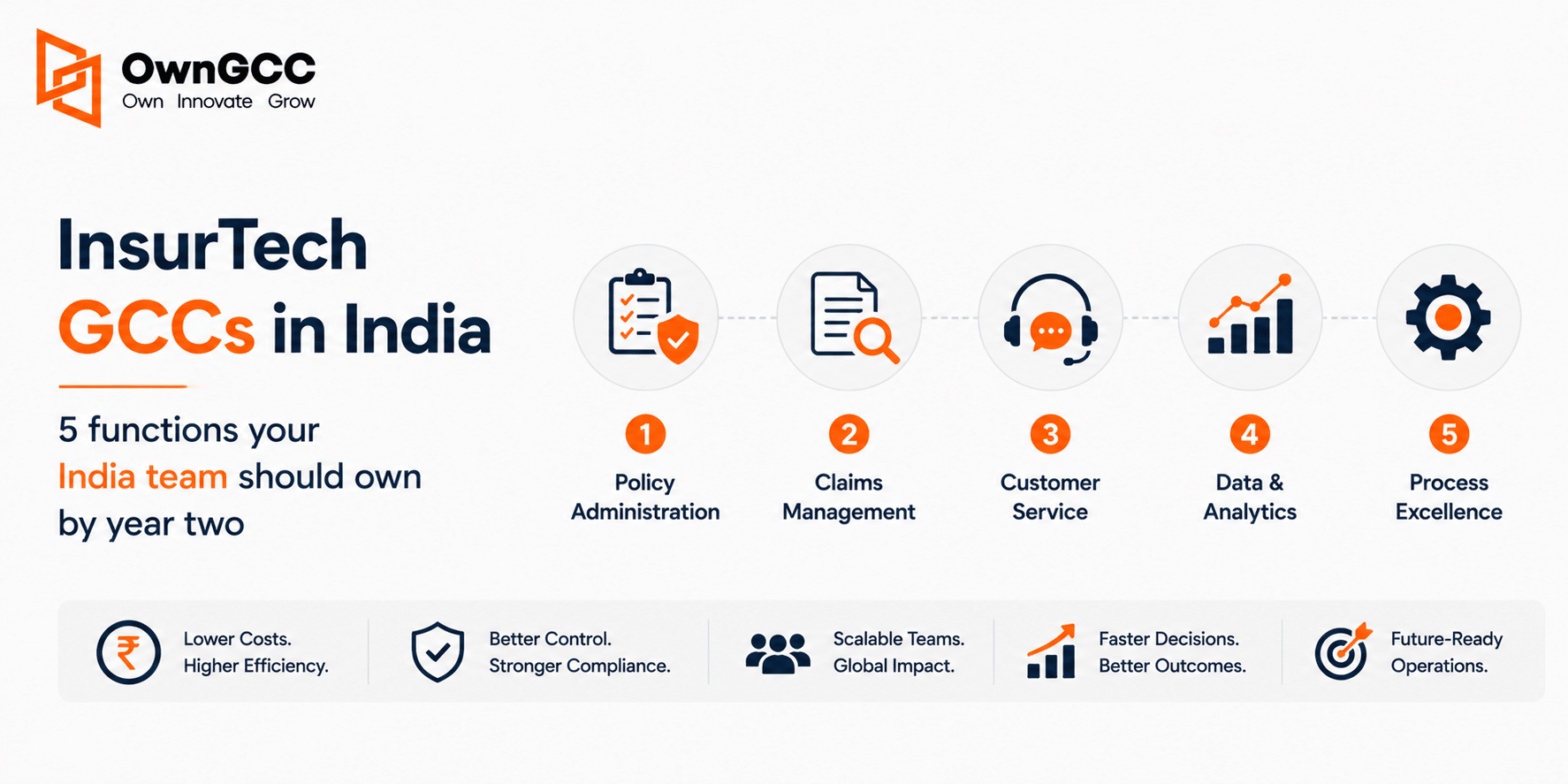
InsurTechs raising a Series B or C are usually scaling states, product lines, and distribution channels faster than they’re scaling operations — which means the India team either grows into a real capability center or calcifies into a permanent help desk that never earns more responsibility. This is a roadmap for the first outcome: the five functions a growth-stage InsurTech’s India team should fully own by the two-year mark, and what “ownership” actually has to look like to count.
Why Year One Success Doesn’t Guarantee Year Two Ownership
Year one is usually a win almost by default. Standing up FNOL intake, basic policy servicing, and tier-one support offshore cuts cost and adds coverage hours immediately — the kind of result that gets celebrated in a board deck. The trap is mistaking that early win for a finished build.
A team that’s still triaging tickets and re-keying data at month eighteen hasn’t failed, but it hasn’t matured either. It’s running the same transactional layer at a lower cost, which is real value — but it’s not the value an InsurTech-focused GCC is actually capable of producing once it has eighteen months of institutional knowledge about your book of business. The functions below are ordered the way most InsurTechs actually build them, from the fastest to stand up to the one that changes what the team fundamentally does for the company.
The Five Functions
1. End-to-End Claims Operations — Not Just FNOL Intake
Almost every InsurTech GCC starts with First Notice of Loss intake: capturing the claim, gathering documentation, opening the file. That’s the easy 20% of claims work. By year two, the India team should own the other 80% — adjudication support, damage assessment coordination, reserve-setting data prep, denial and appeal documentation, and claims closure — not just the intake queue that feeds someone else’s decision.
The difference matters financially. A team that only does intake adds speed at the front door. A team that owns the full claims lifecycle reduces claims leakage — the fraud that slips through under-scrutinized files, the reserves set wrong because the data behind them was thin, the settlements that drag because nobody owned the file end to end.
2. Underwriting Support and Risk Data Operations
Underwriting is where most InsurTechs are most protective of control — understandably, since it’s the function closest to loss ratio. But “protective of control” and “keeping it entirely onshore” aren’t the same thing. What can and should move offshore by year two is the data operations layer underneath underwriting: submission intake and data validation, third-party report ordering and reconciliation (MVRs, CLUE reports, property inspections), risk scoring data preparation for underwriting models, and renewal remarketing support.
This is also where a mature GCC starts paying for itself twice — once in cost, and again in underwriting speed, because clean, validated data arriving faster means underwriters spend their time underwriting instead of chasing missing information.
3. Policy Administration Across Every Product and State You’ve Launched
InsurTechs scale by adding states and SKUs faster than almost any other function grows to support them — and policy administration is usually the function quietly buckling under that growth. New business processing, endorsements, renewals, cancellations, and reinstatement processing multiply with every state filing and every new product line.
By year two, this should be fully owned offshore, including the state-specific nuances — because “policy admin” isn’t one workflow, it’s fifty slightly different ones once you’re licensed in every state you’re targeting. A team that only handles the generic, non-state-specific transactions hasn’t actually taken this function off your plate; it’s just handled the easy half.
4. Compliance QA, Regulatory Reporting, and E&O Risk Mitigation
This is the function InsurTechs most consistently underinvest in offshore, usually out of an instinct that compliance has to stay close to home. That instinct gets the risk backwards. Compliance failures in insurance are rarely dramatic — they’re death by a thousand small gaps: a state filing deadline missed because nobody owned the calendar, a documentation audit skipped because the team doing claims work didn’t have time, an E&O exposure that sat unnoticed for a quarter.
A dedicated compliance QA function inside the India team — state regulatory reporting support, documentation audits, policy and endorsement QA, market conduct exam preparation — applies rigor uniformly because that’s the team’s whole job, not something squeezed in between higher-priority tickets. By year two, this should be a standing function with its own SOPs and its own accountability, not a rotating duty inside the claims or policy admin team.
5. Actuarial and Analytics Support — The Function That Changes What the Team Is
This is the destination function, and it’s the one that separates a cost center from a capability center. By year two, a mature InsurTech GCC should be producing loss ratio analytics by product and state, pricing model support and rate filing data, fraud detection pattern analysis, and portfolio-level risk reporting — the analysis that used to sit in an actuarial backlog because there was never enough onshore bandwidth to get to it.
This works because the same team that’s spent eighteen months processing claims and underwriting data has the deepest possible knowledge of what that data actually means. A GCC that reaches this stage isn’t just executing your operations anymore — it’s informing your pricing and your risk appetite. That’s the arc a mid-market insurer’s 100-person GCC build in India followed in practice, moving from transactional support to a function leadership actually relies on for decisions.
Function-by-Function: Year One vs. Year Two Ownership
“`html
| Function | Year One (Launch) | Year Two (Full Ownership) | Business Impact |
|---|---|---|---|
| Claims Operations | FNOL intake and documentation gathering | End-to-end adjudication support, reserve preparation, denial & appeal documentation, claim closure | Lower claims leakage and faster settlement cycles |
| Underwriting Support | Basic data entry and submission logging | Data validation, third-party report reconciliation, risk scoring preparation, remarketing support | Faster underwriting turnaround with cleaner risk data |
| Policy Administration | Generic, non-state-specific transactions | State-specific endorsements, renewals, cancellations, and reinstatements | Eliminates transaction bottlenecks as states and product lines scale |
| Compliance & QA | Ad hoc documentation checks | Regulatory reporting, audit preparation, and E&O risk mitigation as a dedicated function | Reduced regulatory and errors & omissions (E&O) exposure |
| Actuarial & Analytics | Not yet offshore | Loss ratio analytics, pricing support, fraud pattern detection, and portfolio reporting | Data-driven pricing and better risk management decisions |
“`
Are You on Schedule? Signals by Function
| Function | Sign You’re Behind Schedule | Sign You’ve Reached Year-Two Ownership |
|---|---|---|
| Claims Operations | The team only opens claim files while onshore adjusters handle everything after intake. | The team independently closes claims within defined authority limits. |
| Underwriting Support | Underwriters still spend time chasing third-party reports and missing data. | Clean, validated submissions reach underwriters ready for review. |
| Policy Administration | State-specific transactions continue to be routed back onshore because they are considered too complex. | Transactions for every licensed state are completed offshore without exception. |
| Compliance & QA | Compliance reviews happen only when someone remembers to perform them. | A dedicated team manages audits, regulatory filings, and compliance reviews on a fixed schedule. |
| Actuarial & Analytics | Loss ratio analysis and pricing insights remain an onshore backlog. | The India team delivers recurring analytics that leadership uses in pricing and portfolio decisions. |
Why Ownership Requires a Different Engagement Model Than Launch
The functions that show up late in this roadmap — compliance, actuarial support — carry more regulatory and financial weight than the ones that launch first, which is exactly why the engagement model has to evolve alongside the function list. A staffing arrangement built to get FNOL intake running in month one isn’t the structure you want carrying loss-ratio analytics and regulatory filings by month eighteen. Most InsurTechs that reach real year-two ownership have already moved toward a Build-Operate-Transfer model or a managed team structure built for standing functions — not a headcount subscription designed for a queue.
Process design matters just as much as the model. Functions like claims adjudication and compliance QA only scale cleanly offshore if the workflow was engineered for it — mapped, documented, and stress-tested — rather than lifted as-is from however it ran onshore. That’s the gap Lean Six Sigma-driven process design is built to close before a function moves, not after it breaks.
What This Means for InsurTechs Planning Their Build Now
The InsurTechs getting real value out of their India teams by year two aren’t the ones with the most headcount offshore. They’re the ones who planned the function roadmap before they hired the first analyst — knowing that claims intake in month one was supposed to become full claims ownership by month eighteen, and that a compliance QA function was always meant to exist, not get invented under audit pressure.
The India GCC market is only getting more competitive for talent and mindshare — a trend well documented across the broader BFSI GCC landscape as more financial services and insurance companies stand up captive centers in India. InsurTechs that treat their India team as a five-function roadmap, not a cost line, are the ones building an operational advantage the slower movers will be paying to catch up on later.
FAQs
How long does it realistically take to move from FNOL intake to full claims ownership?
Most InsurTechs see this transition happen over twelve to eighteen months, assuming the team has stable claims volume and clear escalation protocols from day one. Rushing it before the team has enough file history to recognize patterns usually creates more rework than it saves.
Should compliance and QA move offshore before or after claims and policy admin are stable?
After. Compliance QA works best once the team has enough operational maturity in claims and policy admin to know where the actual risk points are — auditing a process the team doesn’t yet understand produces checklists, not real risk mitigation.
Can a smaller, earlier-stage InsurTech follow this roadmap, or is it only for Series B/C companies?
The sequence holds at smaller scale, but the timeline stretches — a smaller InsurTech may take longer to reach full ownership of each function simply because claims and underwriting volume take longer to generate the pattern history analytics depends on. The order (claims, then underwriting data, then policy admin, then compliance, then analytics) doesn’t change with size.
What’s the biggest reason InsurTechs stall at the transactional stage?
Usually a mismatched engagement model — keeping a staffing-style arrangement built for ticket volume long after the functions that need to move (compliance, actuarial support) require standing team structure, SOPs, and accountability a subscription-based model wasn’t built to carry.
Does moving underwriting data operations offshore mean giving up underwriting control?
No — the data operations layer (validation, report reconciliation, risk scoring prep) is distinct from underwriting decisioning, which stays with your underwriters. What moves is the data work that currently eats their time before a decision can even be made.