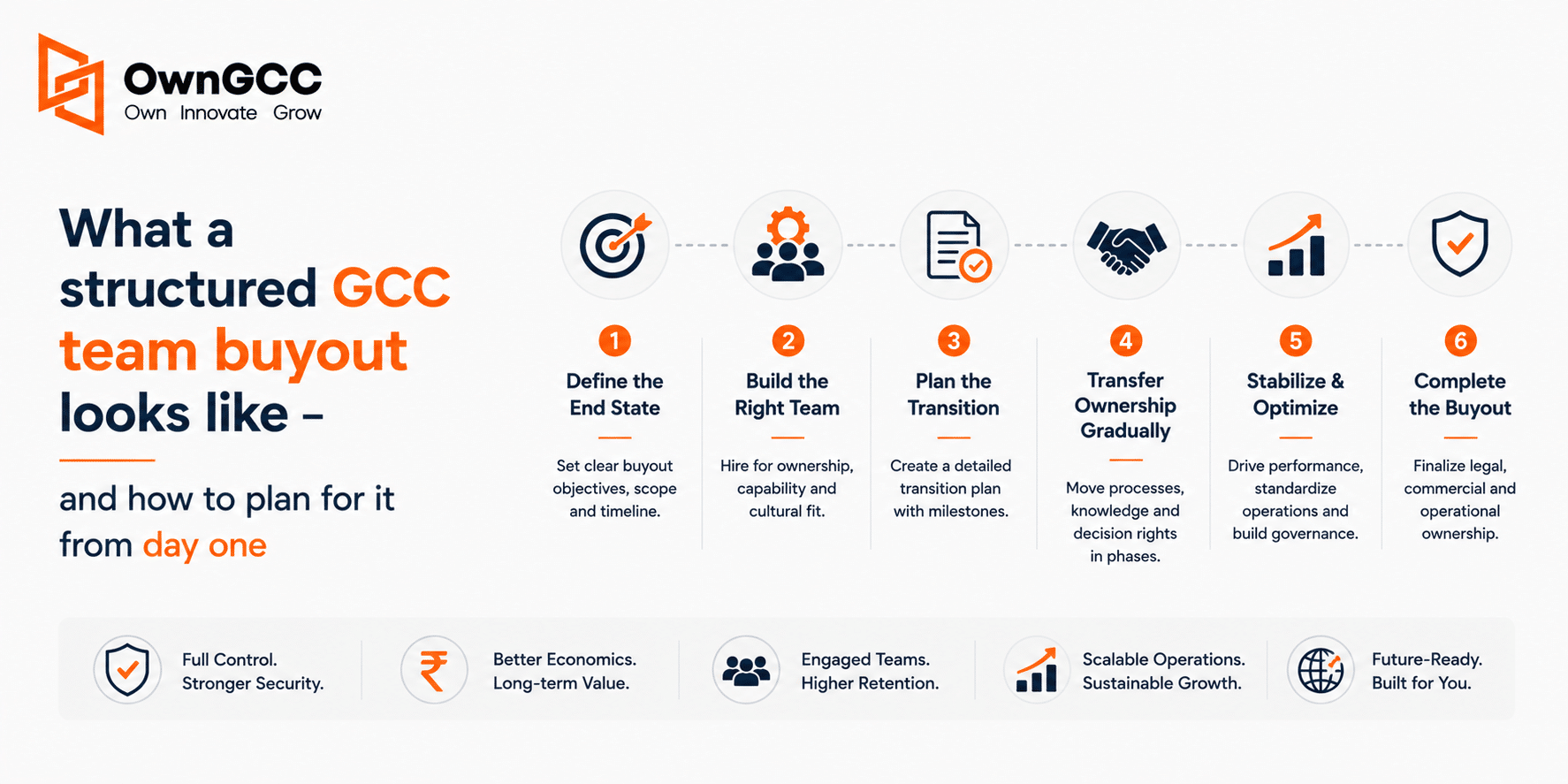
Most conversations about buying out a GCC team happen far too late — usually around month sixteen, when a company that’s been running an offshore operation under a vendor or enabler decides it’s time to own it outright, and someone finally asks the question that should have been asked at signing: “Can we actually do this cleanly?”
The honest answer, more often than anyone in this industry admits, is no — not cleanly. Not because ownership transfer is impossible, but because the entity, the employment contracts, the IP assignments, and the systems access were never structured to make a transfer simple. They were structured to run an operation, and transfer was left as a someday conversation instead of a day-one design decision.
A structured GCC team buyout isn’t a negotiation you have when you’re ready to own the team. It’s the outcome of decisions made before the first person is hired. Here’s what that structure actually looks like, and why the planning has to start at signing, not at the exit conversation.
Why Most “Transfer-Ready” GCCs Aren’t
The term “transfer-ready” gets used loosely across the GCC enablement market. In practice, three structural gaps are what turn a promised transfer into a drawn-out, expensive renegotiation:
Shared or multi-tenant legal entities. If your team operates inside an enabler’s shared entity alongside other clients’ teams, there’s no clean legal container to hand over — untangling your team’s contracts, assets, and liabilities from everyone else’s requires a fresh entity formation anyway, which defeats the purpose of “transfer.”
Vendor-pooled employment. If your team members are formally employed by the enabler’s staffing entity rather than a dedicated entity built for your operation, transfer means re-hiring — new offer letters, renegotiated terms, and a real risk that key people don’t make the jump, taking the institutional knowledge with them.
Undocumented IP and process ownership. If the SOPs, workflow documentation, and process improvements your team built over two years live in someone’s head or in a vendor’s internal systems rather than in a structure you already own, “transfer” becomes a knowledge-extraction project under time pressure — the exact scenario that turns a planned handover into a scramble.
None of these gaps show up in year one. They show up at the exact moment they’re most expensive to fix — when you’re trying to close a transfer, not when you had the leverage to structure it correctly at signing.
The Four Things That Have to Be Right From Day One
1. A Dedicated Legal Entity, Built to Be Transferred
The entity your team operates inside has to be a distinct legal container from the outset — not a shared services line inside a larger vendor operation. OwnGCC’s Build-Operate-Transfer model sets up a dedicated legal entity specifically for your BOT team at the start of the build, which means the “transfer” at the end is a change of ownership and control over an entity that already exists cleanly — not a formation project layered on top of an unwind.
2. Direct Employment, Not Vendor Pooling
Team members should be hired directly into the dedicated entity from their first day, with compensation, benefits, and role design aligned to your standards from the outset — not to a generic vendor pay scale. This is the single biggest determinant of whether a buyout is smooth: when employment already sits inside the entity being transferred, the people don’t have to be re-hired, re-negotiated, or convinced to make a jump. Nothing changes for them operationally on transfer day except who holds the entity above them.
3. IP and Data Ownership Assigned as You Go
Every process improvement, every piece of documentation, every workflow refinement a GCC team builds over its operating life has value — and that value needs to sit inside your ownership structure continuously, not get assembled retroactively at transfer time. IP assignment, data governance, and systems access all need to be architected around the client’s ultimate ownership from the build phase forward, not bolted on when the transfer conversation starts.
4. Documentation Built as the Team Runs, Not Reconstructed at Exit
The single most common finding across real GCC transitions is that documentation extraction done reactively — after notice is given, after the transfer date is already set — is slower, more expensive, and loses more institutional knowledge than documentation built continuously as SOPs, playbooks, and process maps from month one. A mid-market insurer’s transition into a captive GCC learned this the hard way on the vendor side of a transition — the lesson translates directly: whatever operational knowledge your team accumulates needs a home in your systems continuously, not a scramble to capture it once someone announces they’re leaving.
Day-One vs. Bolted-On: What the Difference Actually Costs You
| Structural Element | Planned From Day One | Bolted On at Transfer Time |
|---|---|---|
| Legal Entity | A dedicated legal entity is established at the start of the build. The transfer is simply a change of control. | A new entity must be created later, requiring contracts and assets to be separated from a shared structure. |
| Employment | Employees are hired directly into the dedicated entity, making the transfer seamless. | Employees often need to be re-hired, increasing the risk of attrition and knowledge loss. |
| IP & Data Ownership | Intellectual property and data ownership are assigned continuously as the team builds processes. | Ownership must be negotiated retrospectively, creating potential disputes over processes developed under unclear ownership. |
| Documentation | SOPs and operational playbooks are created and maintained throughout the engagement. | Documentation is extracted reactively under tight timelines and is often incomplete. |
| Transfer Timeline | Typically completed in weeks through a structured handover of a clean, dedicated entity. | Can take months due to parallel entity formation, contract migration, and knowledge recovery. |
| Cost Predictability | Transfer costs are planned and included in the original engagement. | Unexpected legal, tax, retention, and transition costs often emerge late in the process. |
What the Buyout Itself Actually Looks Like
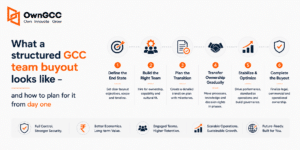
Assuming the structural work above was done from the start, a GCC team buyout follows a defined sequence rather than an open-ended negotiation:
The trigger point is set in advance, not improvised. Most structured BOT engagements define what “ready for transfer” looks like at signing — a stabilized operation, functions performing at or above agreed benchmarks, and a leadership layer capable of running independently — so the transfer conversation starts from an objective readiness bar, not a subjective negotiation under pressure.
Ownership transfer is a change of control, not a rebuild. Because the entity, employment, and IP were already structured around your eventual ownership, the transfer mechanics are a matter of transferring equity or management control of an entity that has been operating cleanly the entire time — not standing up a new legal and operational structure from scratch.
People experience continuity, not disruption. Because the team was employed by the dedicated entity from day one, transfer doesn’t require anyone to resign, re-apply, or sign a new employment contract with different terms. The org chart above them changes; their day-to-day doesn’t.
Systems, access, and vendor contracts transfer with the entity. IT infrastructure, software licenses, facility leases, and third-party vendor relationships tied to the entity move with it, provided they were contracted with transfer in mind rather than under the enabler’s own umbrella agreements.
A transition support window follows, not a hard cutoff. A responsible transfer includes a defined period of continued support — knowledge transfer sessions, operational shadowing, and issue escalation support — so the newly independent leadership team isn’t left without a safety net in the first weeks of full ownership.
The Build-Operate-Transfer Arc, Structured for a Clean Exit
| Structural Element | Planned From Day One | Bolted On at Transfer Time |
|---|---|---|
| Legal Entity | A dedicated legal entity is established at the start of the build. The transfer is simply a change of control. | A new entity must be created later, requiring contracts and assets to be separated from a shared structure. |
| Employment | Employees are hired directly into the dedicated entity, making the transfer seamless. | Employees often need to be re-hired, increasing the risk of attrition and knowledge loss. |
| IP & Data Ownership | Intellectual property and data ownership are assigned continuously as the team builds processes. | Ownership must be negotiated retrospectively, creating potential disputes over processes developed under unclear ownership. |
| Documentation | SOPs and operational playbooks are created and maintained throughout the engagement. | Documentation is extracted reactively under tight timelines and is often incomplete. |
| Transfer Timeline | Typically completed in weeks through a structured handover of a clean, dedicated entity. | Can take months due to parallel entity formation, contract migration, and knowledge recovery. |
| Cost Predictability | Transfer costs are planned and included in the original engagement. | Unexpected legal, tax, retention, and transition costs often emerge late in the process. |
What a Structured Buyout Doesn’t Remove
Structuring correctly from day one removes the avoidable friction — the re-hiring, the knowledge scramble, the entity untangling. It doesn’t remove the real work of running a team once you own it outright, and it’s worth being direct about that. Cultural integration, ongoing leadership development, and the ordinary management effort of any operating team don’t disappear at transfer — they simply become fully yours, without the structural debt of an operation that was never built to be handed over cleanly. Legal and tax steps at the transfer point still take real time, even in a well-structured deal; “weeks, not months” is a function of preparation, not the absence of process.
This is also a trend the wider GCC market is moving toward — shared and structured ownership models are increasingly redefining how India-based capability centers get built, precisely because enterprises have learned the cost of treating ownership as an afterthought.
Where This Conversation Actually Needs to Start
The structural decisions that determine whether your eventual buyout takes weeks or months get made at the discovery and blueprint stage of a BOT engagement — not after the team is fully staffed and running. If ownership is the destination for your GCC, the entity structure, employment framework, and IP assignment terms need to be part of the conversation before you sign, alongside the same rigor OwnGCC brings to its ISO 27001:2022-certified operating standards and its Lean Six Sigma-driven approach to building documented, repeatable processes from month one.
If you’re evaluating a Global Capability Center or BOT engagement and ownership is somewhere on your roadmap — even eighteen months out — that’s the right moment to have this conversation, not the moment you’re ready to transfer.
Talk to OwnGCC about structuring your GCC for a clean transfer from day one. Schedule a call to walk through entity structure, employment framework, and IP ownership before your build begins.
FAQs
How early can we plan for a buyout — do we need to know our exact timeline at signing?
You don’t need an exact date, but the structural decisions — entity formation, direct employment, IP assignment — need to be built in from the start regardless of when transfer eventually happens. The trigger point (functional stability, performance benchmarks, leadership readiness) is typically defined during discovery, even if the calendar date isn’t fixed until later.
Do our team members need to resign and re-join a new company at transfer?
Not if the entity was structured correctly from day one. Because the team is employed by the dedicated entity built for your operation from the start, transfer is a change of ownership and control above them — their employment continues without interruption or re-contracting.
Who owns the IP, processes, and documentation our India team builds before transfer happens?
When structured properly, IP and process documentation are assigned continuously throughout the build and operate phases, so ownership already sits with you in substance well before the legal transfer occurs. This is exactly the structural detail that separates a smooth buyout from a contested one.
Can we transfer only some functions or the whole team at once?
Yes — a well-structured BOT arrangement can support a phased transfer, where functions that have reached stability transfer first while others continue operating under the existing structure. The entity and employment framework need to be built to support that flexibility from the outset rather than assuming an all-or-nothing handover.
What happens in the weeks immediately after transfer?
A responsible transfer includes a defined support window — typically involving knowledge transfer sessions and operational shadowing — so your newly independent leadership team has a safety net rather than being handed full ownership with no transition support on day one.