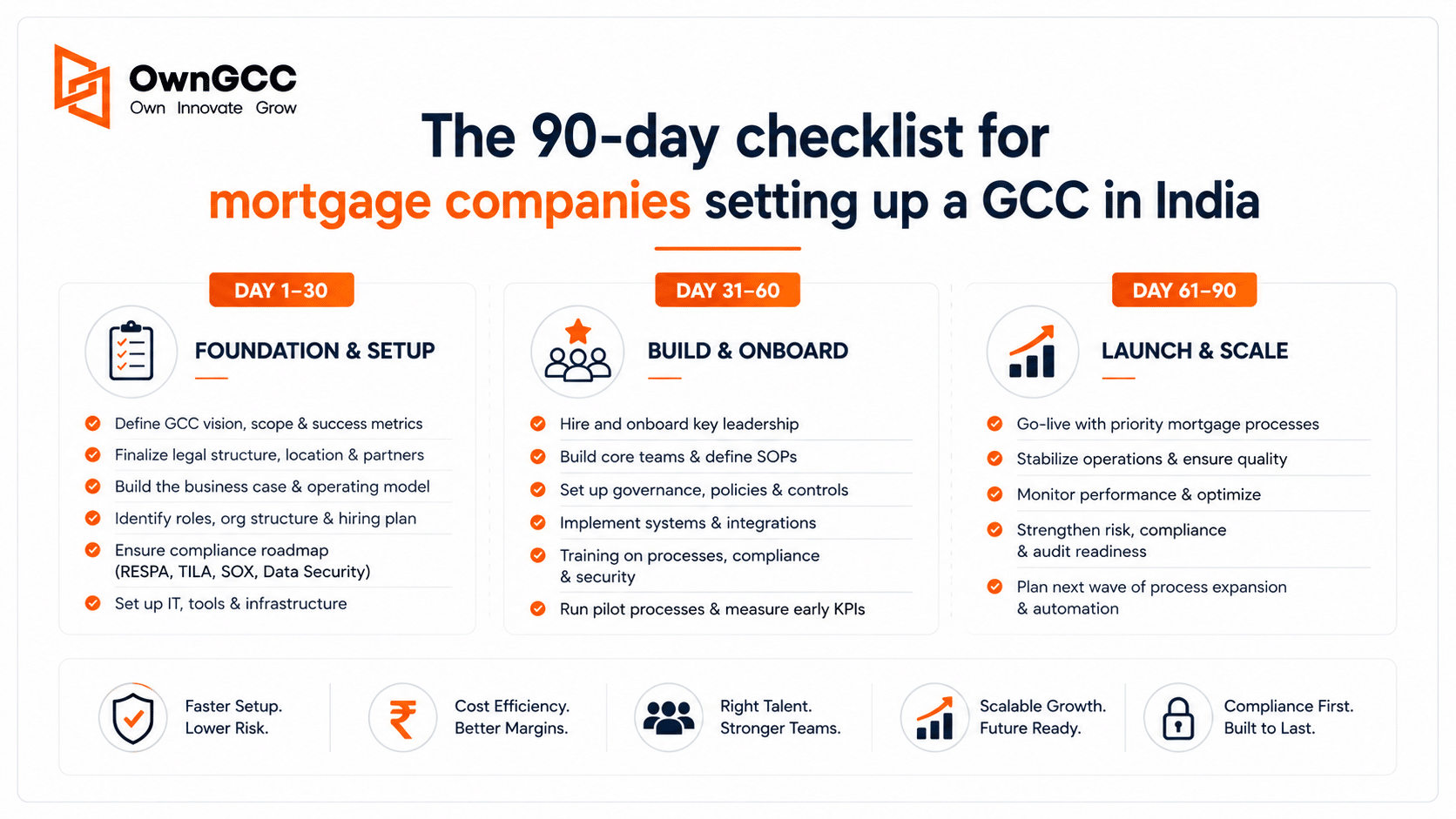
Board approval to build a GCC in India is the easy part of this project. The hard part is the ninety days after — the sequence of entity formation, leadership hiring, technology integration, and function ramp that determines whether you have a functioning processing team by day ninety or a half-built operation still waiting on IT access.
Most “90-day roadmaps” in this industry are marketing slides — five vague phases with no specificity about what actually has to happen in week three versus week eleven. This is the version built from what mortgage ops leaders who’ve actually done this report worked, and where the timeline slips when it isn’t planned for. If you’re past the “should we do this” question and into “how do we execute,” this is the checklist.
Before Day One: What Has to Be Decided First
A handful of decisions need to be locked before the ninety-day clock starts, because everything downstream depends on them:
- Function scope for the first ramp. For most mortgage firms, loan processing is the right function to launch with — highest volume, clearest workflow, fastest ramp. Trying to launch processing, underwriting support, and title operations simultaneously is the single most common cause of a slow, chaotic first ninety days.
- Engagement model. Whether you’re building through a Build-Operate-Transfer structure toward eventual ownership, or starting with managed teams to prove the model first, this decision shapes the entity and employment structure from day one.
- Vendor transition plan, if applicable. If you’re exiting an outsourcing vendor, the notice timeline and knowledge-extraction plan need to be mapped before day one — not improvised after notice is given.
- Budget and volume commitment. The team size and site scale for the first ninety days should be sized to a realistic volume commitment, not an aspirational one.
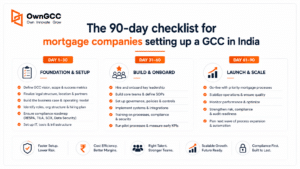
Days 1–30: Foundation
This phase is entity, leadership, and infrastructure — the unglamorous work that determines whether everything after it moves fast or drags.
Legal and compliance
- Incorporate the dedicated Indian entity for your GCC — a distinct legal container, not a shared services line inside a larger operation
- Complete tax registrations and Shops and Establishment Act registration
- Establish banking relationships and payroll infrastructure
- Build the employment framework — offer letter templates, benefits structure, HR policies — compliant with Indian labor law and competitive enough to attract experienced mortgage talent
Site and workspace
- Finalize city and location based on mortgage processing talent density, not just real estate cost
- Execute the workspace lease and begin fit-out
- Scope IT infrastructure requirements — dedicated connectivity, backup systems, endpoint security aligned to your existing IT security policy
Leadership hire — the most consequential decision in this phase
- Hire the GCC Site Head first, before any other role. This should be treated as a senior operations leadership hire — equivalent to a VP of Operations — not a team lead position
- Hire team leads for the functions in scope
- Schedule an immersion visit for the site leadership team to your US operation before bulk hiring begins, so institutional context is absorbed before it’s needed
If exiting a vendor
- Begin documentation extraction from the outgoing vendor team now, as a dedicated workstream — not after formal notice is given, when key vendor resources are most likely to disengage or be reassigned
- Map the parallel operation plan: which volume runs through the vendor, which transfers to the new team, and on what schedule
Days 31–60: Team and Systems
With leadership in place and infrastructure underway, this phase is about building the team and proving the technology works before live volume depends on it.
Hiring
- Launch bulk recruitment for the first function’s tiered roles — entry-level processors for documentation intake, mid-level processors for conditions management, senior processors for complex files
- Protect hiring quality over hiring speed — candidates who are fastest to hire are rarely the ones who perform best on judgment-intensive work months later
- If underwriting support is in the near-term roadmap, begin specialist recruitment for that profile now — this talent pool is thinner and takes longer to source than processing talent
Training
- Deliver structured training on your specific LOS platform, agency guidelines, and workflow — not a generic mortgage processing curriculum
- Build training around the complexity map of your actual file mix: start the team on straightforward purchase files with clean documentation before introducing refinance or non-QM complexity
- Establish the quality standards and escalation protocols the team will operate under from day one of live work
Technology
- Complete VPN architecture and system access provisioning for your LOS and downstream systems
- Run redundancy testing on connectivity infrastructure before go-live — a configuration issue discovered in week one of live processing is expensive; the same issue caught in testing is routine
- Design handoff protocols between the India team and the US team as a joint operational exercise, not an IT provisioning task
Compliance and QC infrastructure
- Stand up pre-fund and post-fund QC processes
- Build TRID tolerance check procedures into the workflow from the start, not as an add-on after go-live
- Define the documented quality process that catches errors before they reach a loan decision
Days 61–90: Go-Live and Stabilization
This is where the team starts processing real volume — under structure, not just under hope.
Go-live
- Start the parallel operation: the vendor or existing onshore team continues processing full volume while the new India team processes a designated, lower-complexity volume on the same workflows
- Track first-pass approval rates and cycle times against your existing benchmarks from week one — early data is expected to be mixed, but the trend matters more than the starting point
- Run daily team huddles where the India team logs and discusses its own errors — this is the seed of a self-correcting quality culture, not an optional nicety
Calibration
- Establish a weekly calibration session between the GCC team lead and the US processing manager
- Review escalations weekly and refine the escalation protocol based on what’s actually happening, not what was assumed during design
- Begin tracking the reduction in US team hours spent correcting or compensating for the new team’s output — this is one of the most financially significant and most commonly unmeasured outcomes of a GCC build
Review and next-phase planning
- Conduct a formal 90-day performance review against the benchmarks set during discovery
- Begin scoping the second function — typically underwriting support — informed by what the first ninety days revealed about ramp speed and training investment
- If a vendor transition is underway, confirm the vendor exit timeline against actual India team readiness rather than the originally contracted notice period alone
The 90-Day Milestone Checklist
| Phase | Days | Key Milestones | Primary Owner |
|---|---|---|---|
| Foundation | 1–30 | Entity incorporated, banking and payroll operational, site leadership hired, office lease signed, and IT infrastructure planned. | GCC partner, with client approval for leadership hiring. |
| Team & Systems | 31–60 | Bulk hiring completed, employee training delivered, system access provisioned and tested, and quality/compliance framework established. | GCC partner, with client input on training content and quality standards. |
| Go-Live & Stabilization | 61–90 | Parallel operations underway, weekly calibration meetings established, 90-day performance review completed, and planning for the next functional expansion initiated. | Joint ownership — GCC partner manages day-to-day operations while the client reviews performance and outcomes. |
Realistic Ramp Expectations by Function
Even within a well-run ninety days, different mortgage functions reach onshore-quality parity on different timelines. Planning against these benchmarks avoids the most common scoping mistake — applying a single training and ramp assumption across functions that don’t ramp at the same speed.
| Function | Typical Time to Onshore Parity | What Drives the Timeline |
|---|---|---|
| Loan Processing | 2–3 months | Well-defined workflows, a deep talent pool, and relatively lower complexity for entry-level processing roles. |
| Underwriting Support | 3–4 months (standard files) | Requires familiarity with agency underwriting guidelines and access to a smaller, more specialized talent pool. |
| Title Operations | 4–6 months (trained states) | Depends on state-specific legal knowledge and is best achieved by focusing on 3–5 states before expanding nationwide. |
Where This Goes Wrong Without a Partner Who’s Done It Before
The mistakes that derail a 90-day mortgage GCC build are consistent: hiring the site leader too late, treating technology integration as an IT ticket instead of an operational design project, compressing the training timeline for underwriting or title work to match the processing timeline, and delegating the vendor transition to procurement instead of managing it as an operational workstream with its own risks.
None of these are exotic failure modes. They’re the same handful of mistakes across most builds that stall — which is exactly why a structured, mortgage-specific execution partner matters more here than in most offshore builds. OwnGCC’s leadership has consulted with and delivered services to 100+ mortgage lenders, which means the ninety-day sequence above isn’t a generic BOT template applied to a new vertical — it’s built from what actually happens when mortgage-specific complexity meets an aggressive timeline. That domain depth is also why OwnGCC operates under ISO 27001:2022 certification as a baseline, and applies Lean Six Sigma process design to the workflows before the new team learns them, rather than letting them inherit whatever inefficiencies existed onshore.
Workspace planning deserves its own mention here: India’s GCC real estate market has been absorbing capacity fast, with leasing activity hitting record levels in 2026 as more companies compete for the same premium space in the same handful of cities — one more reason site and lease decisions belong in week one of the ninety days, not week six.
Ready to Map Your 90 Days?
The teams that hit day ninety with a live, stabilized processing function are the ones who had this sequence mapped before day one — leadership hired first, technology tested before it’s needed, training scoped to the actual function, and a vendor transition managed as its own workstream if one is running in parallel.
Talk to OwnGCC about scoping your mortgage GCC’s first ninety days. Schedule a discovery call to walk through entity structure, function sequencing, and a realistic build timeline before you commit to a date.
FAQs
Can a mortgage GCC realistically go live with processing volume inside ninety days?
Yes, for loan processing specifically — assuming leadership is hired in the first thirty days, not the last, and technology integration is tested before go-live rather than discovered live. Underwriting support and title operations, if included in the initial scope, typically need longer than ninety days to reach full quality parity, even if hiring and training begin within the same window.
What’s the single biggest reason a 90-day timeline slips?
Hiring the Site Head late. This role sets the quality culture, absorbs institutional context from the US team, and leads the bulk hiring effort — delaying it delays everything downstream. The second most common cause is treating LOS and system access as a same-week IT request instead of a planned integration project.
Do we need to exit our current vendor before the India team can start processing?
No — a parallel operation model is the standard approach. The vendor or existing team continues full volume while the new team processes a designated, lower-complexity volume alongside it. Full vendor exit happens only after the new team has demonstrated sustained performance at or above the existing benchmark.
How many people should we plan to hire in the first ninety days?
That depends on your volume commitment, but a common pattern is to size the initial team to the volume you’re confident you can sustain — not the volume you hope to reach. Overstaffing a new function before quality is proven creates more risk than starting smaller and scaling once the first cohort is performing.
Should title operations or underwriting support be part of the first ninety days?
Generally no, unless one of them is your specific bottleneck. Most mortgage firms get a cleaner, faster first ninety days by launching loan processing alone and scoping underwriting support and title operations as the next phase, once leadership and quality infrastructure are already established.