Introduction: The Ops Leader’s Question Has Changed
Not long ago, the question mortgage operations leaders asked about India was “should we offshore?”
That question has been answered. The mortgage industry has been sending processing and support work to India for over a decade through outsourcing vendors. The talent is there. The time zone works. The functional capability is established.
The question ops leaders are asking now is different: “Should we own it?”
And the answer, for a growing number of mid-market mortgage firms — independent mortgage banks, regional lenders, specialty servicers — is yes. Not because owning is always better than outsourcing on principle. Because the math, the quality data, and the operational experience of firms that have made the transition are making the case in language that CFOs and COOs cannot ignore.
But ownership requires scoping. And scoping a mortgage GCC in India requires a function-by-function view of what is actually being built, what profiles are needed, what the ramp looks like, and where the complexity lives.
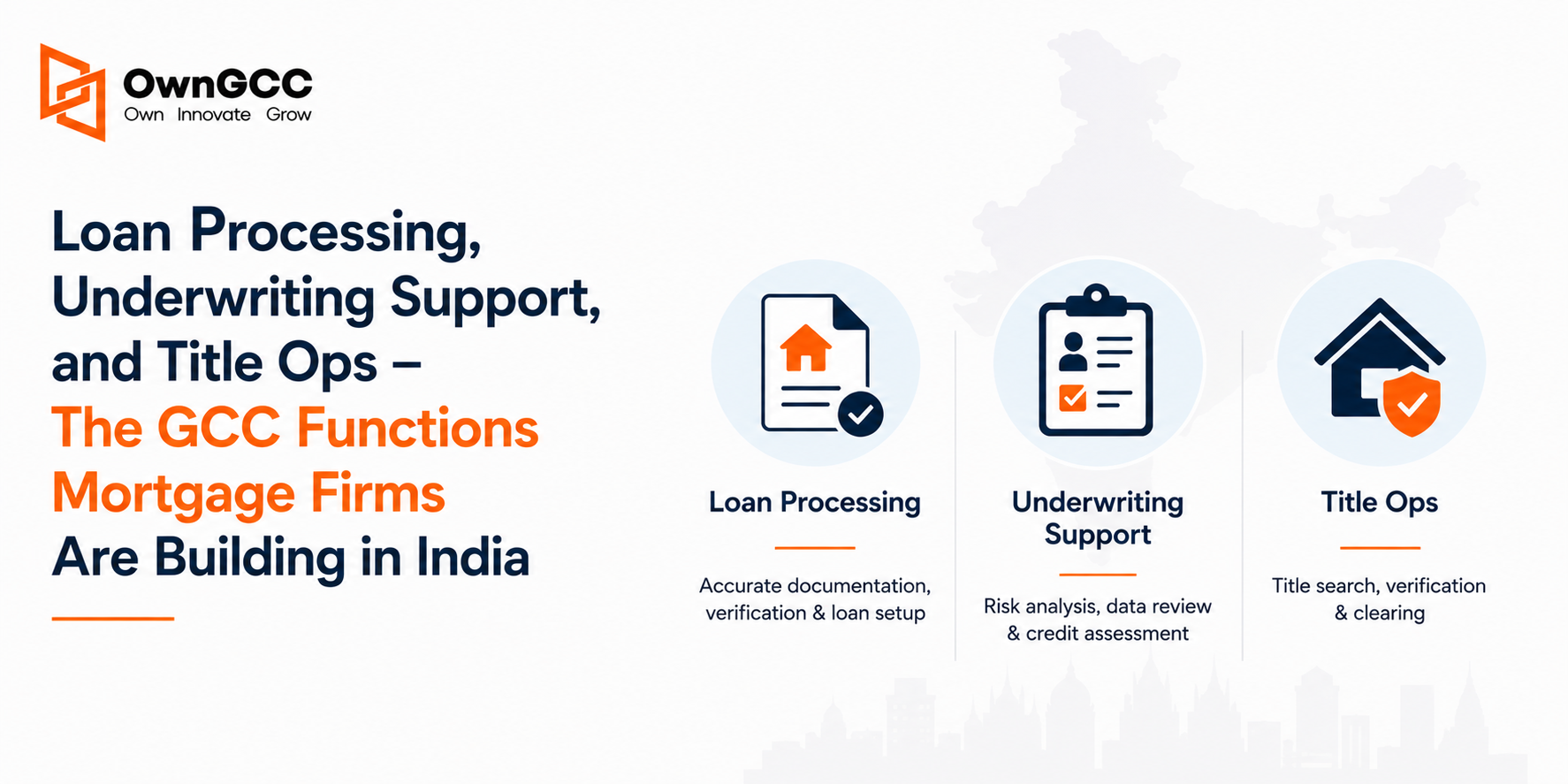
This article is for mortgage ops leaders who are past the “whether” question and into the “how” question. It covers the three core GCC functions that mortgage firms are building in India right now — loan processing, underwriting support, and title operations — with enough operational specificity to be useful for anyone actively scoping an India expansion.
Why Mortgage Is One of the Strongest Verticals for India GCC Builds
Before getting function-specific, it is worth being clear about why mortgage is one of the verticals where captive India teams consistently outperform the outsourcing alternative — not just on cost, but on quality and operational resilience.
Mortgage operations are process-intensive, documentation-heavy, and highly dependent on consistent execution across a defined workflow. These are precisely the characteristics that make offshore captive teams work well. Unlike functions that require real-time judgment calls in fast-moving environments, mortgage processing, underwriting support, and title operations follow defined sequences — with complexity concentrated in specific decision points that can be mapped, trained to, and quality-controlled.
The other structural advantage for mortgage is talent. India’s financial services back-office talent pool includes a substantial cohort of professionals with direct experience in US mortgage operations — Fannie Mae and Freddie Mac guidelines, TRID compliance requirements, title examination procedures, and underwriting condition management. Many of these professionals built their expertise working for outsourcing vendors serving US mortgage clients. In a captive model, that expertise works for you — not for a vendor who bills you for access to it.
The third factor is cycle sensitivity. Mortgage volume is notoriously cyclical — rate-driven origination swings can double or halve processing demand within a single year. A captive GCC with a stable core team and a defined flex model handles cycle swings differently than a vendor relationship where volume changes trigger renegotiations and rate adjustments. Ownership of the team gives ops leaders a lever they simply do not have in an outsourced model.
Function One: Loan Processing
What the Function Covers
Loan processing in a mortgage GCC context is the broadest of the three functions — and for most firms building India teams, it is the first function they scope and the first one they ramp.
The processing function covers the full workflow from initial file setup through conditions clearance and pre-closing preparation. In practice, that means:
Initial disclosure preparation and delivery tracking. Verification of borrower documentation — income, employment, assets, identity. Ordering and tracking third-party services — appraisal, title search, flood certification, credit supplements. File stacking and organization in the loan origination system. Conditions management — tracking outstanding conditions, following up with borrowers and agents, uploading cleared conditions for underwriter review. Pre-closing preparation — final document checklist, closing disclosure preparation support, coordination with closing teams.
This is not a single role. It is a workflow chain that, in a well-structured GCC, is staffed with tiered profiles: entry-level processors handling documentation intake and ordering, mid-level processors managing conditions and borrower communication, and senior processors handling complex files and pre-closing preparation.
The Talent Profile
India’s mortgage processing talent pool is deeper than most ops leaders expect when they first start scoping. The combination of years of outsourcing activity in the mortgage sector and a large population of finance graduates entering the back-office market has created a talent base that includes genuinely experienced US mortgage processors — not just people trained on generic financial services workflows.
The profiles to target for a processing GCC are candidates who have worked on US mortgage accounts in an outsourcing environment for at least two to three years, with direct experience in specific LOS platforms — Encompass, Byte, Calyx — and familiarity with agency guidelines. These candidates exist in volume in major Indian cities and are actively looking for opportunities to move from vendor floors to captive operations, where career development and compensation structures are typically more favorable.
The entry-level tier can be hired from a broader talent pool — finance graduates with strong documentation and attention-to-detail profiles who are trained to your specific processing workflow. The ramp for this tier is longer but the hiring cost is lower, and firms that build a deliberate entry-to-mid career path inside the GCC create a retention dynamic that vendor teams structurally cannot replicate.
The Complexity Map
Not all processing is equal, and scoping a processing GCC requires understanding where the complexity lives so the right profiles are assigned to the right work.
Straightforward purchase files with clean documentation and standard product types are the ideal starting point for a new GCC processing team — high volume, defined workflow, measurable quality outcomes, and a fast ramp to productivity. Refinance files add moderate complexity, particularly cash-out transactions with seasoning requirements and specific documentation expectations.
Non-QM files, jumbo loans, and files with complex income documentation — self-employment, rental income, partnership returns — require senior profiles with specific experience in those file types. These are not Day One functions for a new GCC team. They are Month Six to Month Twelve functions, added to the team’s scope as the senior tier builds confidence and the quality baseline is established.
The ops leader’s job in scoping a processing GCC is to map their current file mix against this complexity spectrum, identify the volume that can transfer to the GCC immediately and the volume that requires a longer ramp, and build the team profile and the transition timeline accordingly.
What Good Looks Like at Maturity
A mature processing GCC — operating at full capability after the initial ramp and stabilization period — should be delivering first-pass approval rates on processed files that are competitive with your best onshore processors. Condition clearance cycle times should be at or below onshore benchmarks. And the volume of escalations requiring onshore processor intervention should be measurable and declining quarter over quarter.
The performance trajectory of a captive processing team is not flat — it improves over time as the team builds institutional knowledge of your specific guidelines, your LOS configuration, and your underwriting preferences. That trajectory is the structural advantage of ownership. A vendor team stabilizes at the SLA level. Your team keeps getting better because they are accountable to your outcomes.
Function Two: Underwriting Support
What the Function Covers
Underwriting support is the function that generates the most skepticism among mortgage ops leaders scoping India GCCs — and the function that, when built correctly, generates the most operational leverage.
The skepticism is understandable. Underwriting is where lending decisions get made. It requires judgment, regulatory knowledge, and accountability for credit risk. The assumption is that this is not a function that translates to an offshore captive team.
But that assumption conflates underwriting with underwriting support — and the distinction matters enormously.
Underwriting support is not the credit decision. It is the work that enables the underwriter to make the credit decision efficiently and accurately. In practice, that means:
File pre-review and completeness checking before the file reaches the underwriter. Income calculation — running the numbers on W-2 income, base salary, overtime, bonus, commission, and self-employment income according to agency guidelines and presenting a calculated income figure with supporting documentation. Asset verification — reviewing bank statements, retirement accounts, and gift funds against program requirements. Collateral review support — reviewing appraisal reports against guideline requirements and flagging issues before the underwriter reviews. Condition writing support — drafting standard conditions based on file analysis, for the underwriter to review and issue. Post-underwriting condition clearing — reviewing borrower responses to conditions and preparing a recommendation for the underwriter on whether the condition is satisfied.
What this function does, in effect, is take everything that happens before and after the underwriter’s credit decision and structure it so the underwriter’s time is spent on the judgment call — not on the setup work and the follow-up work that surrounds it.
The Operational Case
The operational case for underwriting support in a GCC becomes clear when you look at how underwriters’ time is actually spent in a typical mortgage operation.
In most mid-market lending shops, underwriters are spending a meaningful portion of their time on work that is not credit decision-making — file review for completeness, income calculation verification, condition writing for standard items, and reviewing condition responses that don’t require judgment. This is not a criticism of underwriters. It is a reflection of how workflows get structured when there is no dedicated support layer.
An underwriting support team in a GCC changes that ratio. Underwriters spend more of their time on the decisions only they can make. Their capacity increases without adding headcount to the underwriting function. Turnaround times improve — not because the GCC team is faster than the underwriter, but because the file that reaches the underwriter is better prepared and the conditions that come back from the borrower are pre-reviewed before they land in the underwriter’s queue.
For ops leaders managing underwriter capacity in a cyclical environment, this is not a marginal improvement. It is a structural change in how the underwriting function scales.
The Talent Profile
Underwriting support requires a specific talent profile that is different from the processing tier. The right candidate for this function has direct experience with agency guidelines — Fannie Mae Selling Guide, Freddie Mac Guide, FHA Handbook — and the analytical capability to apply those guidelines to real file documentation.
In India, this profile is found primarily among professionals who have worked on US underwriting accounts in outsourcing environments — performing income calculations, running DU and LP findings analysis, and preparing credit summaries for US underwriter review. These are not entry-level candidates. They are mid-to-senior profiles with substantive functional experience, and hiring them requires a targeted recruitment approach, not a broad job posting.
The investment in getting the right profiles for underwriting support is justified by the output differential. An underwriting support analyst who genuinely understands agency guidelines and can perform income calculations accurately on the first pass is qualitatively different from one who is working from a checklist without the conceptual understanding behind it. The former adds real leverage to your underwriting capacity. The latter adds processing volume but requires significant underwriter oversight to be operationally safe.
Compliance and Oversight Architecture
Underwriting support in a GCC context requires a clearly defined compliance and oversight architecture — not because the India team is less capable, but because the function sits close to credit decision-making and the governance model needs to be explicit.
The architecture that works in practice has the following elements: US-based underwriters retain full decision authority — no credit decision is made or implied by the GCC team. The GCC team’s output — income calculations, condition recommendations, appraisal review flags — goes to the underwriter as structured input, not as a decision. The GCC team lead reviews all output before it reaches the underwriter. And there is a documented quality process that catches errors before they affect loan decisions.
This architecture is not burdensome when it is designed into the GCC from the start. It becomes burdensome when it is retrofitted onto a team that was set up without it.
Function Three: Title Operations
What the Function Covers
Title operations is the GCC function that mortgage firms most frequently underestimate — both in how much can be done from India and in how significant the operational impact is when it is done well.
Title work in a mortgage context covers the chain of activity from title search order through commitment preparation, examination support, and post-closing title clearance. The specific functions that translate effectively to a GCC include:
Title search coordination and ordering — tracking search orders, managing vendor relationships with county search firms, and organizing search results as they are returned. Abstract review and summarization — reviewing title search abstracts and summarizing the chain of title, open liens, easements, and encumbrances in a structured format for the examiner. Title commitment support — preparing draft title commitments based on the abstract review and the lender’s requirements, for examiner review and issuance. Exception management — tracking and organizing documents to clear title exceptions — subordination agreements, payoff letters, release documents, satisfaction recordings. Curative work coordination — tracking open curative items, following up with county recorders, prior lenders, and attorneys on outstanding documentation. Post-closing follow-up — tracking recorded documents, managing the recording and return process, and following up on outstanding post-closing items.
This is substantive work — not data entry. It requires understanding of property records, lien priority, the legal significance of different encumbrance types, and the specific requirements of the title commitment forms used in different states.
Why Title Is Underrepresented in Offshore Discussions
Title operations is underrepresented in discussions of offshore GCC functions for mortgage firms for a specific historical reason: the function is perceived as legally sensitive and state-specific, and early offshore experiments in title — done through vendors without adequate training or oversight structures — produced quality outcomes that reinforced that perception.
The perception is not wrong as a description of what went wrong in those early experiments. It is wrong as a description of what is possible with the right talent, the right training, and the right oversight model.
India has a substantial population of professionals trained in US property law concepts, title search procedures, and the specific documentation requirements of US title commitments and policies. Many have worked on title accounts for US lenders and title companies through outsourcing engagements. The knowledge base exists. The question is whether you structure the GCC to access it correctly.
The firms that have built successful title operations functions in India GCCs — and there are more of them than the industry conversation reflects — have done so by investing in training that goes beyond workflow documentation. They have trained their India teams on the conceptual framework behind title examination: why lien priority matters, what makes a cloud on title material versus cosmetic, how different encumbrance types affect marketability of title. Teams that understand the why behind the process make better decisions at the edges than teams that only know the what.
The State-by-State Complexity Question
The most common objection to title operations in a GCC is the state-by-state variability of property law and title requirements. It is a legitimate objection when it is not managed deliberately, and it is manageable when it is.
The approach that works is geographic concentration in the initial build. Rather than trying to staff for all states simultaneously, a title GCC function is initially scoped for the states that represent the highest volume of the firm’s business — typically three to five states — with deep training on those specific states’ requirements before expanding the scope.
This concentration approach means the team develops genuine expertise in a defined set of state-specific requirements rather than superficial familiarity with a broad geography. Expansion to additional states happens in sequence, with each state treated as a training and quality assurance event before the team takes live volume.
The ops leaders who have successfully built title GCC functions in India are consistent on this point: geographic scope is the variable to control most carefully in the initial build. Teams that tried to cover all states from Day One consistently struggled. Teams that started concentrated and expanded deliberately consistently succeeded.
The Quality Infrastructure for Title
Title operations in a GCC requires a quality infrastructure that is more rigorous than the processing function — because the consequences of title errors are more significant and more visible.
The quality model that works has two components. First, a tiered review structure where GCC output on complex items — multi-lien properties, properties with complex easement structures, properties with prior foreclosure history — goes through a senior GCC reviewer before reaching the US examiner. Second, a structured exception tracking system that logs every quality issue, categorizes it by type, and feeds into a weekly calibration session between the GCC team lead and the US title operations manager.
The calibration session is not optional. It is the mechanism through which the GCC team’s understanding of what good looks like is kept aligned with the US team’s evolving standards. Without it, quality drift is inevitable. With it, the GCC team’s quality typically improves quarter over quarter as the feedback loop runs continuously.
Scoping Your GCC: The Function Sequencing Decision
For mortgage ops leaders actively scoping an India GCC, the function sequencing decision — which function to build first, which to add in sequence, and how to structure the transition from vendor or onshore to captive — is the most consequential early decision in the build.
The sequencing that works for most mid-market mortgage firms follows a consistent logic: start with the function that has the highest volume, the clearest workflow definition, and the lowest consequence of early-stage errors. Expand to higher-complexity functions as the team builds institutional knowledge and the quality baseline is established.
In practice, this means loan processing almost always goes first. It has the volume to justify the build, the workflow clarity to enable a fast ramp, and an error profile where quality issues are visible and correctable before they affect loan decisions.
Underwriting support is typically the second function added — either built in parallel with processing from the start for larger operations, or added three to six months into the processing ramp for firms where underwriter capacity is the binding constraint on throughput.
Title operations is frequently the third function — not because it is less important, but because it requires the most state-specific training and benefits from having a leadership layer and quality culture already established in the GCC before the complexity of title work is added.
This sequencing is not a rule. Firms with a specific bottleneck in title operations have started there. Firms with a particular need for underwriting support capacity have led with that function. The sequencing logic is about managing ramp risk — not about the importance of any individual function.
The Build vs. Vendor Decision at the Function Level
For each of these three functions, the build-versus-vendor decision looks different — and understanding the difference matters for ops leaders who are evaluating whether to build, extend an existing vendor relationship, or do some combination.
For loan processing, the vendor alternative is the most mature and the most commoditized. Processing vendors are numerous, pricing is competitive, and quality benchmarks are established. The case for a captive processing team is primarily financial — the margin savings on a large processing team over multiple years are substantial — with a secondary quality argument that becomes more compelling as the team builds institutional knowledge. For processing specifically, the question is whether your volume and timeline horizon justify the build investment.
For underwriting support, the vendor alternative is thinner and the quality differential of the captive model is more pronounced. There are fewer vendors with genuinely strong underwriting support capability, and the ones that do exist price the function at a premium that makes the captive economics more immediately attractive. Additionally, the compliance and oversight architecture is easier to maintain in a captive model where the team works directly inside your operational structure. For underwriting support, the captive case is strong even at moderate team sizes.
For title operations, the vendor market is fragmented and quality is highly variable. The history of offshore title work includes enough vendor quality failures that many ops leaders are skeptical of the entire offshore model for title — a skepticism that is misapplied to captive models but understandable given the vendor track record. For title specifically, the captive model is not just preferable on economics — it is preferable on risk management, because the quality infrastructure of a captive team is more directly controlled than a vendor’s.
What the India Talent Market Looks Like for Mortgage Functions in 2026
For ops leaders scoping a mortgage GCC, a realistic picture of the India talent market in 2026 is more useful than a theoretical description.
The processing talent pool is deep and distributed across multiple cities. Experienced US mortgage processors — candidates with two or more years of LOS experience on US accounts — are available in meaningful volume in major metro areas. Competition for the strongest candidates is real but manageable, particularly for captive operations that can offer a career path and compensation structure that vendor floors cannot match.
The underwriting support talent pool is smaller and more concentrated. The specific profile — analysts with genuine agency guideline knowledge and income calculation experience — is found primarily in professionals who have worked on underwriting support accounts through the major mortgage outsourcing shops. This population is actively recruitable for captive positions, but requires a targeted approach and typically takes longer to source than the processing tier.
The title talent pool is the most specialized and the most geographically concentrated. Professionals with genuine US title examination knowledge and property records experience are found primarily in a small number of cities and primarily among those who have worked on US title accounts in outsourcing environments. Recruiting for this function requires either a specialist recruiter with existing relationships in this population or a GCC partner with a track record in title-specific mortgage builds.
Attrition dynamics differ by function. Processing talent has the highest attrition risk in vendor environments — where career paths are limited and the work is repetitive. In a captive environment with a defined career progression, processing attrition is substantially lower. Underwriting support and title talent have naturally lower attrition because the roles are more specialized and lateral options are fewer — but the captive environment’s career development advantages still matter for retention of the strongest performers.
What Ops Leaders Get Wrong When Scoping India Expansion
The mistakes that ops leaders make when scoping mortgage GCC builds in India are consistent enough across engagements to be worth naming directly.
Underestimating the training investment for specialized functions. Loan processing can be ramped with a training program of a few weeks for the entry-level tier. Underwriting support and title operations require substantially longer training periods and more structured calibration between the India team and the US team. Ops leaders who apply the same training timeline assumptions across all three functions consistently end up with underwriting and title teams that are not ready when the volume transfer begins.
Overloading the initial scope. The temptation to build all three functions simultaneously — or to add additional functions like post-closing, servicing support, or compliance review to the initial build — is understandable but consistently counterproductive. The leadership and quality infrastructure that makes a GCC work needs to be established before the scope expands. Teams that try to do everything at once end up doing nothing particularly well in the early months.
Ignoring the technology integration complexity. Giving a captive India team access to your LOS, your title production system, your document management platform, and your communication tools requires planning — not just VPN provisioning. The integration between your India team’s workflow and your US team’s workflow needs to be designed deliberately, with clear handoff protocols and documented escalation paths. Ops leaders who treat technology integration as an IT project rather than an operational design project consistently experience more disruption during ramp than those who treat it as a joint business-IT initiative.
Undervaluing the site leadership hire. The GCC Site Head is the single most consequential hire in the entire build. This is not a junior management position. It is a senior operational leader who sets the quality culture, manages the relationship with the US team, makes day-to-day staffing and workflow decisions, and is the institutional memory of the operation. Ops leaders who treat this hire as equivalent to a team lead hire — rather than equivalent to a VP of Operations hire — consistently end up with a GCC that requires more US management attention than anticipated.
Treating the vendor transition as a procurement event. Exiting an outsourcing vendor while simultaneously ramping a captive GCC is an operational transition that requires dedicated management attention, not just a contract notice and a handover plan. The knowledge that lives in the vendor team, the SLA commitments that continue through the notice period, and the morale and performance dynamics of the vendor team during wind-down all require active management. Ops leaders who delegate the vendor transition to a procurement function while focusing their own attention on the GCC build consistently experience more quality disruption during transition than those who treat both as equally demanding parallel workstreams.
The Conversation That Should Happen Before the RFP
For mortgage ops leaders who have read this far and are moving toward a decision, there is a conversation that should happen before any RFP is issued or any vendor is engaged.
That conversation is internal — with the US functional leaders who will be most directly affected by the GCC build and whose engagement is the single largest determinant of whether the build succeeds.
The processing manager who will be calibrating quality with the India team. The chief underwriter who will be defining the scope of what the underwriting support team does and does not do. The title operations lead who will be designing the training program and the state-by-state ramp sequence. The technology leader who will be architecting the system access and integration model.
These are not stakeholders to be briefed after the build plan is designed. They are co-designers of the build plan. The GCC builds that succeed are the ones where the US functional leaders are invested in the outcome — not because they were told to support it, but because they helped design it.
The role of the GCC partner in that conversation is to bring the market knowledge, the operational playbook, and the honest assessment of what is achievable in what timeline — not to sell a solution but to help the internal team make a better-informed decision about how to scope and sequence the build.
That conversation, done well, is the foundation of a GCC that performs. Done poorly — or skipped entirely in favor of a faster path to contract — it is the foundation of a GCC that requires constant remediation.
Conclusion: The Functions Are Proven. The Question Is Whether You Own Them.
Loan processing, underwriting support, and title operations are all being done from India right now — by captive GCC teams working inside US mortgage firms’ organizational structures, with quality outcomes that match or exceed their vendor predecessors and cost structures that fundamentally change the economics of the back-office operation.
The question for mortgage ops leaders in this market is not whether these functions work offshore. They do. The question is whether you want to own the team that does them or keep paying a vendor to own it for you.
Ownership means the institutional knowledge stays in your organization. The quality improvements accrue to your operation. The cost savings compound over time rather than being absorbed in vendor margins. And the team that processes your loans, supports your underwriters, and clears your title work is accountable to you — not to an SLA that was written to protect the vendor’s interests.
For firms with the volume to justify the build and the operational maturity to manage the transition, the case for a captive mortgage GCC in India has never been stronger. The talent is there. The playbook is established. The firms that moved earlier have the results to show for it.
The firms that move now are not early adopters taking a risk. They are making a decision that their competitors have already made — and closing a gap that grows more expensive to close with every renewal cycle they stay in.
Frequently Asked Questions
Q: Which mortgage function should we build first in an India GCC?
For most mid-market mortgage firms, loan processing is the right starting function — highest volume, clearest workflow, fastest ramp to productivity, and lowest consequence of early-stage quality issues. Underwriting support and title operations are typically added in sequence as the team and quality infrastructure mature. Firms with a specific capacity constraint in underwriting or a particular bottleneck in title can adjust this sequence, but the principle of starting with the function that has the most defined workflow and the highest volume holds regardless.
Q: Can underwriting support really be done from India without creating compliance risk?
Yes, with the right governance architecture. The critical distinction is between underwriting support — income calculation, condition preparation, appraisal review support — and the credit decision itself, which remains entirely with the US-based underwriter. A well-designed underwriting support GCC has clear role definitions, documented decision authority boundaries, a tiered review structure for complex items, and ongoing quality calibration with the US underwriting team. Within that architecture, the function is both operationally effective and compliance-safe.
Q: How do we handle the state-by-state variability in title operations?
Geographic concentration in the initial build is the most effective approach. Start with the states that represent your highest volume — typically three to five — with deep state-specific training before expanding scope. Each state addition is treated as a training and quality assurance event, with the team demonstrating consistent quality on existing states before new states are added. This approach builds genuine expertise rather than superficial familiarity across too broad a geography.
Q: What LOS platforms and technology systems can an India GCC team work with?
India GCC teams for mortgage are actively working on all major platforms including Encompass, Byte, Calyx Point, and various title production and document management systems. The technology integration — VPN architecture, access provisioning, workflow integration — requires deliberate planning and should be treated as an operational design exercise, not just an IT provisioning task. The platform itself is rarely the constraint; the integration design between the India team’s workflow and the US team’s workflow is where the planning investment matters.
Q: How long does it take for a mortgage GCC team in India to match onshore quality benchmarks?
For loan processing, well-recruited and well-trained teams typically reach parity with onshore quality benchmarks within two to three months of going live and begin to exceed those benchmarks within six months as institutional knowledge builds. Underwriting support takes three to four months to reach parity on standard file types, longer for complex income scenarios. Title operations has the longest ramp — four to six months to reach parity on trained states — but also shows the most pronounced quality improvement trajectory over time as the team builds property law conceptual knowledge alongside procedural expertise.
Q: How is OwnGCC different from a general GCC operator for mortgage functions?
OwnGCC’s focus on mortgage, insurance, and financial services means the operational design for a mortgage GCC is informed by direct domain knowledge — not a generic BOT methodology applied to a new vertical. The talent recruitment targets profiles with specific US mortgage experience. The training frameworks are built around agency guidelines, LOS platforms, and mortgage-specific quality standards. The transition planning accounts for the specific complexities of moving loan processing, underwriting support, and title operations from vendor or onshore to captive. And the compliance architecture is designed with mortgage regulatory requirements — not generic financial services standards — as the baseline.