Logistics has always been a margin business, and the margins have rarely been thinner. Freight brokers are working through a prolonged soft market where every load is contested. Carriers are absorbing insurance and equipment cost increases they can’t pass through. 3PLs are being asked to do more for shippers at the same rates. In that environment, the cost structure of your back office isn’t an accounting detail — it’s a competitive weapon.
That’s the backdrop against which US logistics companies — brokers, 3PLs, asset-based carriers, freight forwarders, and last-mile operators — are building captive teams in India. Not outsourced call centers under someone else’s brand, but their own GCCs: dedicated teams on their own systems, running their own processes, wearing their name.
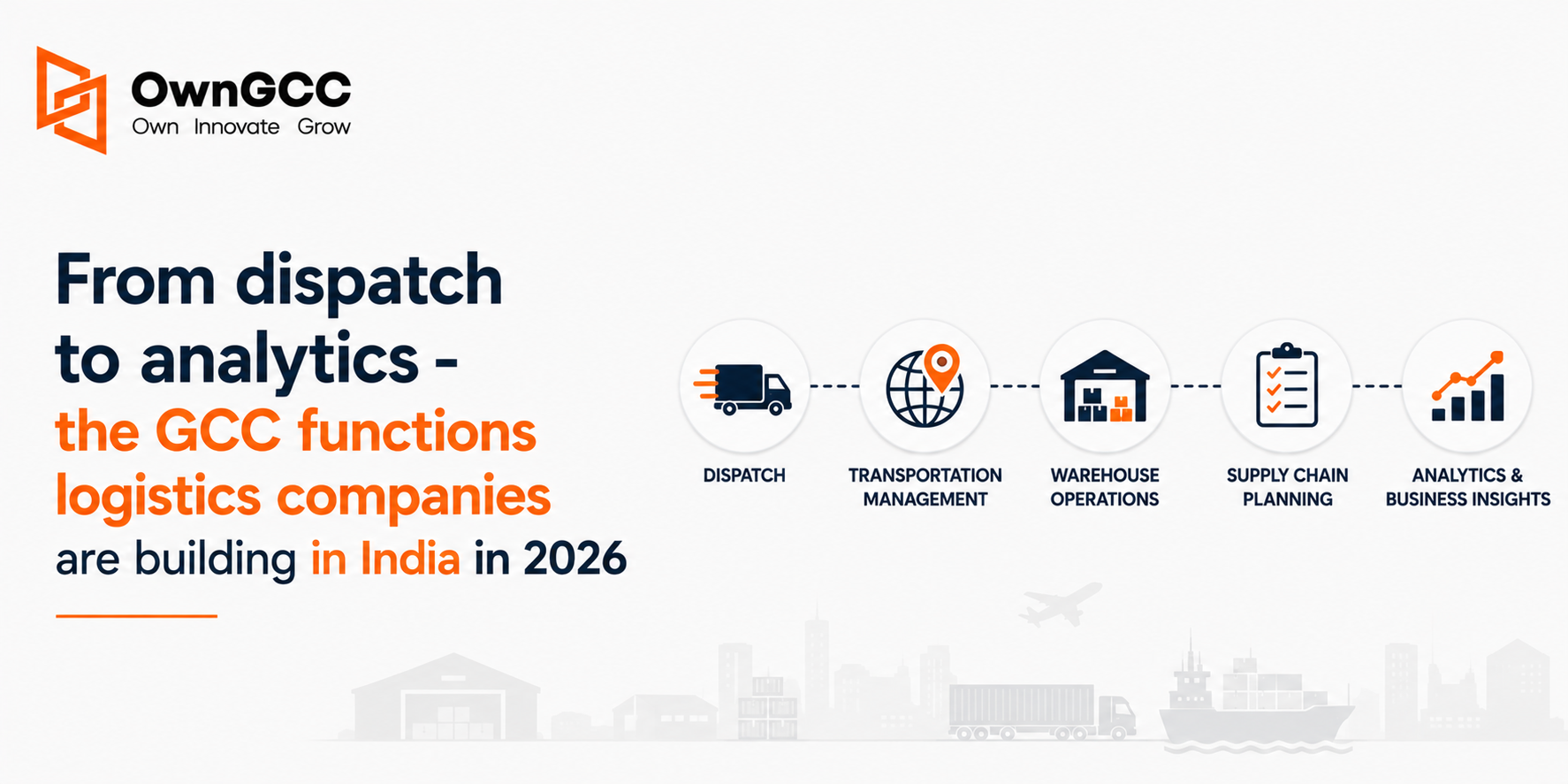
The interesting part isn’t that this is happening. It’s what these teams are being built to do. The function list has moved well beyond data entry, and it now spans an arc — from 24/7 dispatch support at one end to pricing analytics and network optimization at the other. This is a function-by-function look at that arc, and at the order in which most operators build it.
1. After-hours dispatch and load coverage: the time zone is the product
Start with the function where geography itself does the work. India runs nine and a half to twelve and a half hours ahead of the US, depending on the coast. India’s standard business day maps almost perfectly onto the American night.
For a logistics operation, that’s not a scheduling quirk — it’s structural. Freight doesn’t stop at 6 PM Central. Drivers break down at 2 AM. Loads get rejected at delivery and need recovery overnight. Reloads need covering before the morning rush. Historically, US operators handled this with skeleton night crews at premium pay, on-call rotations that burn people out, or expensive third-party after-hours services that don’t know your freight.
An India-based dispatch support team turns the night shift into someone else’s day shift. Teams handle overnight driver check-ins, monitor loads in transit, manage breakdowns and service failures as they happen, coordinate with recovery carriers, and hand a clean board back to the US team every morning. The freight moves around the clock; nobody works a graveyard shift; the after-hours premium disappears from the P&L.
This is the most common entry point into a logistics GCC for a simple reason: the value is visible in week one, and the workflows are well-bounded enough to transition quickly.
2. Track-and-trace and exception management: from check calls to control tower
Track-and-trace is the highest-volume, most relentless function in freight operations — and it’s where offshore teams have matured furthest.
At the basic level, this is the classic work: scheduled check calls, in-transit status updates in the TMS, ETA confirmation with drivers and carrier dispatchers, and proactive notification when a load slips. High volume, time-sensitive, and utterly unforgiving of gaps — a missed status update becomes an angry shipper email by morning.
But the function has evolved. Modern track-and-trace teams sit on top of visibility platforms and ELD feeds, which means the job is no longer dialing every truck — it’s monitoring the exceptions. The offshore team watches the dashboard, identifies loads trending late, intervenes before the appointment is missed, reschedules with the receiver when it can’t be saved, and documents everything for the service record. Detention events get flagged and time-stamped as they occur, which matters later when the accessorial has to be billed or disputed with evidence.
The economics compound with the previous function: a team that runs your overnight dispatch and your track-and-trace board is effectively a 24-hour control tower, staffed at India cost, that never hands a shipper the phrase “we’ll find out in the morning.”
3. Freight audit, payment, and carrier settlement: where the margin leaks
If dispatch is where GCCs prove speed, freight audit is where they prove money. Freight invoicing is notoriously messy: carrier invoices that don’t match the rate confirmation, accessorials that were never authorized, fuel surcharges calculated against the wrong index, duplicate billings, lumper receipts that never made it into the file.
Every one of those discrepancies is either margin leaking out or a carrier dispute waiting to happen — and catching them requires exactly the kind of systematic, line-by-line, high-volume verification work that most US operations chronically understaff because it’s nobody’s favorite job.
A GCC freight audit team does this as a core function, not a side duty. Invoices are matched three ways against the rate confirmation and the delivery documentation. Accessorial charges are validated against the documented events — the detention that track-and-trace time-stamped in function two now pays for itself here. Discrepancies are worked with carriers systematically instead of being written off because nobody had time to chase them. Clean invoices flow to payment on terms; carrier settlement runs on schedule, which quietly improves carrier relationships too, because carriers prioritize brokers who pay accurately and on time.
For shipper-side and 3PL operations, the same team handles the outbound direction: auditing carrier bills before the client is invoiced, so billing disputes get caught internally instead of by the customer.
4. Carrier onboarding, compliance, and fraud screening: the function that protects everything else
Freight fraud — identity theft, double brokering, fictitious pickups — has become one of the defining operational risks in US trucking. And the first line of defense is a function most brokerages treat as administrative overhead: carrier onboarding and compliance.
Done properly, this is meticulous work. Verifying operating authority and safety records against FMCSA data. Confirming insurance certificates are genuine, current, and adequate — and monitoring them continuously, because a certificate that was valid at onboarding lapses quietly eleven months later. Cross-checking contact details, addresses, and banking information against known fraud patterns. Processing carrier packets completely instead of waving them through because a load is hot and the sales floor is shouting.
That last clause is the real problem with keeping this function onshore and understaffed: compliance rigor collapses exactly when it matters most, under time pressure. A dedicated GCC compliance team removes that failure mode. Vetting standards get applied uniformly on every carrier, every time, because the team’s entire job is applying them — not squeezing them in between covering loads. Insurance monitoring, watchdog-list screening, and re-verification cycles run on schedule instead of when someone remembers.
One prevented double-brokering incident can cover a year of this team’s cost. That math is why compliance has moved from afterthought to one of the fastest-growing logistics GCC functions.
5. Documentation, billing, and claims support: the paper trail that pays
Freight generates paper the way trucks generate miles: bills of lading, proofs of delivery, rate confirmations, lumper receipts, customs documentation, OS&D reports. Every day a POD sits uncollected is a day added to your cash conversion cycle, because the customer invoice can’t go out without it.
GCC documentation teams close that loop as a production process. POD retrieval is chased daily, not weekly. Documents are indexed against the load file, checked for completeness and exceptions (shortages, damage notations, signature issues), and pushed straight into billing. Customer invoices go out same-day or next-day after delivery instead of aging in a queue. For forwarders, the same team handles commercial invoices, packing lists, and the customs document choreography that international freight demands.
Claims support belongs here too. When freight is damaged or lost, the difference between a recovered claim and a write-off is usually documentation discipline: the photos, the delivery receipt notation, the carrier notification inside the time window. An offshore team that owns the claims file from first notice through resolution keeps that discipline when the US team is consumed by live freight.
The financial translation is direct: faster billing means measurably lower days sales outstanding, and in a working-capital-hungry business like brokerage, DSO improvement is real money.
6. Customer service and appointment scheduling: the coverage layer
Between the operational functions sits the communication layer: shipper tracking inquiries, order entry, dock appointment scheduling with receivers, rescheduling when the inevitable happens. It’s not glamorous, and that’s precisely the point — this work interrupts your US operations staff dozens of times a day, fragmenting the attention of exactly the people you pay to solve hard problems.
Moving the interrupt-driven work to a GCC team does two things at once. It gives customers faster, more consistent responses — including outside US business hours, which matters for import/export customers operating in other time zones anyway. And it returns focus to the onshore team, whose job shifts from answering “where’s my freight” to managing carriers, customers, and exceptions that genuinely require judgment and relationships.
Appointment scheduling deserves special mention because it quietly drives service performance: a dedicated team working scheduling queues in retailer and facility portals books appointments faster, which shortens transit commitments and reduces the missed-appointment fees that big-box receivers charge without mercy.
7. TMS administration, EDI, and systems support: the plumbing
Every function above runs on a TMS — and every logistics company knows the gap between what its TMS could do and what it actually does. Records go stale. Integrations break silently. EDI transactions fail and sit in error queues. Reports that leadership wants never get built because the one person who knows the system is busy.
A GCC systems team owns this plumbing: maintaining carrier, customer, and location master data; monitoring EDI queues and working failures (the 214 status messages, the 210 invoices, the 990 responses that keep shipper scorecards green); managing user setup; building the reports and workflows the operation keeps asking for. For companies running API-based integrations with visibility platforms, load boards, and capacity tools, the team monitors connection health so that “the integration was down for three days” stops being a sentence anyone says.
This is also where a logistics GCC starts to bend upward in value — because the same people who administer the systems sit on top of all the data those systems generate. Which leads to the top of the arc.
8. Pricing, analytics, and network intelligence: the destination function
Here’s the function that separates a cost play from a capability play. Logistics companies are drowning in data — every load carries a lane, a rate, a margin, a carrier, a transit time, a service outcome — and most mid-market operators barely use it, because analytics headcount onshore is expensive and perpetually deprioritized against operational hiring.
India changes that calculus. The analytics talent pool is deep, and a logistics GCC that started with dispatch can grow into a genuine intelligence function:
Lane and margin analytics — which lanes make money, which customers erode it, where buy rates are drifting against market, and where the pricing team is leaving margin on the table out of habit rather than data.
Carrier scorecards — on-time performance, tender acceptance, claims frequency, and rate competitiveness by carrier and lane, turning carrier selection from tribal knowledge into a managed portfolio.
Pricing and RFP support — building shipper bid responses with real cost data underneath, modeling scenarios, and giving the US commercial team analysis-backed answers inside the deadline instead of gut-feel numbers at midnight.
Network and capacity intelligence — seasonal pattern analysis, backhaul opportunity identification, and demand forecasting that informs where to build carrier relationships before the freight shows up.
The overnight advantage applies here too, in a subtler way: analysis requested at the end of a US business day is on the leadership team’s desk by the next morning. The India team’s day is your analytics night shift.
This is the function that changes what the GCC is. A dispatch team saves money. An analytics team makes decisions better. Companies that build the full arc end up with both.
Captive GCC vs. outsourced BPO: why the ownership model matters in logistics
Everything above could, in theory, be bought from a logistics BPO. Many companies have — and many of them are the ones now building captive teams instead. The reasons are consistent.
Logistics knowledge compounds inside people. A track-and-trace agent who has worked your freight for two years knows your shippers’ quirks, your carriers’ reliability, your TMS’s oddities, and your customers’ tolerance levels. In a BPO, that person is a shared resource who can be reassigned to another client next quarter, and the knowledge walks away. In a captive team, the knowledge stays and compounds — and so does the data, which matters enormously once you reach the analytics end of the arc. Your lane history, margin data, and customer intelligence are strategic assets; running them through a third party’s shared operation is a strange place to keep your crown jewels.
The traditional objection to captive builds was setup burden: entity formation, compliance, hiring, facilities — a distraction no logistics operator wants. That’s what the Build-Operate-Transfer model exists to remove. An enabler builds the team, runs the operation until it’s stable, and then transfers the entire entity — team, systems, processes — to you. You get BPO-speed setup with captive-model ownership at the end, rather than renting your own back office in perpetuity.
The sequencing playbook: what to build first
The full arc doesn’t get built at once, and shouldn’t be. The pattern that works looks like this:
Phase one — the coverage functions. Track-and-trace and after-hours dispatch first. High volume, well-defined workflows, immediate and visible value, and the fastest path for the offshore team to learn your freight. This is also the right moment to apply operational transformation to the workflows themselves — mapping and redesigning the process before the new team learns it, rather than lifting-and-shifting the inefficiencies you already have.
Phase two — the money functions. Freight audit, documentation and billing, and carrier compliance. These build on the operational knowledge phase one created — the team that tracked the load understands the file it’s now auditing — and they hit the P&L and the working capital line directly.
Phase three — the intelligence functions. TMS/EDI ownership, then pricing and analytics. By this point the team knows your freight, your systems, and your data deeply enough to generate insight rather than just process volume.
Run in that order, each phase funds and de-risks the next. Companies that try to start at phase three — analytics without operational grounding — usually get dashboards nobody trusts.
The bottom line for logistics decision-makers
The question in 2026 is no longer whether logistics back-office work can run from India — thousands of teams already prove it every night. The question is whether you’ll own that capability or rent it, and how far up the value arc you’ll take it.
The operators getting this right treat the GCC not as a cost line but as an operating asset: a 24-hour extension of their own company that starts by covering the night board and ends up informing how they price, which carriers they trust, and where their next margin point is hiding. From dispatch to analytics isn’t just a function list. It’s a maturity curve — and in a freight market this unforgiving, the companies climbing it are building an advantage the ones who wait will have to buy back later at full price.
Frequently Asked Questions
Which logistics functions should move to a GCC first?
Track-and-trace and after-hours dispatch support are the standard entry points. They’re high-volume, well-documented workflows where the time-zone advantage delivers visible value immediately, and they give the offshore team the operational grounding that later functions — freight audit, compliance, analytics — depend on. Starting with judgment-heavy functions like pricing before the team knows your freight is the most common sequencing mistake.
Can an India-based team really handle live dispatch situations like breakdowns and rejected loads?
Yes, with the right structure: documented escalation protocols, direct TMS and phone access, and clear authority boundaries defining what the team resolves independently versus escalates. Overnight teams routinely manage driver check-ins, breakdown coordination, recovery arrangements, and receiver rescheduling. The critical success factor isn’t geography — it’s whether the workflows and escalation paths were properly engineered during transition, which is why process design during the build phase matters as much as hiring.
How is a captive GCC different from using a logistics BPO?
Three ways that matter operationally: knowledge retention, data ownership, and control. In a BPO, trained staff are the vendor’s shared resources and your operational data flows through their environment; in a captive GCC, the team, the institutional knowledge, and the data are yours, and they compound over time. Under a Build-Operate-Transfer structure, you also avoid the traditional captive-setup burden — the enabler handles entity, hiring, and stabilization, then transfers full ownership to you.
What about data security — our TMS contains customer rates and carrier information?
Treat this as a hard requirement, not a preference. The baseline should include ISO 27001-certified operations, role-based access controls on TMS and rating systems, secure facilities, and contractual data-protection terms aligned with your customer agreements. A captive structure inherently helps: your team operates inside your security perimeter and policies, rather than inside a vendor’s shared environment serving multiple logistics clients — some of whom may be your competitors.
How large does a logistics company need to be to justify a GCC?
Smaller than most assume. The old rule that captives only made sense at enterprise scale reflected the old setup model, where the company carried the full burden of entity formation and management overhead. Under a BOT model that burden sits with the enabler during the build, which brings viable team sizes down to the mid-market range — brokerages, 3PLs, and carriers that need a dedicated team across two or three functions, not a thousand-seat campus. The practical threshold is having enough recurring back-office volume to keep a dedicated team productively loaded across shifts.
Does the time-zone difference create handoff problems between the US and India teams?
Only when handoffs aren’t engineered. Mature operations run a structured turnover at each shift boundary — a documented board status, open exceptions with next actions, and a live overlap window where both teams are on. Done properly, the time difference is an asset rather than a friction point: the US team ends its day knowing the board is covered, and starts the next one with overnight exceptions already worked. The operators who struggle are the ones who treated the handoff as an email instead of a process.