A Note Before We Begin
The company in this story is a composite — built from real patterns, real decisions, and real outcomes across multiple mid-market insurance GCC builds. The challenges are not hypothetical. The timelines are not padded. The mistakes are the ones that actually happen. If you are a COO or CFO at a US insurer evaluating whether a GCC is possible for your organization, this account is as close to the unfiltered version as a case study format allows.
The Setup: A Company Running Out of Road on Its Outsourcing Model
A regional property and casualty insurer writing substantial annual premium across multiple states had been running its back-office operations through an outsourcing vendor for several years.
The vendor relationship looked fine on paper. Claims support, policy administration, underwriting data entry, and document processing — all covered. A sizeable offshore team in an Asian location. Clean QBR decks. SLAs in the green.
But inside the organization, a few numbers told a different story.
The vendor’s annual billing had grown significantly over the engagement period while headcount had grown modestly. The cost-per-head was not only not decreasing — it was climbing faster than inflation with every contract renewal.
And the COO had started tracking a number the vendor never put in a QBR: the weekly hours the US team spent correcting offshore output, re-explaining processes, and handling escalations the offshore team couldn’t resolve. When converted to a salary cost, it was a significant and entirely invisible line item in the operating budget.
The third number came from the CFO’s office. With a renewal negotiation approaching and the vendor already signaling a meaningful rate increase, a multi-year forward model on the current path showed vendor costs growing substantially — while the captive alternative modeled at a fraction of that trajectory by Year Three.
The decision to explore an alternative was not bold. At that point, it was arithmetic.
The Decision That Almost Didn’t Happen
The first internal conversation about a captive GCC almost ended before it started.
The CFO was supportive. The multi-year model was compelling. But the COO had questions the financial model didn’t answer.
Could they actually build a large operation in India? How long would it take — realistically, not in a vendor’s sales deck? Who would run it on the ground? What happened to the vendor relationship during the transition? And what was the actual risk that claims operations would be disrupted during a switchover?
These were not abstract concerns. This was not a technology company comfortable with operational experimentation. It was an insurance carrier with producer relationships, state regulator commitments, and a claims operation where disruption had real consequences for real policyholders.
What changed the direction of the conversation was a reference call.
Through a peer network, the COO connected with a counterpart at a comparable regional insurer who had completed a GCC build in India some time earlier. The call was long. The peer was direct: the build was harder than expected in some ways and easier in others. The financial outcome had exceeded the model. The operational quality of the captive team was materially better than the vendor they had replaced.
That call shifted the decision from “whether” to “how.” The company engaged OwnGCC under a Build-Operate-Transfer agreement. The clock started.
The Target: A Large Team, Fully Operational, in Record Time
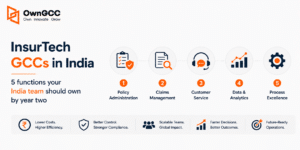
The scope agreed at the outset was specific: a captive GCC handling claims support, policy administration, underwriting data services, and document processing — the full scope of what the existing vendor was doing, plus several functions that had never been offshored because the vendor wasn’t set up for them.
The timeline was aggressive. Most GCC operators quoted significantly longer for an operation of this size. OwnGCC’s position was that the aggressive milestone was achievable for the initial operational target — not full transfer of all functions, but the full team hired, trained, and actively processing work — with a structured phased ramp built into the plan.
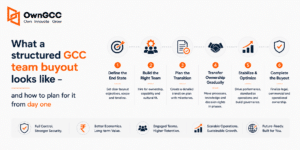
The function breakdown was deliberate. Claims support and document processing came first — highest volume, lowest complexity, targeted to be operational earliest. Policy administration came next — moderate complexity, requiring product-specific training on the insurer’s systems. Underwriting data services followed — the most specialized function, requiring candidates with underwriting support backgrounds. Quality assurance and team leadership were hired first of all, before any other function, and seeded into the operation from the beginning.
The location decision was made quickly, based on available talent density in insurance back-office functions, lower attrition rates compared to other major Indian cities, and competitive real estate costs for the target footprint.
Phase One: Entity, Infrastructure, and the Leadership Layer
The opening phase was infrastructure — and it ran on two parallel tracks simultaneously.
On the legal and compliance track: incorporation of the Indian subsidiary, tax registrations, Shops and Establishment Act registration, and the establishment of payroll infrastructure. Simultaneously, banking relationships were established, vendor contracts for facilities and IT were executed, and the employment framework — offer letter templates, benefits structure, HR policies — was built to comply with Indian labor law while meeting the quality bar required to attract experienced insurance talent.
On the talent track: the first hires were the leadership layer. Team leads and senior operations managers in each functional area, plus the GCC Site Head — an experienced insurance operations professional with substantial experience in US carrier back-office work who had built and led large teams before.
This sequencing — leadership first, team second — was a deliberate choice and one of the decisions that most directly determined the success of the ramp. The site leadership was in place within the first few weeks. They participated in the process documentation sessions. They traveled to the US operation for an immersion visit. By the time bulk hiring began, the people who would run the GCC had already absorbed the institutional context that typically takes months to develop.
The technology infrastructure — dedicated connectivity, backup systems, workstation deployment, VPN architecture for secure access to the insurer’s systems, endpoint security aligned with the carrier’s IT security policies — was completed on schedule. Having a technology team that had done this before, with a vendor network and a deployment playbook, made the difference between a fast setup and a slow one.
The Hiring Sprint — and the First Real Problem
The bulk hiring phase was ambitious. With the leadership team in place and the infrastructure ready, the recruitment engine ran hard. Hundreds of applications were screened, many were interviewed, and offers were extended to the strongest candidates.
The acceptance rate exceeded the modeled expectation. The talent pool in the chosen city was deep enough, and the employer value proposition — working directly for a US insurance carrier’s captive operation, not a vendor floor — was a genuine differentiator in the market.
But this phase also produced the first real problem of the build.
The underwriting data services function required a specific profile: candidates with US property and casualty underwriting support experience, familiarity with rating systems, and the ability to work with exposure data and risk classification logic. This profile existed in the market, but in smaller numbers than expected. The talent intelligence from the pre-build market mapping had underestimated how tightly this specific profile was concentrated in a small number of employers — large outsourcing vendors who paid retention bonuses specifically to reduce attrition of this population.
Rather than compromise on candidate quality — accepting profiles with adjacent experience but not the specific underwriting background — the timeline for the underwriting function was adjusted, and a specialist recruiter with existing relationships at the target employers was engaged. The function ramped later than planned but ramped with the right people.
The lesson: in a GCC build, timeline compression on hiring is always a temptation. The candidates who are easiest to hire quickly are rarely the candidates who perform best on complex, judgment-intensive functions. Protecting quality on hiring, even at the cost of timeline, consistently produces better outcomes than the reverse.
First Functions Go Live — and What the Data Showed
The claims support and document processing team was the first to go live.
Two weeks of structured training — process walkthroughs, system access familiarization, quality standards, escalation protocols — had been completed before the team started processing. The team began under a parallel operation model: the existing vendor continued processing its full volume while the new India team processed a separate, designated volume of lower-complexity claims on the same workflows.
The parallel model served two purposes. It gave the India team live processing experience with a safety net. And it gave the US team a real-time quality comparison between the two operations.
The first weeks of data were mixed, as expected. The India team’s error rate was higher than the existing vendor’s on initial volume — not alarming for a team early in live operations, but carefully watched.
Within weeks, the error rate had dropped below the vendor benchmark.
The speed of improvement was faster than modeled, and the reason was visible in the data. The India team was flagging errors themselves, logging them, and discussing them in daily team huddles. The quality culture — the team taking ownership of their own accuracy — had been seeded by the site leadership who had been in place from the beginning and who had participated in building the quality standards with the US team.
The existing vendor’s team, by contrast, had been processing the same workflows for years and had never developed the same self-correction dynamic — because their incentive was to meet the SLA, not to improve beyond it.
Policy Administration Goes Live — and a Vendor Complication
The policy administration team coming online coincided with the first significant complication in the vendor transition.
When formal notice was given to the existing vendor — timed to align with the contract’s notice requirement — the account team responded professionally at first. Then the dynamic changed.
Several of the most experienced members of the vendor team — senior processors and the team’s de facto quality lead — resigned within a short window of each other. The timing was not coincidental. Post-notice, key vendor resources began receiving recruitment approaches from the vendor’s other client teams. The institutional knowledge those people carried walked out the door.
This is a pattern in outsourcing transitions that is not accidental and is not often discussed openly. Vendors who learn they are being exited sometimes accelerate the departure of key resources — either actively or by withdrawing retention efforts — because those resources become available for other client assignments. The carrier bears the quality risk during the notice period; the vendor’s loss is minimized.
The response was to accelerate the documentation effort — spending weeks intensively extracting process knowledge from the remaining vendor team members and converting it into structured SOPs for training the India replacements. It was more effort than planned and it added cost. But the documentation that came out of that exercise became one of the most valuable assets the GCC inherited.
The lesson: in an outsourcing-to-captive transition, assume key vendor resources will not be available through the full notice period. Build documentation extraction into the transition plan as a formal workstream, not an afterthought.
The Underwriting Team — Late but Right
The underwriting data services team came online later than originally planned — but with the right people in place.
The specialist recruiter engagement had produced strong hires from target competitor employers, all with direct US property and casualty underwriting support backgrounds. Additional hires came from the site leadership team’s own professional network — candidates who had worked with them at previous employers.
The underwriting function was the most technically demanding of the four areas, and the team’s ramp reflected that. It was slower than claims and policy administration to reach acceptable accuracy benchmarks. But the complexity of the function warranted the slower ramp, and the quality of the hires meant the ramp reached a higher ceiling once it stabilized.
The functional head of underwriting at the US operation — who had been skeptical about the GCC from the beginning — made a comment at the review that was later repeated in the board presentation: “These people know what they’re looking at. The previous team knew the workflow. This team knows the work.”
Full Team. All Functions Live. The Outcome.
At the agreed milestone — all four functional areas live, the full team in place, all SLAs met or exceeded versus the prior vendor baseline — the financial picture was clear.
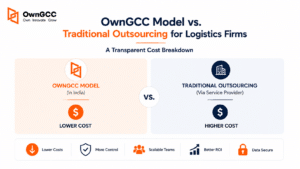
The build cost — entity formation, infrastructure, hiring, training, technology, management fees, and fully loaded salaries through the build period — was close to what the insurer had been paying the vendor for the same period. Not dramatically more. Not dramatically less. Essentially a wash.
This outcome — where the GCC build cost is broadly comparable to vendor continuation cost for the same period — is typical when the BOT model is executed efficiently. It is also the number that most powerfully rebuts the assumption that “building will cost more than staying.” In the period when you are building, you are not paying significantly more. And from the moment the team stabilizes, the cost advantage is structural and compounding.
The annualized run-rate cost of the India GCC at stabilization, fully loaded, was a fraction of what the vendor trajectory had been heading toward. The multi-year NPV of the captive model was significant — well into eight figures when modeled against vendor cost escalation.
What the Data Showed at the One-Year Mark
At the one-year mark, the leadership team conducted a formal operational review of the India GCC against the performance baseline from the prior vendor relationship.
Error rate across all functions had dropped materially below the vendor baseline — and continued to improve past the stabilization point. The trajectory of quality improvement had continued after the initial ramp because the team owned the quality and had the context and organizational standing to keep improving it.
Attrition at the one-year mark was dramatically lower than the vendor had reported in the final year of the prior engagement. The difference represented multiple avoided ramp cycles across the team — significant avoided recruiting and training cost, and an incalculable amount of avoided institutional knowledge loss.
The weekly US team hours spent compensating for offshore gaps — tracked by the COO from the beginning — had dropped by nearly three-quarters. The US team was no longer a quality backstop for the offshore operation. They were managing outcomes, not compensating for failures.
The policy administration team had identified a systematic billing code mapping error in one of the insurer’s older policy forms — an error that had been generating small but consistent discrepancies in premium calculations for an extended period before the GCC team noticed it. The prior vendor had processed the same forms and never flagged the issue. The India team flagged it because they were trained to understand what the output should look like, not just to execute the step.
That single finding — a systematic premium calculation correction — recovered a meaningful amount in previously unrecognized premium adjustments. The GCC had effectively paid for a significant portion of its own build cost with one quality observation.
The Honest Accounting: What Went Wrong
No case study that only reports what worked is worth reading. Here is the honest version of what didn’t go to plan.
The underwriting hiring timeline slipped, as described, and the talent concentration risk in that profile was underestimated during pre-build planning. The lesson is to invest more rigorously in talent market mapping for specialized profiles before the build starts — not after the hiring sprint reveals the gap.
The vendor transition management was harder than expected, particularly after notice was given. The knowledge departure risk was underestimated, and the documentation extraction workstream was reactive rather than proactive. Future builds should treat vendor knowledge extraction as a dedicated project workstream beginning before notice is given, not after.
The IT setup, while completed on schedule, created a period of reduced productivity when a connectivity configuration issue affected a portion of workstations. The fix was straightforward once identified, but the diagnostic process consumed IT resources and caused measurable throughput impact. Redundancy testing for the connectivity infrastructure needed to be more rigorous before go-live.
The site leadership team, despite being exceptional, needed more structured onboarding support from the US functional heads in the early weeks. The assumption that one immersion visit was sufficient context transfer for complex insurance workflows turned out to be optimistic for the policy administration function. A second visit for the policy administration lead — added reactively — should have been built into the plan from the start.
None of these issues derailed the build. All of them were recoverable. But a future build would plan for each of them — and would arrive at the milestone with fewer surprises.
What the COO Said at the Board Presentation
At the board presentation covering the first year and a half of operations, the CFO presented the financial outcomes. Significant multi-year NPV savings. Annual run-rate cost at a fraction of the prior vendor trajectory. The board approved expansion of the GCC, adding actuarial data support and a compliance documentation function.
The COO was asked to present last. She had been the most skeptical person in the room at the start of this process. Her remarks, edited for length, captured what the numbers alone couldn’t:
“I want to be clear about what changed my mind and what I’d say to anyone who is where I was at the beginning of this. The financial model was always compelling. I knew that. What I didn’t know was whether we could actually operate a team in India — whether the people would be good, whether the quality would hold, whether I’d be spending my time managing an offshore operation instead of running an insurance company.
What I know now is this: I spend less time managing the India team than I spent managing the vendor. The India team tells me what’s wrong before I ask. They find problems I didn’t know existed. They don’t hit SLAs — they exceed them and then ask what we could do better.
That’s not the vendor relationship I had for years. That’s a team. And the difference between a team and a vendor is the most important thing I can tell you about this.”
Ten Lessons for Mid-Market Insurers Considering the Same Move
Drawing from this build and the pattern of similar engagements, here are the ten lessons that consistently separate successful GCC builds from ones that struggle.
Hire leadership first, always. The site leadership layer determines the culture, the quality, and the ramp speed of everything that follows. Do not start bulk hiring until the leadership is in place and has absorbed institutional context from the US team.
Do talent market mapping before you commit to a timeline. Specialized profiles — underwriting, actuarial, compliance — have different supply dynamics than general back-office talent. Know the market before you promise a date.
Treat vendor knowledge extraction as a formal project. Begin before notice is given. Assign dedicated resources. Do not assume vendor team members will cooperate generously through the transition period once they know what is happening.
Build a parallel operation, not a hard cutover. Running the GCC team alongside the vendor on designated volume is not inefficiency — it is quality insurance. The parallel period is where the quality culture gets established without operational risk.
Plan for the IT issues you don’t plan for. Build buffer into every technology-dependent milestone. Test everything redundantly before go-live. The connectivity or access issue that surfaces in the first week of live operations is almost always avoidable with more rigorous pre-launch testing.
Protect hiring quality over hiring speed. The candidates who are easiest to hire quickly are rarely the candidates who perform best months later. A delay in getting the right people is almost always better than filling seats with the wrong people on schedule.
Send US functional leaders to India — not just slide decks. An immersion visit for site leaders in the US operation is better than any amount of documentation. Two visits is better than one. The quality of institutional knowledge transfer is the primary determinant of how fast the team reaches independence.
Design the data governance architecture before the first hire. HIPAA compliance, PII handling, access controls, and audit logging need to be built into the infrastructure from Day 1. Retrofitting security architecture onto a live operation is expensive and creates gap periods of elevated risk.
Model the vendor transition costs explicitly. Notice period costs, knowledge departure risk mitigation, documentation extraction effort, and parallel operation overhead all have real costs. Include them in the build model so the financial case is defensible under scrutiny.
Measure the US productivity impact, not just offshore metrics. The reduction in US team hours spent compensating for offshore gaps is one of the most financially significant outcomes of a successful GCC — and the one most consistently omitted from vendor QBR decks. Track it from the start so you can quantify the full value of the improvement.
Frequently Asked Questions
Q: Is an aggressive timeline realistic for a large insurance GCC in India?
An aggressive initial operational milestone is achievable with the right partner, the right location, and a build plan that sequences function rollout in order of complexity. It requires parallel tracking of entity setup, infrastructure, and hiring from Day 1, and it requires leadership hiring to precede bulk hiring by several weeks. It is not the right timeline for every build — some functions and organizational contexts require more time — but for a well-scoped insurance back-office GCC with clear functional definitions, it is operationally achievable.
Q: How do we handle the transition from our existing vendor without disrupting claims operations?
A phased parallel operation model is the standard approach. The existing vendor continues processing its full volume during the GCC ramp period. The new team processes designated volume in parallel, with quality validation. Functions transfer progressively — lowest complexity first — so the vendor is not exited from any function until the GCC team has demonstrated sustained performance at or above the vendor’s benchmark. Disruption risk is managed through sequencing, not speed.
Q: What does a large insurance GCC in India cost to build and operate?
Build costs vary based on team size, function mix, and location but are typically structured such that Year One total cost is broadly comparable to continuing with a vendor for the same period. The structural cost advantage of the captive model becomes pronounced from Year Two onward and compounds as the team stabilizes and the vendor’s escalating billing trajectory is avoided entirely.
Q: What insurance functions work best in an India GCC?
The full scope of insurance back-office operations is viable in a captive India GCC, including claims support and document processing, policy administration, underwriting data services, actuarial support, compliance documentation, quality assurance, and customer correspondence. More judgment-intensive functions — complex claims adjudication, producer relationship management, regulatory filing — typically ramp later and with more senior profiles, but are well within the capability of a well-staffed captive team.
Q: How is a captive GCC different from an outsourcing vendor in practice?
The structural difference is ownership and incentive alignment. A vendor team is accountable to the SLA metrics in a contract. A captive team is accountable to your operational outcomes. In practice, this means captive teams self-identify and escalate quality issues rather than managing to reported metrics, build institutional knowledge that stays in your organization rather than in a vendor’s systems, and improve over time rather than stabilizing at the contracted performance level. The operational quality difference typically becomes visible within the first year of stabilization.
Q: What should we look for in a GCC partner for an insurance build?
Domain depth in insurance back-office operations, not just GCC setup capability. A partner who can speak to claims workflow design, underwriting data requirements, and HIPAA compliance architecture from functional knowledge — not from a generic framework. Transparency in pricing so you can validate the cost model. A demonstrated track record in insurance-specific builds with referenceable outcomes. And a BOT methodology designed for transfer from Day 1 — so the team you build is yours to own, not a new dependency.