Ask any GCC enabler what they do, and you’ll hear some version of the same pitch: we hire your team, we set up your entity, we handle payroll and compliance, we get you an office. Some do it faster. Some do it cheaper. Some wrap it in better dashboards.
Almost none of them will touch the thing that actually determines whether your GCC works: the process itself.
That’s the quiet gap in the GCC enablement industry. The entire market is built around standing up capacity — people, seats, infrastructure. Very little of it is built around engineering what that capacity does. And the difference between those two things is the difference between a GCC that compounds in value and one that just relocates your existing problems to a cheaper time zone.
The lift-and-shift trap
Here’s how most GCC builds actually happen. A US company documents its current workflows — loan processing steps, claims handling procedures, reconciliation routines — and hands them to the offshore team as the operating manual. The offshore team learns the process exactly as it exists onshore. Leadership celebrates when quality scores match the US baseline.
Nobody stops to ask whether the US baseline was any good.
In most operations it isn’t. Mature back-office workflows accumulate waste the way old houses accumulate wiring: redundant quality gates added after some incident years ago, handoffs that exist because two departments once didn’t trust each other, wait states where files sit idle between queues. In loan manufacturing specifically, the ratio of wait time to actual processing time is often staggering — a file can spend the vast majority of its cycle time sitting in a queue, touched by no one.
Lift-and-shift replicates all of it. You get the same redundant touches, the same rework loops, the same idle time — performed by a lower-cost team. The unit economics improve on paper. The process capability doesn’t improve at all.
And that matters more than most CFOs realize, because labor arbitrage is a depreciating asset. Offshore wages rise. Attrition-driven backfill costs rise. The gap between onshore and offshore fully-loaded cost narrows every year. If arbitrage is the only source of value in your GCC, your business case has a shelf life. Process capability is the part that compounds — and it’s the part nobody in the enablement market is selling you.
Why enablers skip it: follow the incentives
It would be easy to say most GCC enablers skip operational transformation because it’s hard. It is hard. But the more honest answer is structural: their business models punish it.
Most enablers monetize headcount. Whether the pricing is a per-seat fee, a percentage markup on salaries, or a managed-services rate card, revenue scales with the number of people on the floor. Lean Six Sigma exists to do more with fewer touches, fewer handoffs, and often fewer people. An enabler who genuinely re-engineers your workflow is engineering down their own invoice. Very few firms build practices that shrink their revenue base — even when it’s the right thing for the client.
Transformation talent doesn’t come from recruiting shops. Running a real DMAIC program requires certified Black Belt practitioners who also understand the domain — underwriting queues, claims adjudication, servicing exceptions. That combination is rare and expensive. Staffing-led enablers don’t have it on the bench, and hiring it undermines the low-overhead model their margins depend on.
Reports are safer than results. Some enablers gesture at “process consulting” — a current-state assessment, a slide deck of recommendations, a roadmap. Then they leave. A recommendations deck carries no accountability. Implementing alongside the client’s team, piloting a redesigned workflow on live files, and being measured on outcomes carries enormous accountability. The industry has overwhelmingly chosen the safer product.
The sales cycle rewards speed, not depth. GCC deals are won on time-to-first-hire and cost-per-seat. Process capability doesn’t show up in an RFP scoring matrix, so it doesn’t show up in anyone’s pitch. Buyers don’t ask for it because no one has taught them to — and enablers are happy to keep it that way.
The result is a market where operational transformation is close to zero-coverage territory. Not because it doesn’t matter, but because the dominant business models can’t afford for it to matter.
What Lean Six Sigma actually does inside a GCC
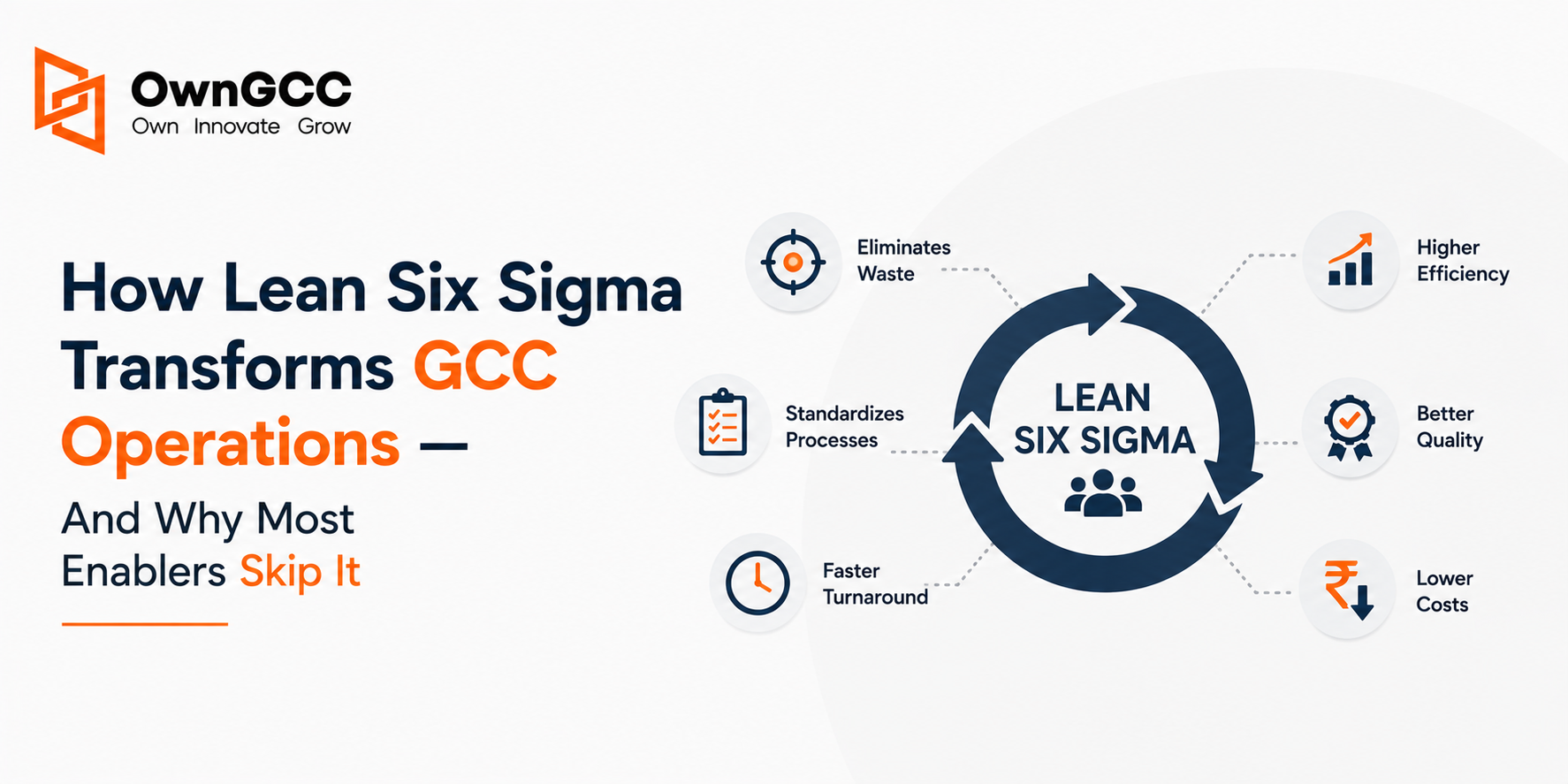
Stripped of certification jargon, Lean Six Sigma inside a GCC answers three questions: where is the work actually going, why do defects and delays happen, and how do we keep improvements from decaying. The toolkit maps directly onto GCC operations.
Value Stream Mapping lays out the entire flow of work — every step, handoff, decision point, and delay from intake to completion. In mortgage GCC operations, that means mapping a loan from application through processing, underwriting, closing, and post-close. What it exposes is uncomfortable: a large share of the activity in most workflows adds no value the borrower or the business would pay for. It’s checking, re-checking, routing, and waiting. You can’t fix what you’ve never mapped, and most GCCs are running on processes nobody has mapped in years.
DMAIC programs — Define, Measure, Analyze, Improve, Control — turn improvement from an opinion contest into a data exercise. Instead of the loudest team lead deciding which fix to try, the process data decides. Defect rates, touch counts, and cycle times get measured before and after, so improvement is a fact, not a feeling.
Root cause analysis breaks the band-aid habit. When rework spikes, the reflexive move in most operations is to add another quality checkpoint — which adds cost and cycle time while leaving the actual cause intact. Fishbone analysis and 5-Whys drill past the symptom to the driver: a document intake problem, an ambiguous guideline interpretation, a system field nobody populates correctly. Fix the cause once instead of inspecting the symptom forever.
Statistical Process Control is the part that separates transformation from a one-time cleanup. Control charts monitor the redesigned process continuously and flag drift before it becomes a quality event. This is what shifts an operation from reactive firefighting — leadership discovering a problem when the SLA report goes red — to proactive management, where the process tells you it’s wobbling weeks earlier.
Cycle time analysis separates the time work is being done from the time work is sitting still. In queue-based operations, idle time dominates — and it’s invisible in most reporting because dashboards track throughput, not wait states. Aligning capacity to the actual rhythm of demand routinely recovers speed no hiring spree could buy.
None of this is theoretical. These are the same methods that transformed manufacturing decades ago, applied to knowledge work: loan files instead of engine blocks, claims queues instead of assembly lines. The physics of flow are identical.
What you actually inherit at transfer
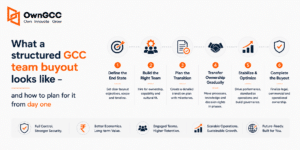
For companies building under a Build-Operate-Transfer model, this question stops being academic. At transfer, you don’t just take ownership of a team — you take ownership of a process. Whatever operating discipline exists on transfer day is what you’ll be running, funding, and defending to your board for years afterward.
If the enabler spent the build phase optimizing for seat count, you inherit a lift-and-shifted version of your old workflow, staffed offshore, with no measurement infrastructure and no improvement muscle. The moment the enabler exits, the operation starts drifting — because nothing was ever put in place to hold the gains.
If the build phase included genuine process re-engineering, you inherit something categorically different: mapped value streams, redesigned workflows with the waste engineered out, live KPI dashboards, control charts that catch drift, and a local team trained to run continuous improvement without external help. The Build-Operate-Transfer model only delivers its full promise when the “Operate” phase builds capability, not just capacity.
That’s the real test to put to any enabler: not “what will my cost per seat be,” but “what will my process look like on the day you leave, and how will I know it’s holding.”
The layer most enablers never build
This is the gap OwnGCC’s Lean Six Sigma transformation practice — Lean Edge — was built to close. It sits on top of the GCC build as a distinct operational transformation layer, led by Black Belt practitioners with deep mortgage and BFSI operations backgrounds, and it works nothing like advisory consulting.
The engagement is immersive by design. It starts with stakeholder discovery across every level of the operation, then in-depth interviews with the people who actually touch the work — processors, underwriters, closers, QA teams — because workflow reality never matches the documented process map. Practitioners shadow the frontline to observe what actually happens versus what the SOP claims happens. Only then is the future state designed: workflow redesign, automation candidates, staffing models, and a technology roadmap grounded in observed reality rather than assumptions.
Then comes the part traditional consultants avoid: implementation. The redesigned process is piloted on live work, refined against real-world feedback, and scaled with training and support — with the transformation team working alongside the client’s team rather than emailing them a report. Sustainment is engineered in from the start through KPI dashboards, control plans, and statistical monitoring, so the gains hold after the engagement ends.
The philosophy is simple and rare in this market: don’t advise — implement, operationalize, and measure outcomes with shared accountability. Every recommendation backed by process data. Senior practitioners on every engagement, not junior staff learning on the client’s dime.
The question to ask your enabler
The GCC market has trained buyers to compare enablers on speed, seat cost, and compliance coverage. Those things matter — but they’re table stakes, and every serious enabler can deliver them.
The differentiating question is the one almost no one asks: once my team is hired, who is going to make the work itself better — and what happens to their revenue when they do?
For most of the market, the honest answer is: nobody, and that’s by design. An enabler paid by the head has no reason to reduce the heads. An enabler who leaves after go-live has no stake in whether your process capability improves or decays.
A GCC that merely relocates work saves you money for a few years. A GCC with engineered processes, statistical controls, and an embedded improvement culture becomes a genuine operating asset — one that keeps getting better after the enabler is gone. Lean Six Sigma is how you get the second one. And the fact that almost no one else in this market offers it tells you everything about how the market is built.
Frequently Asked Questions
Isn’t Lean Six Sigma a manufacturing methodology? Does it really apply to GCC back-office work?
The methodology originated on factory floors, but its subject is flow — how work moves, where it waits, and why it fails. Loan files, insurance claims, and reconciliation queues behave exactly like physical work-in-progress: they sit in queues, get handed off, accumulate defects, and consume rework. Value stream mapping, DMAIC, and statistical process control apply to a mortgage processing floor as directly as they applied to an assembly line. Financial services operations have been among the biggest adopters of these methods for decades.
Why can’t we just run process improvement ourselves after the GCC is built?
You can — and eventually you should, which is why a proper transformation engagement trains your team to sustain and continue improving independently. The problem with starting after the build is that you’ve already institutionalized the lifted-and-shifted process. The offshore team has been trained on the wasteful workflow, staffing has been sized to it, and SLAs have been benchmarked against it. Re-engineering during the build phase means the team learns the optimized process from day one instead of unlearning a bad one later.
How is this different from the “process consulting” other firms offer?
Most process consulting in the GCC market ends at a recommendations report: a current-state assessment, a future-state slide, a roadmap, an invoice. Transformation is different in kind — it means piloting the redesigned workflow on live work, implementing alongside the operations team, and installing measurement infrastructure (KPI dashboards, control charts, control plans) that keeps the gains from decaying. The test is accountability: a consultant is accountable for a deliverable; a transformation partner is accountable for a measured outcome.
Does process optimization mean cutting the offshore team we just built?
Not typically. Removing waste from workflows frees capacity, and growing operations almost always redeploy that capacity — absorbing volume growth without proportional hiring, taking on functions that were previously kept onshore, or improving turn times and quality on existing work. The point isn’t fewer people; it’s more value per person. That’s also precisely why headcount-monetized enablers avoid this work: the value accrues to the client’s productivity, not the enabler’s invoice.
When in the GCC lifecycle should Lean Six Sigma work begin?
Ideally before workflows are handed to the offshore team — mapping and redesigning during transition means the GCC never runs the wasteful version at all. For GCCs already operating, the entry point is a diagnostic: value stream mapping and cycle time analysis of current operations, which typically surfaces enough non-value-add activity to define the first improvement program. Under a Build-Operate-Transfer model, transformation belongs squarely in the Operate phase, so that what transfers is an engineered operation rather than a relocated one.
What should we see from a transformation partner before signing?
Three things. First, domain fluency — practitioners who can talk about your specific workflows (underwriting touches, claims adjudication stages, exception queues), not generic frameworks. Second, an implementation commitment in the engagement structure itself: pilots on live work, shared KPIs, and sustainment deliverables like control plans and dashboards. Third, senior practitioners named to the engagement, not a partner who sells and a junior team that delivers.