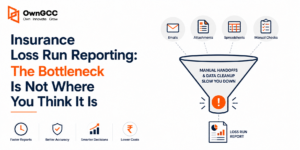
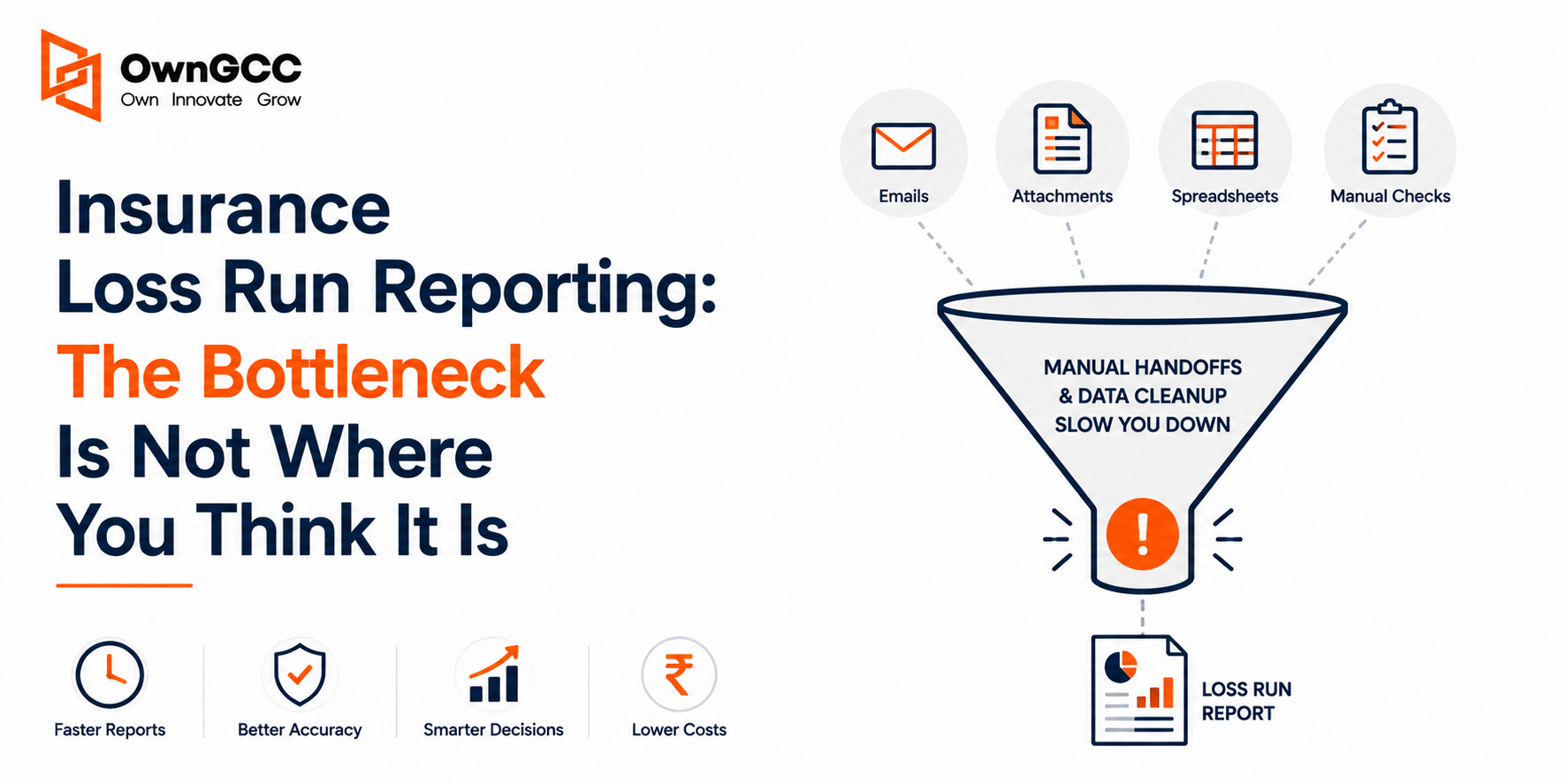
Ask a commercial lines operations leader what goes wrong with loss runs and you will almost always get the same answer: carriers are slow.
It’s a real problem. It is also the smallest part of the problem.
The chase is visible, so it gets attention. What doesn’t get attention is what happens after the report lands — the hours spent turning a stack of inconsistent PDFs from four carriers across five policy years into a single, comparable, currently-valued picture of an account’s claims history that an underwriter can actually price against.
That second stage is where submissions get delayed, where quoting errors originate, and where a quietly enormous amount of skilled labour disappears every renewal season. It is also almost never staffed as a function. It’s absorbed — by account managers between phone calls, by producers who shouldn’t be doing it, by whoever has capacity on a Thursday.
This article is about why insurance loss run reporting behaves this way, and what changes when you treat it as an owned operational capability rather than an administrative errand.
What a loss run actually is, and why the stakes are higher than the task implies
A loss run report is a carrier-issued summary of claims activity under a policy: claim counts, dates and descriptions of loss, amounts paid, and — depending on the state and the carrier — open reserves. Underwriters use it to assess frequency and severity, and it feeds directly into pricing, terms, and the decision to quote at all.
Florida’s statute is a useful reference point for what the document is legally understood to contain. Under Fla. Stat. § 626.9202, a loss run statement means a report with the policy number, coverage period, number of claims, paid losses, and the date of each loss — and explicitly excludes underlying claim file documentation such as investigation reports and evaluation statements. The same section provides that an insurer is not required to furnish loss reserve information, and may not charge for one annual statement.
Two things follow from that definition, and both are consistently underestimated.
First, it is a pricing input, not a formality. An account’s loss run is the closest thing commercial insurance has to a credit file. Get it late and you lose position in the underwriting queue. Get it wrong and you have mispriced the risk or misrepresented the exposure.
Second, it is not standardised. The statute describes what a report must contain. Nothing describes what it must look like. Every carrier issues its own format, its own field names, its own treatment of open versus closed claims, its own conventions for recoveries and subrogation. That gap between legally sufficient and operationally usable is the entire workload.
The seven failure points in insurance loss run reporting
1. Retrieval, with rules that vary by state
Most states impose a statutory deadline on carriers responding to a valid loss run request, and the common benchmark is around ten business days. But the specifics differ. Florida sets 15 calendar days from receipt of the insured’s written request. New York’s Insurance Law § 3426(g)(2) requires the insurer to mail or deliver loss information within a defined window on written request by the first named insured or their authorised agent or broker, covering closed claims, open claims and notices of occurrence.
Deadlines are the backstop, not the norm — and carriers miss them, particularly when a request is incomplete, spans multiple policy years, or arrives during peak renewal periods.
The operational implication is that your team needs to know, per state and per carrier, what constitutes a valid request, who is authorised to make it, what the clock is, and what the escalation path looks like when the clock runs out. That is institutional knowledge. It does not live in a checklist.
2. Authorisation friction that scales badly
Carriers increasingly require a letter of authorisation, an officer’s confirmation, or a portal-verified identity before releasing claims data. Businesses with multiple carriers should expect to submit separate authorisation for each one.
Now take a mid-sized account with three prior carriers, an entity name change from an acquisition, and a broker of record change two years ago. That’s not one request. It’s six, with three different authorisation formats, two of which will bounce back.
3. The currently-valued trap
Underwriters routinely require loss runs to be currently valued — meaning the valuation date on the report falls within a defined window of the application, commonly in the region of 30 to 90 days.
This creates a timing problem that pure speed does not solve. Request too early in the renewal cycle and the report goes stale before submission, forcing a re-request. Request too late and you miss the underwriting window. Managing valuation dates across a book of accounts with staggered renewal dates is a scheduling discipline, and most agencies run it out of somebody’s head.
4. Format chaos at the point of consolidation
This is the real labour sink.
Carrier A reports incurred; Carrier B reports paid and outstanding separately. One report classifies by coverage line, another by claim type. Dates appear as date of loss in one and date of report in another. Some arrive as clean data extracts; many arrive as scanned PDFs, occasionally as images of printouts.
To produce a five-year, multi-carrier loss summary an underwriter can compare against a rate, someone has to normalise all of it into one schema — mapping coverage lines, reconciling valuation dates, deduplicating claims that appear across policy terms, and deciding how to treat recoveries and subrogation consistently.
There is no shortcut here that survives contact with a real book. Extraction tooling helps with the clean 60%. The remaining 40% is judgment, and judgment requires someone who understands what the numbers mean.
5. Silent data-integrity errors
The dangerous errors in loss run reporting are not the ones that look wrong. They are:
- Claims duplicated where policy terms overlap
- A large loss that appears in one carrier’s report and not the prior carrier’s, because of how the occurrence was dated
- Reserve movement between the valuation date and submission that materially changes the incurred figure
- Coverage lines mapped to the wrong bucket, distorting frequency by line
- Missing years presented as clean years, rather than as gaps
Every one of these produces a number that looks plausible and prices badly. None of them is caught by a turnaround-time SLA.
6. The analysis nobody has time for
The output that actually helps a producer win the account is not the loss run. It’s the analysis: frequency and severity trends by line, loss development patterns, large-loss commentary with remediation context, claims-free periods worth arguing for credit, and — in workers’ compensation — verification of the experience modification factor against the underlying data.
That work is what turns a submission into an argument. In most agencies it is done well on the largest accounts and skipped entirely on everything else, purely for lack of hours.
7. Claims data is regulated data
Loss runs contain nonpublic personal information. Insurance entities are financial institutions under the Gramm-Leach-Bliley Act, and the FTC’s Safeguards Rule requires a written information security program with administrative, technical and physical safeguards protecting customer data.
Loss run files routinely move by email attachment between agency staff, carrier service desks and offshore support teams. That is a controls question, and it deserves a better answer than “we’re careful.”
Why this is getting harder, not easier
The volume side of this equation is moving in the wrong direction.
As commercial property conditions have loosened, broker behaviour has changed — when premiums soften, brokers shop more, and shop wider. One market analysis of the 2026 environment describes submission volume decoupling from headcount: more submissions moving through the same or smaller teams, with direct premiums written expected to grow while underwriting teams stay flat or contract.
At the same time, underwriting scrutiny has not relaxed. Industry commentary heading into the second half of 2026 makes the point that stabilising rates do not mean relaxed underwriting: carriers are validating submitted data against aerial imagery, satellite assessment and GIS, and discrepancies surfaced during underwriting are difficult to walk back. S&P Global’s 2026 outlook projects a median combined ratio of 92.1% for the sixteen largest US P&C insurers, slightly worse than 2025, with most expected to deteriorate year over year.
Read those together and the position is uncomfortable: more submissions, tighter underwriting, thinner tolerance for data discrepancies, and no additional people.
And the labour market offers no relief. Industry research points to a persistent talent shortage, with employers citing a lack of suitable applicants as their primary hiring constraint and very low interest in insurance careers among younger workers.
You cannot hire your way out of this domestically at a cost that works. That is the honest starting position.
The structural problem with how loss run work is usually outsourced
The default response is to hand loss run retrieval to a BPO vendor priced per request, per report, or per FTE.
Look at what that pricing rewards.
Per-request pricing rewards requests, not results. A vendor billing per loss run request has no financial interest in reducing the number of follow-ups, re-requests and stale-valuation redos. Your inefficiency is their volume.
The scope stops at retrieval. The retrieval piece is easy to specify and easy to contract, so that’s what gets contracted. Normalisation, integrity checking and analysis — the parts that carry actual risk and actual value — stay with your overloaded internal team. You’ve outsourced the visible work and kept the hard work.
Carrier and account knowledge never compounds for you. In a shared-resource model, the person who learned which carrier’s portal breaks on multi-year requests, and how your top three markets like their loss summaries formatted, is on a different client’s queue next quarter. You pay for that learning curve on repeat.
Blended rates hide the real economics. You cannot manage a cost you cannot see, and a rate card built on a concealed spread is designed so you can’t see it.
None of this requires bad faith from anyone. It’s just what the commercial structure points toward. You want fewer touches and better data. The model is paid for more touches.
What changes with an owned team
A Global Capability Center inverts the incentive. When the loss run team is your team — your entity, your payroll, your management line — every follow-up eliminated is your margin, and every piece of carrier-specific knowledge stays permanently in your business.
This matters more for loss run reporting than for most back-office functions, because the work is cumulative. A reviewer in month two is guessing at carrier quirks. A reviewer in year two knows which markets value quarterly, which portals require a fresh LOA annually, and how your largest carrier formats subrogation recoveries. That compounding only pays you if the reviewer is yours.
What agencies, MGAs and carriers typically run from a captive team:
- Loss run retrieval across carrier portals, service desks and prior markets, with per-state deadline and escalation tracking
- Authorisation and LOA preparation, including entity-history reconciliation for acquired or renamed insureds
- Valuation-date scheduling mapped to the renewal calendar, so reports are current at submission
- Normalisation of multi-carrier, multi-year reports into a single comparable loss summary
- Data-integrity review: deduplication, coverage-line mapping, gap identification, reserve-movement flags
- Loss analysis — frequency and severity by line, development trends, large-loss narrative support, experience mod verification
- Submission assembly, including ACORD forms, supplementals and carrier-specific packaging
- Renewal and endorsement processing, certificates, and policy checking in adjacent workflows
The obvious objection is whether an offshore team can carry judgment-intensive work of this kind. The honest answer is that it depends entirely on how the team is built. A generalist pool given a checklist will produce a tidy-looking summary with a duplicated claim in it. A dedicated team hired against insurance-specific criteria, trained on your carriers and your account base, working inside an ISO 27001:2022 information security framework with process discipline applied through structured Lean Six Sigma methods, performs the way a good domestic team performs — because it is one.
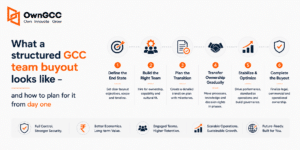
The Build-Operate-Transfer model exists to make that contractual rather than aspirational. OwnGCC builds the entity and the team, operates it to a defined standard, and transfers ownership on an agreed timeline at transparent, itemised pricing. A partner whose revenue depends on you continuing to pay per seat has no reason to ever hand the keys over. Ours is structured to.
Frequently asked questions
How long do carriers legally have to provide a loss run report? It varies by state. A common benchmark is around ten business days from a valid written request, but the specifics differ — Florida sets 15 calendar days under § 626.9202, and New York’s § 3426(g)(2) governs delivery of loss information to the first named insured or their authorised agent or broker. Carriers do not always meet the statutory window, particularly on multi-year or incomplete requests. The practical answer is to build your renewal calendar around realistic turnaround plus a buffer, not around the statutory floor.
Can an offshore team request loss runs directly from US carriers? Yes, within the authorisation structure the carrier requires — which typically means the request originates under your agency’s identity and authority, with your team executing it. What matters is that the people doing it understand carrier-specific requirements and can escalate correctly. This is precisely why a dedicated team outperforms a rotating pool: carrier handling is learned, not documented.
How do we protect claimant data if this work moves offshore? With the same controls a domestic operation requires, formalised rather than assumed. That means an ISO 27001:2022-certified environment, role-based access, restricted-egress workstations, audited access logs, and contractual alignment with GLBA and the FTC Safeguards Rule obligations that already apply to you. A captive entity gives you direct control of those controls instead of dependence on a shared vendor environment.
Isn’t automation going to solve loss run processing anyway? Extraction tooling handles a meaningful share of clean, machine-readable reports and should be used. It does not resolve the cases that cause the damage: scanned documents, inconsistent coverage-line taxonomies, overlapping policy terms, reserve movement between valuation dates, and gaps that need to be identified rather than inferred. Automation raises throughput on the easy portion and concentrates the hard portion. Somebody still has to own the hard portion.
Where should we start if we’ve never done this? Start with retrieval and normalisation, because output quality is objectively measurable — was the report obtained, was it currently valued at submission, did the consolidated summary reconcile. Once the team’s carrier knowledge is real, layer in analysis and submission assembly. Trying to start with judgment work before the team knows your book is the most common way these builds fail.
How is BOT different from just hiring an insurance BPO? Ownership and incentive. In BPO, the vendor owns the entity, the employment relationship and the accumulated process knowledge, and bills you for access indefinitely. In Build-Operate-Transfer, those are built with the explicit intent of becoming yours on a defined timeline at a defined cost. In month three the work looks similar. By year three, one model has left you with an operating asset and the other with a renewal negotiation.
The takeaway
Insurance loss run reporting gets treated as clerical work because the first step — asking a carrier for a document — looks clerical.
Everything after that step is not. It is data normalisation, integrity review and risk analysis performed against a deadline, on regulated data, feeding directly into how an account gets priced. Agencies that staff it accordingly submit earlier, submit cleaner, and argue better on behalf of their insureds.
Agencies that don’t will keep believing the problem is that carriers are slow.