The Build-Operate-Transfer model has a seductive pitch: let a vendor build your offshore team, run it for two or three years, and then hand it over to you. You get the upside of offshore operations without the Day 1 complexity of running them yourself.
It sounds like a responsible middle path. And for some firms, it genuinely is. But for many others — particularly those who discover the reality of what “transfer” actually means — Build-Operate-Transfer turns out to be a very expensive detour on the road to something a captive GCC would have delivered from the start.
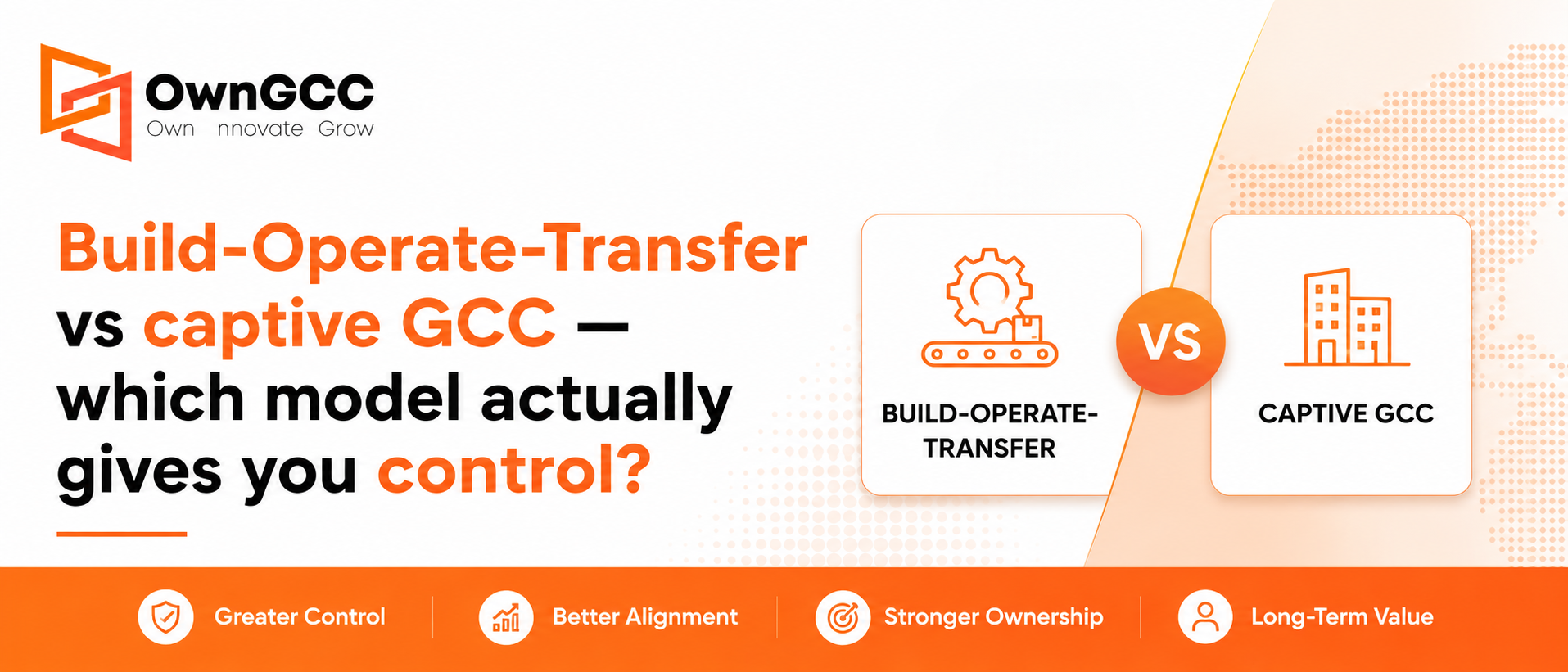
This article is a direct, honest comparison. We’ll examine both models across cost, control, IP ownership, talent, compliance, and long-term strategic value — so you can make an informed decision before committing to either path.
The core question: Both models ultimately promise the same destination — your own offshore team. The question is how much you pay to get there, what you actually own when you arrive, and what you sacrifice during the journey.
What Is the Build-Operate-Transfer Model?
Build-Operate-Transfer (BOT) is an offshore engagement model where a third-party vendor establishes and runs an offshore operation on your behalf, with a contractual commitment to transfer ownership back to you at a defined future point — typically after two to five years.
The model unfolds in three phases:
Phase 1 — Build The vendor sets up the legal entity, secures office space, recruits the team, and implements initial workflows — typically over a 3–6 month period. You provide requirements; they provide execution.
Phase 2 — Operate The vendor manages the offshore team on your behalf — HR, payroll, performance management, IT infrastructure, and day-to-day operations. You interact with outputs, not the team directly. This phase typically runs 18–36 months.
Phase 3 — Transfer At contract end, the operation is handed over to your firm. The legal entity, team employment contracts, infrastructure, and workflows transfer to your ownership. In theory. In practice, this is where the model most frequently disappoints.
BOT is widely used in banking, insurance, IT services, and mortgage operations. The model has genuine merits — but its limitations are structural, not incidental.
What Is a Captive GCC?
A Captive Global Capability Center (GCC) is a wholly-owned offshore subsidiary that your firm establishes, staffs, and operates directly — with no vendor intermediary in the ownership chain.
Unlike Build-Operate-Transfer, a captive GCC gives you legal, operational, and cultural control from Day 1. The entity is yours. The employees are yours. The data governance framework is yours. The institutional knowledge your team builds accrues entirely to your firm.
India has emerged as the dominant destination for captive GCCs, now hosting over 1,700 GCC operations from global companies across financial services, technology, healthcare, and manufacturing. The country offers a deep talent pipeline, competitive cost structures — typically 60–70% below equivalent US or UK roles — a mature legal environment for foreign subsidiaries, and a well-established GCC support ecosystem.
A captive GCC isn’t just cheaper than BOT over time. It gives you something BOT structurally cannot: institutional ownership of every capability your offshore team develops, from Day 1.
The Control Problem with Build-Operate-Transfer
Here is the fundamental issue that most BOT vendor pitch decks don’t address honestly: during the Operate phase — which typically lasts two to three years — you don’t control your offshore team. The vendor does.
This has real consequences across four critical dimensions.
Talent decisions aren’t yours
In the BOT model, the vendor hires, manages, promotes, and exits employees according to their HR policies and commercial incentives — not yours. The team may nominally work on your account, but their employment relationship, culture, and career trajectory are shaped by the vendor. When the transfer happens, the team you receive is not the same as a team you would have built yourself.
Process IP accumulates elsewhere
Every workflow refinement, automation, process improvement, and operational playbook developed during the Operate phase lives inside the vendor’s systems and governance framework. While contract language around IP transfer is improving, the practical reality is that institutional knowledge doesn’t transfer cleanly — it transfers selectively, incompletely, and sometimes not at all.
Data governance is the vendor’s domain
During the Operate phase, your sensitive business data — and in sectors like financial services and mortgage, sensitive customer data — sits within the vendor’s infrastructure. This creates meaningful compliance exposure, particularly as data privacy regulations tighten globally.
The transfer rarely goes smoothly
The transfer trigger is often the most contentious moment in a BOT relationship. Disputes arise over asset valuation, employee retention, infrastructure handover, and intellectual property. Even in well-structured contracts, the transition period creates a window of operational risk and business disruption.
Pattern to watch: A significant number of BOT engagements never reach a clean transfer. Some vendors use the Operate phase to make themselves structurally indispensable — creating technology dependencies, retention packages, and process complexity that make transfer costly enough that clients simply extend the vendor relationship instead.
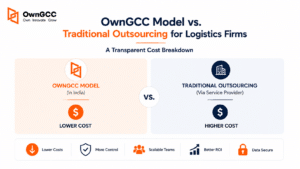
Build-Operate-Transfer vs Captive GCC: Full Comparison
| Dimension | Build-Operate-Transfer (BOT) | Captive GCC (India) |
|---|---|---|
| Day 1 Ownership | Vendor-owned during Operate phase | 100% yours from incorporation |
| Setup Complexity | Low — vendor manages | Moderate — requires expert partner |
| IP Retention | Partial / contested at transfer | Full — accrues to you from Day 1 |
| Talent Control | Vendor HR policies govern | Your standards, culture, performance |
| Data Security | Shared vendor infrastructure | Private, dedicated environment |
| Total 3-Year Cost | Higher (vendor margin + transfer costs) | Lower — no vendor margin in cost base |
| Transfer Risk | High — operational disruption window | No transfer event needed |
| Compliance Control | Vendor SLAs and policies | Your internal controls and audits |
| Process Innovation | Vendor-constrained during Operate | Fully yours, compounds over time |
| Cultural Alignment | Vendor culture dominant for 2–3 years | Built to your DNA from the start |
The Hidden Costs of Build-Operate-Transfer
BOT pricing appears competitive in vendor proposals. The vendor absorbs setup costs and spreads them across the contract term. What proposals rarely show clearly is the full cost picture over three to five years.
1. Vendor margin on every FTE
During the Operate phase, the vendor bills you a markup on every employee — typically 25–40% above the actual cost of that person. Over a team of 30 FTEs operating for 36 months, this margin alone can represent $800,000–$1,500,000 in non-recoverable cost that you would never pay in a captive structure.
2. Transfer costs and legal fees
The transfer event is not free. Asset valuation, legal structuring, employment contract novation, IT infrastructure migration, and transition management all carry costs — often $150,000–$400,000 depending on team size and contract complexity. These costs appear nowhere in the original BOT proposal.
3. Talent attrition at transfer
Employees hired and managed by the vendor often leave when the transfer happens. Their relationship is with the vendor, not with you. Attrition rates of 20–40% in the six months around transfer are common — triggering rehiring, retraining, and productivity loss that is genuinely difficult to quantify in advance.
4. The opportunity cost of lost years
This is the cost most business cases ignore entirely. Every month spent in the Operate phase under a vendor’s control is a month where your institutional knowledge, process IP, and cultural alignment could have been accruing in a captive structure. For fast-moving firms, this opportunity cost is often the largest single number in the BOT equation.
Cost perspective: When firms compare BOT against captive GCC on a true 5-year total cost basis — including vendor margins, transfer costs, and post-transfer attrition — the captive model is typically 35–50% less expensive in total, despite higher Year 1 setup investment.
When Build-Operate-Transfer Still Makes Sense
In the interest of a genuinely useful comparison, here are the scenarios where BOT remains a legitimate strategic choice:
- No internal offshore management capability: If your firm has no experience running offshore operations and no plans to build that capability, BOT provides a structured learning period before you assume full ownership.
- Short-term need with uncertain long-term commitment: If there is real strategic uncertainty about whether you’ll maintain offshore operations beyond three years, BOT limits your downside risk.
- Specific geographies with high regulatory complexity: In markets where entity formation and local compliance are genuinely complex, a vendor with established local infrastructure can de-risk the initial setup phase.
- Smaller teams where captive economics don’t apply: For teams under 10–15 FTEs, the fixed overhead of a captive entity may not be justified. BOT can be a sensible entry point at low scale.
The critical caveat: even in these cases, the BOT contract must be structured with extraordinary care — particularly around IP ownership, transfer valuation methodology, employee notice periods, and vendor exit obligations. Many of the most expensive BOT experiences stem from poor contract structure rather than poor intent.
Decision Framework: BOT or Captive GCC?
Choose Build-Operate-Transfer if:
- Team size is under 15 FTEs
- You have no prior offshore management experience
- Long-term commitment to offshore operations is genuinely uncertain
- You need an extremely fast go-live (under 8 weeks)
- Your legal team can negotiate strong IP and transfer protections upfront
Choose a Captive GCC if:
- Team size is 15+ FTEs or growing toward it
- Data security and compliance are board-level concerns
- Long-term offshore capability is a strategic priority
- Process IP and institutional knowledge retention matter
- You want the cost advantages of offshore without vendor margin in your cost base
Frequently Asked Questions
Is Build-Operate-Transfer cheaper than a captive GCC?
In Year 1, BOT typically has lower visible costs because the vendor absorbs setup expenses. However, on a true 3–5 year total cost basis — including vendor margin across the Operate phase, transfer costs, and post-transfer attrition — captive GCC is almost always 35–50% less expensive. The BOT savings are front-loaded and the costs are back-loaded, which makes vendor proposals look more attractive than the economic reality warrants.
What happens if the BOT vendor gets acquired or goes bankrupt before transfer?
This is an underappreciated risk. If your BOT vendor is acquired, your transfer terms may be renegotiated by the acquirer. In a bankruptcy scenario, the offshore entity — including your team’s employment contracts and your data — may become subject to insolvency proceedings. Robust contractual protections such as escrow arrangements, step-in rights, and data repatriation clauses are essential but rarely negotiated aggressively enough. A captive GCC eliminates this single-point-of-failure risk entirely.
How long does it take to set up a captive GCC vs a BOT engagement?
A BOT vendor can typically have a first team operating in 6–10 weeks. A captive GCC with an experienced setup partner like ownGCC typically reaches first hire in 10–14 weeks and full ramp in 9–12 months. The gap is smaller than most people expect — and the captive setup timeline has shortened significantly as India’s GCC infrastructure has matured. For firms not under extreme time pressure, a 4–6 week speed advantage does not justify three years of reduced control.
What does “transfer” actually involve in a BOT model?
A BOT transfer involves legal entity restructuring, employment contract novation, IT infrastructure handover, process documentation transfer, and data migration from vendor infrastructure to your own. Each step carries cost, timeline risk, and operational disruption. Well-structured transfers typically take 3–6 months. Poorly structured ones take longer and cost significantly more than projected.
Can I negotiate ownership rights during the BOT Operate phase?
Some BOT contracts allow partial control escalation during the Operate phase — for example, giving you authority over hiring decisions from Month 12 onward. This is worth negotiating, but it is not a substitute for ownership. If you need meaningful control during the Operate phase, a managed captive structure — where a partner sets up your GCC but you own it from Day 1 — may better meet your needs.
Does ownGCC offer a BOT model?
ownGCC specializes in captive GCC establishment — where you own the entity from day one. We do not offer traditional BOT because we believe the captive model delivers superior long-term value for most firms. We do offer a managed captive model for clients who want a supported ramp-up: we handle entity formation, recruitment, and operational setup while you retain full ownership throughout — delivering the speed advantages of BOT without the ownership gap.
Ready to Build Your GCC and Own It From Day One?
ownGCC helps firms establish captive Global Capability Centers in India — without the vendor dependency, transfer risk, or IP ambiguity of the BOT model. If your firm is evaluating offshore options for 2026, let’s run the numbers together.
Get a free GCC assessment → Contact us
About ownGCC: ownGCC helps global firms across financial services, mortgage, technology, and operations build and scale captive Global Capability Centers in India. From legal entity formation and talent acquisition to workflow integration and compliance alignment, we deliver end-to-end GCC setup and management — so you own the capability without the complexity.