In a world where a single data breach can cost millions and a compliance failure can end a fintech‘s operating license, the question isn’t just “how do we scale?” — it’s “how do we scale without losing control?”
The $500 Billion Dilemma Every Fintech Faces
Fintech is one of the fastest-growing industries on the planet. But beneath the growth metrics and funding rounds lies a persistent tension that every scaling fintech knows intimately: you need talent to grow, but growth cannot come at the cost of your intellectual property or your regulatory standing.
For years, outsourcing seemed like the obvious answer. Cheap. Fast. Flexible. Hand your requirements to a vendor, get a product team back. Simple, right?
Not anymore.
As fintechs mature — and as regulators worldwide tighten their grip — a smarter model has emerged: the Global Capability Center (GCC). And forward-thinking fintech companies are choosing it specifically because it solves the two problems outsourcing never could: IP ownership and compliance control.
What Is a Global Capability Center (GCC) — and Why Does It Matter for Fintech?
A Global Capability Center is a wholly owned subsidiary or captive unit established by a company in a strategic offshore location. Unlike an outsourcing vendor, a GCC is yours. Your brand. Your culture. Your processes. Your people.
For fintech companies specifically, this distinction is not cosmetic — it’s existential.
When you build payments infrastructure, fraud detection algorithms, credit scoring models, or open banking APIs, the code is the company. Handing that work to a third-party vendor isn’t just a delivery risk — it’s a strategic liability. A GCC eliminates that liability entirely.
OwnGCC helps fintech companies establish fully owned, compliance-ready Global Capability Centers — so you can scale your tech team without scaling your risk.
The IP Problem With Outsourcing That Fintech Leaders Don’t Talk About Enough
Let’s be direct: most outsourcing contracts do not give you clean IP ownership.
Here’s why this matters so much in fintech:
1. Proprietary Algorithms Are Your Competitive Moat Your fraud detection model. Your risk scoring engine. Your AI-powered underwriting logic. These aren’t just features — they’re the core of your valuation. When a vendor’s developers build these systems, questions arise: Who owns the training data pipelines? Who retains the model weights? Who has knowledge embedded in their team that walks out the door when the contract ends?
2. Code Repositories Have Memory Even when contracts stipulate IP transfer, code doesn’t live in a vacuum. Shared libraries, development environments, and institutional knowledge remain with the vendor. In fintech, where your product is largely software, this is a critical vulnerability.
3. Vendor Teams Work Across Clients A talented outsourced developer on your payments module today may be on a competitor’s project next quarter. Industry-specific patterns, architectural decisions, and product instincts don’t disappear when they switch assignments. With a GCC, your team works exclusively for you — full stop.
4. IP Disputes Are Expensive and Distracting Litigation around software IP is notoriously complex. The last thing a growing fintech needs is a legal battle over who owns what while you’re trying to close a Series B or secure a banking license.
A GCC solves all of this at the root. Everything built in your GCC belongs to you — unambiguously.
The Compliance Argument: Why “Managed Compliance” Isn’t Compliance
Fintech operates in arguably the most regulated industry sector in the world. PCI DSS. GDPR. RBI guidelines. FCA rules. MAS regulations. DPDP Act. The list grows every year — and so do the penalties for non-compliance.
Outsourcing vendors promise “compliance-ready” environments. But here’s what that actually means in practice:
What Vendors Call Compliance vs. What Regulators Actually Require
| What the Vendor Promises | What Regulators Expect |
|---|---|
| ISO 27001 certification | Evidence of your internal controls |
| GDPR-compliant data handling | Data residency proof within your systems |
| SOC 2 Type II audit | Audit trail access under your governance |
| “Regulatory expertise” | Accountability that sits with your licensed entity |
Regulators don’t license your vendor. They license you.
When the RBI, FCA, or SEC comes knocking, they want to audit your systems, your controls, and your processes. If those sit inside a third-party vendor’s infrastructure, you’re already in a difficult position — and potentially in violation of outsourcing risk guidelines that many central banks now impose.
The Regulatory Risk Cascade
Consider a real scenario: A fintech company outsources its KYC verification workflow to a vendor. The vendor is breached. Customer data is exposed. The regulator’s investigation finds that the fintech had no direct visibility into the vendor’s security controls, no contractual audit rights that were actually exercised, and no incident response plan that covered third-party environments.
The fine isn’t just for the breach. It’s for the governance failure.
A GCC eliminates this cascade entirely because your compliance infrastructure, your security controls, and your audit trail are yours — embedded within your own entity, under your own management, auditable on demand.
5 Reasons Fintech Companies Are Choosing GCCs Over Outsourcing in 2026
1. Full Ownership of Your Tech Stack and Team
A GCC isn’t a vendor relationship — it’s an extension of your core business. Your engineers hold your company email. They attend your all-hands. They’re aligned to your product roadmap, not a vendor’s utilization target. The result is a team that thinks like owners, because in every meaningful sense, they are part of the ownership structure.
2. Regulatory Accountability Without the Middleman
GCC employees operate under your policies, your security protocols, and your compliance frameworks. When an auditor asks for evidence of your data handling practices, you produce it from your own systems — not a vendor’s SLA document. This single shift transforms your audit readiness from reactive to proactive.
3. Cost Economics That Actually Work at Scale
The “outsourcing is cheaper” narrative collapses at scale. Hidden costs accumulate fast: vendor margins, account management overhead, transition costs between contracts, quality degradation as your best outsourced resources rotate to other clients. A GCC involves setup investment upfront — but within 18–24 months, the per-headcount cost is typically 30–40% lower than comparable outsourced arrangements, with dramatically better quality and retention.
4. Deep Domain Expertise Stays In-House
Fintech is complex. Payments rails, lending regulations, treasury operations, embedded finance — these domains take years to master. In an outsourced model, that expertise walks out when the contract ends or the team rotates. In a GCC, institutional knowledge compounds. Your team gets smarter about your product every quarter. That compounding expertise is itself a competitive asset.
5. Investor and Partner Confidence
Increasingly, institutional investors, banking partners, and enterprise clients conduct deep due diligence on technology governance. A GCC signals that you take IP ownership seriously, that your compliance posture is defensible, and that your technology capability is a genuine core competency — not a managed service. This matters at every stage from Series B to IPO.
India: The Preferred GCC Destination for Fintech Companies
Among global GCC destinations, India stands apart — and the fintech sector has taken notice.
India is home to the world’s largest pool of financial technology talent, with expertise spanning full-stack engineering, data science, ML/AI, cloud infrastructure, and regulatory compliance. The country has produced engineers who have built core systems for global banks, payment networks, and fintech unicorns.
Beyond talent, India offers:
- Regulatory familiarity: Indian engineers understand frameworks like PCI DSS, ISO 27001, and even international standards like GDPR and FCA requirements — because they’ve worked within them for global clients for decades.
- Time zone advantage: For US and European fintechs, India’s offset enables near-24-hour development cycles without the cultural friction of pure near-shore alternatives.
- Established GCC ecosystem: Over 1,600 GCCs already operate in India. The support infrastructure — legal, HR, real estate, compliance — is mature and proven.
- Government support: Multiple states actively court GCC investments with streamlined incorporation, SEZ benefits, and talent development partnerships.
OwnGCC specializes in helping fintech companies set up and operationalize their India GCC — from entity incorporation and regulatory compliance to talent acquisition and day-one readiness.
Common Objections — Answered
“Setting up a GCC is too slow. We need to move fast.”
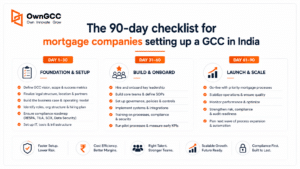
With the right partner, a GCC can be operationally ready within 90–120 days. OwnGCC’s structured setup methodology covers entity formation, compliance registration, office infrastructure, and initial hiring in parallel tracks — dramatically compressing the timeline compared to DIY approaches.
“We don’t know how to manage a team in another country.”
You don’t have to figure it out from scratch. OwnGCC’s embedded management support helps you establish the right governance model, HR frameworks, and communication cadences from day one — so your GCC feels like a natural extension of your headquarters, not a distant satellite.
“Outsourcing gives us flexibility to scale up and down.”
A well-structured GCC is more flexible than most companies realize. The key is right-sizing your initial build and establishing a scalable hiring pipeline. OwnGCC builds this pipeline as part of the setup — so you can grow your GCC headcount in weeks, not months.
“The upfront cost is too high.”
Consider the total cost of outsourcing over three years — vendor margins, attrition, quality costs, and the hidden cost of IP exposure. Then compare it to a GCC ROI model. In almost every fintech scenario we’ve modeled, the GCC breaks even between months 18 and 24, and delivers superior economics every year thereafter.
The GCC Advantage: A Side-by-Side Comparison
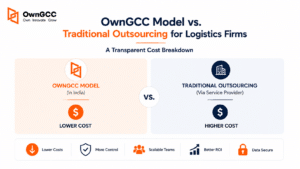
| Dimension | Outsourcing | GCC (via OwnGCC) |
|---|---|---|
| IP Ownership | Contractual (disputed risk) | 100% owned |
| Compliance Control | Vendor-dependent | Direct, auditable |
| Data Residency | Shared environment | Your infrastructure |
| Team Loyalty | Vendor-aligned | Company-aligned |
| Cost at Scale | Increasing margins | Decreasing per-head cost |
| Regulatory Audit | Third-party documentation | First-party evidence |
| Institutional Knowledge | Rotates with team | Compounds over time |
| Cultural Alignment | Variable | Fully embedded |
How OwnGCC Makes It Happen
OwnGCC is purpose-built for companies that want the strategic advantages of a GCC without the complexity of setting one up from scratch.
Our end-to-end model covers:
- Entity Setup & Legal Compliance — Company incorporation, tax registration, labor law compliance, and data protection frameworks specific to your target jurisdiction.
- Office & Infrastructure — From managed workspaces to dedicated offices, we handle real estate, IT infrastructure, and security controls aligned with fintech standards.
- Talent Acquisition — Deep fintech talent networks across engineering, data, compliance, and product. We hire to your standards, not a generic profile.
- HR & Payroll Operations — Full employer-of-record or entity-owned payroll, benefits administration, and HR policy frameworks.
- Governance & Compliance Readiness — Ongoing regulatory compliance support so your GCC is audit-ready from day one and stays that way.
Whether you’re a Series B fintech looking to build your first offshore engineering team, or a scale-up preparing for regulatory expansion, OwnGCC provides the infrastructure, expertise, and ongoing support to make your GCC a genuine competitive advantage.
The Bottom Line
Outsourcing got fintech companies to where they are today. But it cannot take them where they need to go tomorrow.
As regulations tighten, as IP becomes the primary currency of fintech valuation, and as institutional investors demand governance maturity — the question is no longer whether to build a GCC. It’s how quickly you can do it.
The companies that build their GCCs now will enter the next phase of fintech growth with cleaner IP, stronger compliance postures, and talent infrastructure that compounds in value every quarter.
The companies that continue outsourcing will spend the next five years explaining to regulators, investors, and acquirers why their most critical assets sit inside someone else’s organization.
Your technology is your moat. Own it.
Ready to explore what a GCC could mean for your fintech company? Talk to OwnGCC — and let’s build something that’s truly yours.
About OwnGCC
OwnGCC helps fintech and technology companies establish fully owned Global Capability Centers in India. From entity setup to day-one operations, we manage the complexity so you can focus on what matters: building great products with a team that belongs entirely to you.