Introduction: The Vendor Contract Renews. The Problem Doesn’t Go Away.
Every year, health plan CFOs and COOs face the same conversation. The RCM vendor contract is up for renewal. The vendor presents a performance deck. Denial rates, clean claim rates, days in accounts receivable, average handling time. The numbers are defensible. The relationship is comfortable. The renewal gets signed.
And twelve months later, the same conversation happens again.
Meanwhile, the underlying cost structure of the engagement hasn’t improved. The vendor’s margin hasn’t compressed. The institutional knowledge your team has built over years of working the claims cycle still lives in the vendor’s systems, in their people, and on their dashboards — not yours. And the next contract negotiation will look exactly like the last one, because you have no real leverage and no real alternative prepared.
This is the quiet dysfunction at the heart of most payer RCM outsourcing relationships. Not catastrophic failure — just chronic underperformance relative to what a well-run captive operation would deliver, compounded year after year.
US health plans that have started building captive Revenue Cycle Management teams in India through a Build-Operate-Transfer model are discovering something that the vendor community would prefer they didn’t: the gap between outsourced RCM cost and captive RCM cost, at equivalent quality, is larger than almost any CFO assumed going in. And the gap in capability — in what a team working inside your org chart can do versus what a vendor team working to an SLA can do — is even larger than the cost gap.
This article is for CFOs and COOs at US health plans who are running RCM through outsourcing vendors and have started asking whether there is a better model. There is. Here’s what it looks like, what it costs, and what it takes to get there.
What RCM Looks Like Inside a Health Plan — and Where the Gaps Live
Revenue cycle management for a payer is not a single function. It is a chain of interdependent processes that run from eligibility verification through claims intake, adjudication support, medical coding review, denial management, appeals processing, coordination of benefits, and provider dispute resolution.
Each link in that chain involves judgment — not just execution. A claims examiner who understands the clinical logic behind a denial reason code performs differently than one who is processing to a checklist. A denial management analyst who can connect a pattern of denials to a systemic coding issue upstream is qualitatively different from one who works each denial in isolation.
The problem with traditional RCM outsourcing is structural. Vendors are incentivized to provide execution at scale. They staff to SLAs. They train to process. They measure what is measurable and report what shows well. What they are not incentivized to do — and what the SLA framework actively works against — is the kind of continuous process improvement, institutional knowledge building, and root cause analysis that drives meaningful, compounding improvements in RCM performance.
Consider where the real cost of poor RCM lives in a health plan:
Denial rates that are reported as acceptable but mask preventable denials that the vendor’s team doesn’t have authority or context to address at the source. First-pass resolution rates that meet the contractual benchmark but leave a residual volume of complex claims that your onshore team has to absorb. Appeals that are worked transactionally rather than strategically — each case treated independently rather than as part of a pattern that could be corrected upstream. Provider disputes that extend because the offshore team lacks the relationship context and escalation authority to resolve them efficiently.
None of these gaps appear cleanly on the vendor’s dashboard. They appear in your operating costs, in your provider satisfaction scores, in your medical loss ratio, and in the time your US-based clinical and operational staff spend compensating for what the offshore team couldn’t resolve.
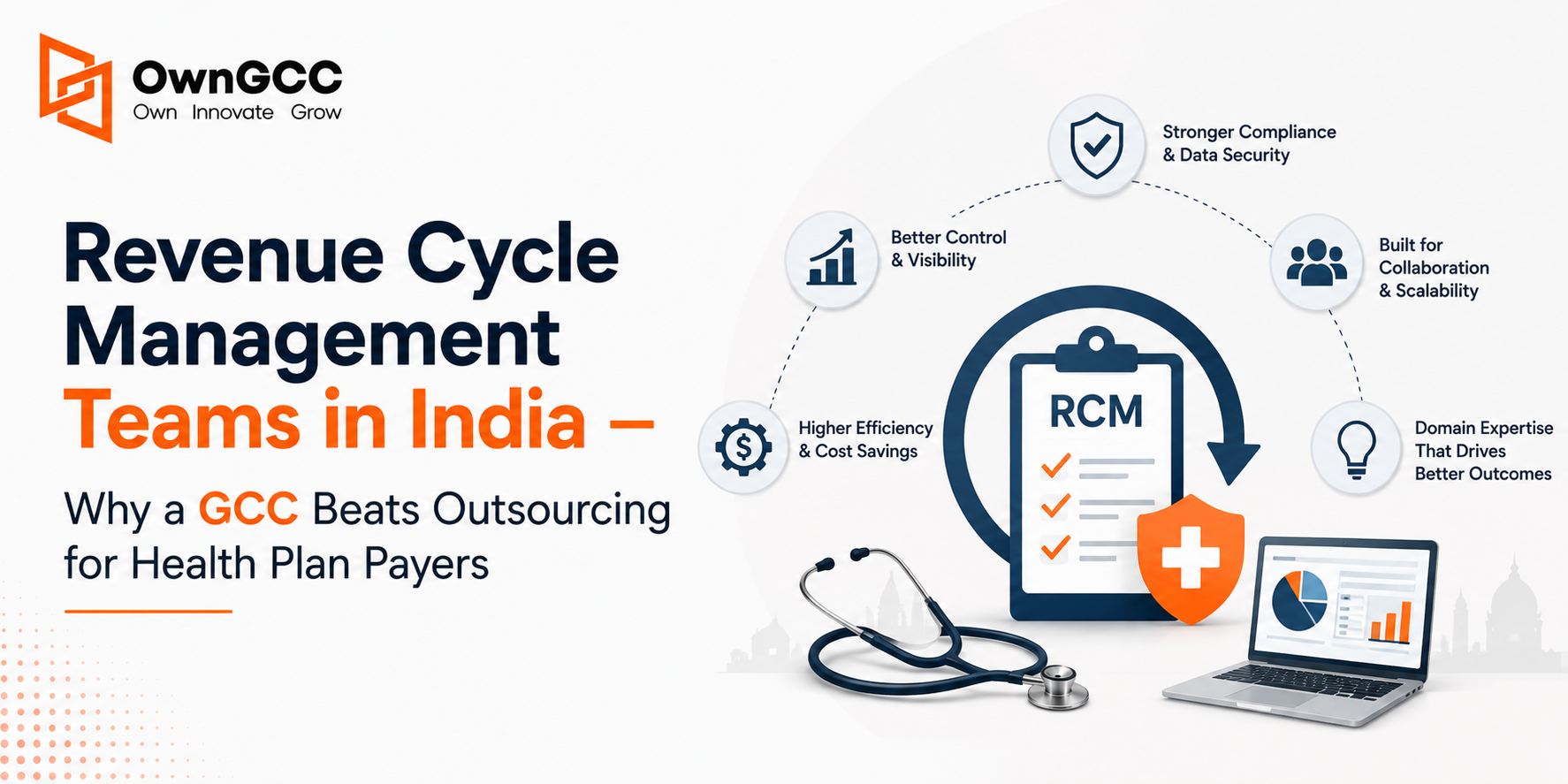
A captive GCC team, working inside your operational structure with visibility into the full revenue cycle and accountability to your outcomes — not to a vendor’s SLA — performs differently in every one of these areas. Not because the talent is different. The talent pool in India is the same. Because the structure is different.
The Cost Architecture: What Payer RCM Actually Costs Through a Vendor
Let’s be specific about the numbers, because this is where the case for a captive model becomes unavoidable for most CFOs.
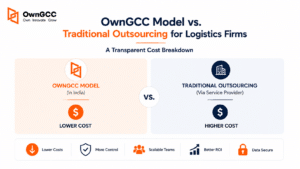
A mid-sized health plan running a 60-person RCM team through an outsourcing vendor — covering claims processing, denial management, coding review, and appeals — is typically paying somewhere between $32 and $48 per hour per resource, depending on the functions, the SLA tiers, and the contract vintage.
On a 60-person team running 2,000 annual hours, that range translates to $3.8 million to $5.8 million per year in vendor billing.
The vendor’s fully loaded cost on that team in India — salaries, benefits, facilities, management overhead, technology — sits between $900,000 and $1.3 million for equivalent headcount.
The vendor margin on a mid-sized payer RCM engagement routinely runs between 55% and 70% of billed revenue. That is not a number vendors share in QBRs.
Now model the captive alternative through a transparent BOT structure. Year 1, with full setup costs including entity formation, HR infrastructure, technology environment, leadership hiring, and initial ramp: $2.1 million to $2.6 million for a team of that size. Year 2, stabilized and operating: $1.5 million to $1.8 million. Year 3, under your full ownership post-transfer: $1.2 million to $1.5 million annually.
The five-year comparison is not ambiguous. Against a vendor baseline of $4.5 million annually (midpoint of the range), a captive model at $1.4 million annually from Year 3 onward represents $15 million or more in savings over a five-year period — net of all build and transition costs.
For a CFO evaluating this, the question is not whether the captive model is cheaper. It clearly is. The question is whether the transition is manageable and whether the operational quality can be maintained through the build period. Both of those questions have well-established answers when the build is executed through a proven BOT methodology.
Claims Accuracy: Why Ownership Changes Everything
The single most consequential operational difference between outsourced RCM and captive GCC RCM is in claims accuracy — and the mechanism behind that difference is ownership.
When your RCM team works for a vendor, their performance is measured against the metrics in the contract. Clean claim rate, denial rate, turnaround time, first-pass resolution. These metrics are real and they matter. But they are also the ceiling of what the vendor is accountable for. Beyond the SLA, the vendor has no stake in your claims outcomes.
When your RCM team works in your GCC — reporting to your operational leadership, contributing to your performance reviews, trained on your payer-specific guidelines and your provider contract details — the alignment of incentives changes entirely.
A captive team can be trained to your specific adjudication logic, not a generic training module. They can be given access to your clinical editing rules, your fee schedule structures, your coordination of benefits hierarchies, and your provider-specific contract terms. They can participate in root cause analysis sessions with your US clinical staff. They can flag systemic issues upstream — coding patterns that generate preventable denials, eligibility data quality problems that cause downstream claims failures — because they have the organizational standing to flag them and the context to identify them.
In practice, health plans that transition from outsourced to captive RCM models consistently report measurable improvements in claims accuracy within 12 to 18 months of stabilization. The mechanism is not mysterious. When a team owns the outcome and has the operational context to see the full cycle, they perform at a level that a vendor team working to a transactional SLA structurally cannot match.
This matters not just for operational efficiency but for the medical loss ratio. Preventable denials that get paid after appeal, claims that require multiple touch cycles, coordination of benefits errors that result in duplicate payment — these are MLR events. A 1% improvement in first-pass resolution rate on a $2 billion claims operation is a $20 million swing. The financial case for ownership runs directly through the P&L.
Denial Management: The Function Where Captive Teams Outperform Most
Of all the RCM functions that health plans run offshore, denial management is the one where the structural limitations of outsourcing are most pronounced — and where captive teams deliver the most differentiated performance.
Effective denial management is not transactional. It requires pattern recognition across a claims population, clinical knowledge to evaluate the basis for denial against the facts of a case, contractual knowledge to assess provider appeals on their merits, and operational authority to escalate systemic issues to the teams that can fix them upstream.
Vendor denial management teams have none of the last element and limited access to the first three. They work the denial queue according to a workflow script. They apply the remediation steps their training specified. They meet their resolution rate target within the contractual window. What they do not do — because they have no visibility into what happens outside their queue — is connect denial patterns to root causes that could be corrected in eligibility intake, in provider education, or in clinical editing logic.
The result is a denial management function that is perpetually reactive. Each denial is worked; many are resolved; but the volume of preventable denials stays flat because nobody with authority and context is attacking the problem at its source.
A captive GCC denial management team, integrated into your operational structure, changes this dynamic. They can participate in utilization management coordination to reduce authorization-related denials. They can communicate with your provider relations teams about billing pattern issues generating systematic rejections. They can contribute to clinical editing rule refinement based on patterns they observe. They can work with your IT team on claims intake data quality improvements that reduce front-end rejections.
This is not theoretical. It is what happens when the people doing the work have organizational standing to speak up — and when they are accountable to outcomes that go beyond the SLA.
HIPAA, PHI, and Data Governance: Why Captive Is Structurally Safer
For health plan COOs evaluating RCM offshore operations, the data governance question is not optional — it is a threshold requirement. RCM operations involve Protected Health Information at every stage. Claims data, member eligibility records, clinical documentation, provider billing data, and coordination of benefits information all carry HIPAA protections that extend to any offshore entity processing them on behalf of a covered entity.
The traditional approach is to structure the offshore vendor as a Business Associate, execute a Business Associate Agreement, and rely on the vendor’s attestation of HIPAA compliance. In the majority of payer-vendor relationships, this is where the formal data governance ends. The BAA is signed. The audit rights clause exists. The audit itself rarely happens.
This creates a compliance posture that is technically defensible and operationally fragile. The vendor’s compliance attestation covers their general security environment. It does not give you visibility into how your PHI is actually accessed, stored, and handled by the specific team working your accounts. It does not tell you whether your member data is co-mingled with another payer’s data in a shared environment. It does not tell you what the vendor’s incident response timeline would be if your PHI were involved in a breach.
The Office for Civil Rights has made clear in its enforcement pattern that covered entities bear responsibility for the PHI handling practices of their Business Associates. “We had a BAA” is not a defense when OCR examines whether the covered entity exercised appropriate oversight.
A captive GCC changes the data governance architecture fundamentally. Your India team operates on your infrastructure — or on dedicated infrastructure you specify and control. Access to PHI is governed by your access control policies, not a vendor’s generalized security framework. Audit logging is continuous and available to your security team. The team is trained under your HIPAA compliance program, not a vendor’s generic module. And when you need to know what happened to a specific data element, you can find out — because it is your environment.
For a health plan carrying HIPAA risk, a COO-level conversation about offshore RCM needs to include the question of whether the data governance model is one you can actually defend in an OCR audit — not just one that passes the initial BAA review.
The Talent Reality: Why India’s Healthcare RCM Pool Is Deeper Than Most Payers Realize
One of the persistent hesitations among health plan executives evaluating India GCCs is the question of talent depth. The concern is understandable: RCM for a US health plan requires knowledge of US insurance systems, CPT and ICD coding, payer-specific adjudication logic, Medicare and Medicaid billing rules, and the regulatory framework of the US healthcare system. Does India have people who can actually do this?
The answer, in 2026, is unambiguously yes — and has been for some time.
India’s healthcare BPO sector has been processing US payer claims for over two decades. The talent base in markets like Bengaluru, Hyderabad, Chennai, and Pune includes tens of thousands of professionals with direct experience in US payer RCM — claims examiners, medical coders with CPC and CCS credentials, denial management specialists, appeals analysts, and clinical documentation reviewers. Many have spent five to ten years working US accounts through outsourcing engagements and carry substantive functional expertise.
The distinction that a captive model enables is not access to this talent — outsourcing vendors access the same pool. The distinction is what you can build with that talent when it works inside your organization instead of inside a vendor’s.
In a vendor environment, the most experienced RCM professionals are the vendor’s asset — they get rotated across accounts, promoted into vendor management roles, or lost to attrition, with no knowledge transfer to your operation. In a captive environment, those professionals build institutional knowledge that belongs to you. They develop deep familiarity with your specific member populations, your provider network dynamics, your clinical editing rules, and your appeals philosophy. That knowledge compounds over time in a way that a vendor relationship structurally prevents.
The captive model also enables a talent strategy that outsourcing does not: targeted recruitment for your specific functional needs. Rather than accepting the generalist staffing that a vendor provides, a GCC build can prioritize candidates with experience on accounts similar to yours — regional health plans, Medicare Advantage plans, Medicaid managed care — and build a team whose prior experience accelerates the ramp to productivity.
Why Generic GCC Operators Are the Wrong Partner for Payer RCM
The GCC market in India has expanded rapidly, and the number of operators offering BOT setup services has grown with it. For health plan executives evaluating this space, the selection of the right partner is not a procurement exercise — it is a strategic decision that determines whether the RCM GCC delivers its potential or becomes a different kind of problem.
Most GCC operators are generalists. They can set up entity structures, hire people, build facilities, and operate teams across a wide range of industries and functions. Their value proposition is speed, scale, and operational competence. For many use cases, that is sufficient.
For payer RCM, it is not sufficient — and the gap shows up in ways that are consequential.
A generalist GCC operator setting up an RCM team for a health plan will hire experienced recruiters to find candidates with RCM backgrounds. They will set up a training program. They will build reporting dashboards against the metrics you specify. They will deliver a team that can execute the defined workflows.
What they will not bring is the domain understanding to help you design the workflows correctly — or to challenge the design when it creates problems downstream. They will not have a view on how your HIPAA compliance architecture needs to be structured to satisfy OCR standards. They will not know that the denial management function you’ve described is structured in a way that will create operational bottlenecks at scale. They will not understand that the access model you’ve proposed for PHI creates audit risk. They are building to spec, and they are assuming the spec is right.
A vertically specialized partner operating in healthcare and financial services — one who has built RCM GCCs for payer organizations and understands the functional requirements from the inside — brings a qualitatively different capability to the engagement. The operational design is informed by domain knowledge. The compliance architecture is built to healthcare standards from the start. The transition plan accounts for the specific complexities of moving payer RCM from a vendor to a captive model — claims volume spikes, provider relationship continuity, SLA maintenance during ramp.
For health plan CFOs and COOs, choosing the right GCC partner for RCM means choosing a partner who can speak to the function as fluently as they can speak to the setup. In this specific domain, operational and regulatory depth is the differentiator that matters.
The Transition: Moving RCM from Vendor to Captive Without Breaking the Cycle
The concern that stops many health plan executives from acting on the captive model is the transition risk. The vendor relationship may be suboptimal, but it is known. The captive model may be superior, but getting there means navigating a transition that could, if mishandled, disrupt claims operations and damage provider relationships.
This concern is legitimate and deserves to be taken seriously — not dismissed as overcaution.
The good news is that a well-structured BOT transition for payer RCM is a solved problem. It requires parallel operation during the ramp period, deliberate knowledge transfer protocols, vendor relationship management through the notice period, and a realistic timeline that does not try to compress the ramp faster than the training can support.
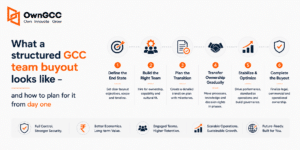
In practice, a managed transition for a 50 to 80-person RCM operation follows a phased model. During the Build phase — typically the first 90 to 120 days — the GCC infrastructure is established, the team is hired, and training begins on the simpler, higher-volume functions: eligibility verification, claims intake, initial coding review. These functions are transferred from the vendor first, allowing the new team to build confidence and efficiency on lower-complexity work while the vendor continues handling complex functions.
During the Operate phase — months 5 through 18 typically — the complexity spectrum shifts progressively toward the GCC team. Denial management, appeals, COB, and provider dispute resolution are transitioned in sequence, with parallel operation where appropriate to catch quality issues before they affect provider or member outcomes.
By the time the Transfer occurs — with the team moving to direct ownership under the health plan’s org chart — the GCC is fully operational across the RCM scope, the team has 12 to 18 months of institutional knowledge built under the health plan’s operational standards, and the vendor is fully exited.
The key to a successful transition is not speed. It is sequencing, transparency, and having a GCC partner who has done it before and can manage the complexity without disrupting the claims cycle that your business depends on.
What the CFO Conversation Looks Like — and What to Bring to It
For CFOs at health plans who are ready to have this conversation internally, the case for a captive RCM GCC in India needs to be presented in the language that matters: numbers, risk, and strategic positioning.
On the numbers, the five-year financial model is the anchor. Vendor cost at current run rate, trended forward with typical 3% to 5% annual escalation. Captive cost modeled at realistic build, operate, and transfer phases. Net present value of savings, discounted appropriately for transition risk. For most health plans running RCM teams of 40 or more, the NPV of the captive model over five years is well into the eight figures.
On the risk side, the conversation needs to address transition risk — mitigated by phased sequencing and a proven BOT methodology — and the data governance risk of the current vendor model, which is often higher than the organization has formally evaluated.
On strategic positioning, the captive RCM GCC argument connects directly to two priorities that are already on every health plan CFO’s agenda: MLR management and operational scalability. A captive team that drives measurable improvement in first-pass resolution, denial rates, and appeals outcomes is an MLR lever. A team you own and can scale without renegotiating a vendor contract is an operational scalability lever.
The conversation is not about offshoring. It is about building the operational capability that makes your revenue cycle more efficient, more controllable, and more defensible — at a cost structure that a vendor relationship will never achieve.
Frequently Asked Questions
Q: How large does our RCM team need to be to justify a captive GCC in India?
The practical threshold for a captive GCC build is typically 25 to 30 full-time equivalents in the offshore function. Below that size, the setup costs are harder to amortize quickly, though the long-term economics still favor captive at smaller team sizes in most cases. Health plans with 40 or more offshore RCM FTEs see the financial case become compelling very quickly when modeled over a five-year horizon.
Q: How do we handle HIPAA compliance for a captive team in India?
HIPAA applies to offshore operations handling PHI for US covered entities regardless of where those operations are located. A captive GCC is structured as part of the covered entity’s operational perimeter — not as a third-party Business Associate — which enables tighter data governance, dedicated infrastructure, and direct application of the health plan’s HIPAA compliance program. The data governance architecture, access controls, and audit trail design need to be built to HIPAA standards from Day 1 of the GCC setup.
Q: What RCM functions can realistically be handled by an India GCC team?
The full scope of payer RCM is operationally viable in a captive India team, including claims intake and indexing, eligibility verification, medical coding review, claims adjudication support, denial management, appeals processing, coordination of benefits, and provider dispute resolution. More complex functions — those requiring clinical judgment calls or provider relationship management — typically transition later in the ramp sequence, after the team has built sufficient institutional knowledge and process maturity.
Q: How do we maintain vendor SLAs during the transition to a captive model?
A phased transition model maintains SLA continuity by sequencing function transfers from simpler to complex, running parallel operations during handover periods, and not exiting the vendor until the captive team has demonstrated sustained performance at or above the SLA benchmark for each function transferred. The transition plan is built around the SLA obligations, not despite them.
Q: What is the typical timeline from decision to fully operational captive RCM GCC?
For a typical payer RCM GCC of 40 to 80 FTEs, the timeline from engagement to operational team processing claims is 90 to 120 days for initial functions and 12 to 18 months for full scope transfer. Entity formation, regulatory setup, and initial hiring happen in parallel during the first 60 to 90 days. The transfer of full operational ownership to the health plan occurs at the end of the Operate phase, typically at the 18 to 24 month mark.
Q: How does a captive GCC affect our relationship with existing RCM vendors?
The BOT transition is designed to be managed professionally, with appropriate contractual notice periods honored and a sequenced handover that maintains vendor performance through the transition window. Most health plans find that having a captive alternative in development changes the dynamics of vendor negotiation positively — the vendor knows the relationship is not indefinite, which creates different incentives in interim performance and transition cooperation.
Q: What makes OwnGCC different from general GCC operators for payer RCM?
OwnGCC’s focus on healthcare, fintech, and financial services vertical GCCs means the operational design for a payer RCM team is informed by domain knowledge — not generic BOT methodology applied to a new vertical. The compliance architecture is built to HIPAA standards from the start. The talent recruitment targets RCM professionals with payer-specific experience. The transition plan accounts for the specific complexities of payer RCM workflows. And the ongoing operational support through the Operate phase brings healthcare sector understanding that broad-market operators do not carry.