⚠ THE ENTERPRISE GCC REALITY CHECK
The average enterprise GCC engagement runs 14–18 months before a single engineer ships code. For mid-market health-tech companies, that’s a competitive runway you simply cannot afford to burn.
The India GCC opportunity is real — lower costs, deep talent pools, and time-zone overlap that actually works. But the consultants who dominate this space were built to serve $10B enterprises, not $50M–$500M health-tech companies with real deadlines and finite capital. If you’ve been quoted 12–18 months to stand up a GCC, you’ve been handed someone else’s timeline.
The Health-Tech Advantage Most Companies Are Leaving on the Table
India’s healthcare technology talent ecosystem has matured dramatically. Bengaluru, Hyderabad, and Pune now house deep clusters of HL7/FHIR engineers, clinical data scientists, regulatory compliance specialists (HIPAA, FDA 21 CFR Part 11), and health informatics professionals — many of whom have worked inside the Indian operations of Epic, Cerner, Philips Healthcare, and Optum.
The talent isn’t the bottleneck. The setup model is.
| 40–60%
Avg. cost reduction vs US health-tech roles |
1.5M+
STEM graduates entering India’s market annually |
12 wks
Time to first hire with the OwnGCC model |
3×
Faster than average enterprise GCC timelines |
Why the Enterprise GCC Playbook Fails Mid-Market Health-Tech
Large GCC consultancies operate on a model optimised for enterprises with multi-year procurement cycles, dedicated PMOs, and executive bandwidth to absorb a slow engagement. That’s not you. The enterprise model has five built-in delays that mid-market companies cannot afford:
- Phased discovery marathons. Weeks of stakeholder interviews and ‘current-state mapping’ before a single entity is formed.
- One-size-fits-all entity structures. Complex multi-entity setups designed for 500+ headcount — when you need 20 engineers in year one.
- Conservative talent pipelines. Relying on passive job boards and slow RPO cycles rather than pre-mapped health-tech talent networks.
- Compliance paralysis. Treating HIPAA cross-border data obligations as unsolvable riddles rather than known, solvable patterns.
- Leadership bottlenecks. Every decision escalating to senior partners split across 30 enterprise accounts.
| ⚡ THE REAL COST OF SLOW
Every quarter you delay your GCC is a quarter your cost structure doesn’t improve and competitors compound their advantage. At $500K+ per quarter in US engineering costs a GCC could replace, an 18-month setup isn’t a project timeline — it’s a $2M+ opportunity cost. |
The OwnGCC 12-Week Framework for Health-Tech Companies
The 12-week GCC launch isn’t theoretical. It’s an engineered operating model that front-loads decisions, pre-builds infrastructure, and leverages health-tech–specific playbooks refined across dozens of India setups.
| WEEKS
1–2 |
Foundation Sprint: Legal Entity + Location Decision
Private Limited company formation initiated. City shortlisted from pre-evaluated health-tech hubs (Bengaluru ORR/Whitefield, Hyderabad HITEC City, Pune Hinjewadi). Lease terms negotiated on pre-identified managed office options — no 6-month real estate RFP required. |
| WEEKS
3–4 |
Compliance & Data Privacy Architecture
HIPAA cross-border data handling framework defined. BAA templates with India entity drafted. IT security baseline (SOC 2 alignment, endpoint policy, VPN) established. India DPDP Act obligations mapped. No guesswork — templated from prior health-tech deployments. |
| WEEKS
5–7 |
Talent Pipeline Activation
Pre-mapped network activated for your specific stack (Epic Bridges, FHIR APIs, HL7 v2/v3, clinical NLP, regulatory engineering). Job descriptions drafted with India market benchmarks. Target: 3–5 offer-stage candidates per role by week 7. |
| WEEKS
8–9 |
GCC Lead Hire + Offers Extended
India GCC Head or Engineering Manager hired — someone with GCC operational experience in health-tech, not a generalist. First cohort of ICs receive offers. Onboarding playbook ready on day one. |
| WEEKS
10–11 |
Infrastructure & Integration Go-Live
Office operational. IT stack deployed (MDM, VPN, SSO, collaboration tools). Payroll and HR systems live. First hires begin orientation. US ↔ India integration rituals established (sprint ceremonies, async norms, documentation standards). |
| WEEKS
12 |
First Sprint. Live.
Your India GCC team is in their first sprint cycle, contributing to production. Not ‘ramping.’ Not ‘onboarding in parallel.’ Actually shipping. This is the moment the ROI clock starts. |
Enterprise GCC Consultants vs. OwnGCC: An Honest Comparison
Mid-market health-tech leaders deserve a clear-eyed look at what different models actually deliver — not marketing language.
| Dimension | Enterprise GCC Consultants | OwnGCC Model |
| Time to first hire | 9–14 months | 8–10 weeks |
| Time to production-ready team | 14–18 months | 12 weeks |
| Built for company size | $1B+ enterprises | $50M–$500M mid-market |
| Health-tech compliance | Generic; requires customization | HIPAA/DPDP pre-templated |
| Talent pipeline | Passive job boards + RPO | Pre-mapped health-tech network |
| Partner attention | Shared across 20–30 accounts | Dedicated team, single focus |
| Entity structure | Complex multi-entity overkill | Right-sized for your headcount |
| Engagement model | Long retainer with scope creep | Fixed-scope, outcome-based |
The Health-Tech Compliance Question: Solved, Not Feared
The single most common objection mid-market health-tech companies raise about India GCCs is compliance — specifically HIPAA. The compliance architecture is known and solvable. It involves:
- BAA framework. A properly drafted BAA between your US entity and India entity — already templated.
- Data residency. Strict data residency controls ensuring PHI never touches India infrastructure unless architecturally required.
- IT security baseline. Endpoint security and MDM policies consistent with SOC 2 Type II requirements.
- DPDP Act compliance. India DPDP Act compliance layered in from day one — not retrofitted later.
- Workflow scoping. Clear delineation of what work runs in India vs. what stays onshore.
| ✅ OWNGCC COMPLIANCE POSTURE
Every OwnGCC health-tech engagement begins with a compliance architecture session. We don’t figure this out during setup — it’s pre-built into the 12-week playbook. Your legal and security teams review; they don’t architect from scratch. |
Choosing the Right India City for Your Health-Tech GCC
Your city choice has a 3–5 year compounding effect on hiring quality, attrition, and costs.
Bengaluru
India’s deepest health-tech talent pool. Home to Philips Innovation Campus, GE Healthcare R&D, and the India operations of dozens of US health-tech firms. Ideal for FHIR/HL7 engineering, clinical AI, or health data platform talent. Higher real estate costs, offset by access to senior talent.
Hyderabad
Strong for health analytics, payer-side technology (UnitedHealth, Optum have large presences), and regulatory/compliance engineering. State government is exceptionally GCC-friendly. Costs slightly lower than Bengaluru.
Pune
Emerging option for companies needing embedded software engineering (medical devices, diagnostics hardware). Proximity to Mumbai without Mumbai’s costs. Attrition historically lower than Bengaluru.
What $200K Buys in India vs. the US
A $200K annual US engineering budget — enough for one mid-senior developer in San Francisco — funds this team configuration in India:
- 1 Senior FHIR Integration Engineer (₹28–32 LPA / ~$34–38K USD)
- 1 Mid-Level Clinical Data Engineer (₹18–22 LPA / ~$22–26K USD)
- 1 QA Automation Engineer, health-tech focused (₹14–18 LPA / ~$17–22K USD)
- 1 Data Analyst with clinical domain knowledge (₹12–16 LPA / ~$14–19K USD)
- GCC operational overhead (entity, payroll, compliance, office) — ~$25–30K USD
Four specialised contributors versus one generalist. The math isn’t subtle — and it compounds as you scale.
What ‘Captive’ Actually Means — and Why It Matters
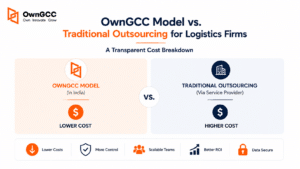
A GCC (Global Capability Center), sometimes called a captive center, means your India team works for you — employed by your India entity, aligned to your culture, building institutional knowledge that stays with you. This is fundamentally different from outsourcing or staff augmentation, where talent loyalty runs to the vendor.
The captive model outperforms outsourcing on every long-term metric that matters to health-tech companies: data security posture, regulatory auditability, product domain expertise, and retention. The tradeoff has historically been setup speed and complexity — which is exactly the problem the OwnGCC model solves.
| 📌 KEY DISTINCTION
With OwnGCC, you own the entity, employ the talent, control the culture, and retain all IP. We’re the launch infrastructure — not a permanent intermediary sitting between you and your team. |
3 Questions to Ask Before Selecting a GCC Partner
- “Experience check:” How many mid-market health-tech GCCs have you launched specifically? Not ‘how many GCCs’ — how many for companies your size, in your sector. Reference clients matter.
- “Timeline accountability:” What is your contractual commitment on time-to-first-hire? If it’s not in the contract, it’s a projection, not a promise.
- “Dedication test:” Who is the dedicated team on my account — and what else are they working on? Senior partners spread across 20 accounts will not move at 12-week pace.
Are You Ready? A 60-Second Diagnostic
The 12-week model works for companies that meet a baseline readiness threshold. You’re likely ready if:
- You have a clear engineering or data function to replicate or extend — not a vague ‘we need offshore help’
- Your US leadership has bandwidth to onboard and manage a remote team through a 90-day integration window
- You have budget certainty for at least 12 months of GCC operations post-launch
- You’ve pressure-tested the decision: this is a strategic capability build, not a cost-cutting reaction
- You’re willing to move — someone owns this internally and can make decisions in days, not weeks
If you hit 4 of 5, you’re ready to start. The one most companies miss is the last: internal ownership. The 12-week clock starts the day you decide to move — not the day you finish evaluating.
| 🚀 READY TO LAUNCH IN 12 WEEKS?
Talk to an OwnGCC health-tech specialist. We’ll assess your readiness, map your talent requirements, and show you exactly what week 12 looks like for a company like yours. No commitment. No 40-slide deck. Just a direct conversation about whether this is right for you. Book your GCC Strategy Call → owngcc.com/strategy-call |