Most articles about Fannie Mae and Freddie Mac are written for borrowers. They explain the secondary market, revisit 2008, and stop.
If you run a mortgage business, none of that is the part that costs you money.
For a lender, Fannie Mae and Freddie Mac are not abstractions in the capital markets. They are the two entities that decide what your underwriters may approve, what documentation your processors must collect, what data fields your LOS must populate at delivery, and what you owe when a file is later judged defective. They publish those decisions continuously, in bulletins and announcements that land whether or not your operations team has capacity that quarter.
Understood that way, the GSEs are less a policy topic and more an operating manual with a rolling revision schedule — and the cost of keeping up with it is almost entirely a labour cost.
This article covers what mid-market lenders need to manage, why the operational burden behaves the way it does across a rate cycle, and what a different staffing structure changes.
First, the part everyone gets slightly wrong
Fannie Mae (Federal National Mortgage Association) and Freddie Mac (Federal Home Loan Mortgage Corporation) are government-sponsored enterprises. Neither originates loans. Both purchase closed loans from approved sellers, pool them into mortgage-backed securities, and guarantee timely payment to investors. That guarantee is what lets a lender in Ohio recycle capital rather than sit on a 30-year asset.
Both have operated under the conservatorship of the Federal Housing Finance Agency (FHFA) since September 2008.
Two corrections worth making, because the older explainers on page one of Google still repeat them:
“Fannie buys from big banks, Freddie buys from thrifts.” This distinction is a historical artifact of the two charters and has little bearing on how the market functions today. Independent mortgage banks — not depositories — now originate the majority of conventional conforming volume, and they sell to both. Practically speaking, most lenders maintain approved seller status with both GSEs and route loans based on pricing, eligibility and automated underwriting outcomes, not institution type.
“The two are essentially identical.” They are aligned, not identical. FHFA has pushed hard toward uniformity — a common security, aligned appraisal datasets, aligned manufactured housing specifications — but Fannie’s Selling Guide and Freddie’s Single-Family Seller/Servicer Guide remain separate documents with separate effective dates. Fannie runs Desktop Underwriter; Freddie runs Loan Product Advisor. Their quality control philosophies have diverged meaningfully in recent years. A team that treats the two as interchangeable will produce defects.
That second point is where the operational cost lives.
The seven things that actually hit your P&L
1. They write your underwriting rulebook
Eligibility, income calculation methodology, asset seasoning, appraisal requirements, project review for condos, occupancy documentation — the GSE guides govern all of it for conventional conforming production. Your credit policy is, in most respects, a set of overlays applied on top of someone else’s document.
This means your underwriters aren’t just applying judgment. They’re applying someone else’s continuously updated judgment, and they need to know which version of it applies to a given application received date.
2. The rulebook changes constantly, and the changes are dated
Both GSEs publish updates on a rolling basis — Selling Guide announcements, Guide bulletins, lender letters, servicing announcements. Many carry staggered effective dates tied to application received date or delivery date rather than publication date, and some permit early adoption.
The operational consequence is that at any moment, your pipeline contains loans governed by several different versions of the rules simultaneously. Somebody has to read each bulletin, decide what it changes, update your procedures and job aids, retrain the affected roles, adjust your QC checklists, and confirm your LOS configuration reflects it.
At most mid-market lenders this work is done by a small number of senior people, on top of their day jobs, at night. It is the single most under-resourced function in the average mortgage operation.
3. Loan quality is now priced, not just punished
This is the most important recent shift and the one that most borrower-facing content misses entirely.
Historically, a significant defect discovered in post-purchase review meant one thing: repurchase. Freddie Mac has moved a large share of that exposure onto a fee-based footing instead. Under its performing loan repurchase alternative, lenders whose non-acceptable quality (NAQ) rate exceeds 2% are charged a fee on a step-up basis tied to the unpaid principal balance delivered in the quarter, rather than being required to buy the loans back — with waivers for sellers too small to generate a statistically significant sample. Freddie Mac has also committed to publishing repurchase data on a recurring basis, and Fannie Mae has extended its own pre-repurchase notification approach.
Read that as a business signal rather than a policy detail. Your defect rate is no longer an occasional catastrophic event you hope to avoid. It is becoming a recurring, quantified, quarter-by-quarter line item that scales with your volume — and one your counterparties can see. A lender running a persistently elevated NAQ rate faces fees, tighter monitoring, and eventually restrictions on doing business.
The lever that moves NAQ is not technology. It is the quality and consistency of the human review applied before delivery.
4. Data standards are the delivery gate
Uniform Loan Delivery Dataset. Uniform Closing Dataset. The Uniform Appraisal Dataset, currently mid-transition to UAD 3.6 alongside the redesigned appraisal forms. Each is a structured data contract, and each carries its own edits, tolerances and remediation loops.
Data defects rarely feel dramatic. They just quietly consume analyst hours — reconciling fields, chasing corrected documents, resubmitting, tracking exceptions. Multiply that across a delivery cycle and it is a full-time function that most lenders have never formally staffed.
5. The credit score transition is live
The GSEs are implementing their first new credit score models in decades, moving to VantageScore 4.0 and FICO Score 10T alongside FHA, under an FHFA and HUD announcement framed explicitly around competition and cost reduction.
For borrowers, this is a headline about access. For a lender, it is a re-plumbing exercise: credit vendor contracts, LOS configuration, pricing engine assumptions, AUS interpretation, and — critically — retraining every person who reads a credit report and every person who prices a loan. Dual-model environments are where scoring errors and eligibility misses get made.
6. Loan limits and housing goals reshape your mix
Conforming loan limits reset annually against the FHFA house price index, which moves the boundary between your conforming and jumbo production every January.
Separately, FHFA finalised its 2026–2028 housing goals for Fannie Mae and Freddie Mac, lowering the single-family low-income home purchase goal from 25% to 21% and cutting the very low-income goal from 6% to 3.5%, with Director Bill Pulte framing the change as a correction to prior mandates.
Goal changes shift where the GSEs lean on pricing and product, which shifts your borrower mix, which shifts the documentation profile of your pipeline — and therefore where your processing hours go.
7. Conservatorship exit is now a planning variable, not a thought experiment
Fannie Mae and Freddie Mac remain in conservatorship. But Treasury and FHFA have set out a framework for an orderly release, Congress has begun floating statutory guardrails, and market participants are actively modelling the transition.
Nobody should build a 2026 operating plan around a specific exit date. But every lender should assume that a release process brings a period of elevated change velocity: capital rules, guarantee fee treatment, seller/servicer eligibility standards, counterparty requirements. Change velocity is the input that determines how much operational absorption capacity you need.
Why this is a staffing problem, not a software problem
Every one of the seven items above resolves to the same operational requirement: people who know the guides, applied consistently, at a volume that swings by multiples across a rate cycle.
That is a genuinely difficult thing to staff domestically, and the failure mode is predictable.
Volume falls. Margins compress. The first cuts land on functions that don’t touch a closing table — pre-funding QC sampling, post-close QC, data remediation, bulletin monitoring, appeals and rebuttals. Those roles are invisible in a slow quarter and structurally hard to defend in a board meeting.
Then rates move, volume returns, and the same lender is hiring underwriters at a premium into a tight market, running them at capacity, and pushing files out the door with thinner review. Defects concentrate exactly in the periods of highest volume. Post-purchase review surfaces them one to three years later — often when the next downturn has already compressed margins again.
Freddie Mac’s own account of the last cycle follows this shape: defect rates peaked in the third quarter of 2022 on the back of pandemic refinance volume, and repurchase requests peaked in the first quarter of 2023 as those loans came under review.
The pattern isn’t a management failure. It’s what happens when the capacity you need for quality is bound to the same headcount budget as the capacity you need for production.
The incentive problem in how lenders usually solve this
The standard answer is to hand QC, processing support or data work to an outsourcing vendor.
Look closely at how the typical arrangement is priced. Per FTE, or per file, or per transaction. Now ask what that means about the vendor’s interests:
- Rework is revenue. A vendor billing per touch has no financial reason to eliminate the touches. Your defect rate is their volume.
- Guide knowledge doesn’t compound in your favour. In a multi-tenant delivery model, staff rotate across clients. The person who learned your condo overlay and your investor-specific documentation quirks is servicing someone else’s queue next quarter. You pay for that learning curve repeatedly.
- You never see the real cost. Blended rate cards conceal the spread between what you pay and what the work costs. You cannot manage a number you can’t see, and the vendor has every reason to keep it that way.
- Accountability stops at the SLA. Turnaround time and throughput are measurable and get contracted. Repurchase exposure stays entirely with you.
This is not an argument that outsourcing vendors behave badly. It’s an argument that the commercial structure points them somewhere other than where you need to go. You want fewer defects, less rework and deeper institutional knowledge. The pricing model rewards the opposite.
What a captive team changes
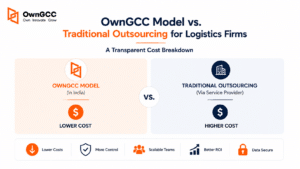
A Global Capability Center reverses the incentive. When the team in India is your team — your entity, your payroll, your management chain — every hour they save is your margin, and every guide bulletin they master stays inside your business permanently.
For GSE-facing work specifically, that matters more than in most functions, because the work is knowledge-dense and cumulative. A pre-funding QC reviewer becomes materially more valuable in year two than in year one. That compounding only accrues to you if the reviewer is yours.
What lenders typically run from a captive team:
- Pre-funding QC sampling and full-file review against Fannie and Freddie requirements
- Post-close QC, defect classification, and remediation tracking
- Loan delivery data validation across ULDD, UCD and UAD, including edit resolution
- Selling Guide and Seller/Servicer Guide bulletin monitoring, procedure updates and training material maintenance
- Repurchase and NAQ response support — evidence assembly, appeal documentation, root-cause analysis
- Post-close audit, trailing document management and investor condition clearing
- Servicing support functions including escrow analysis and insurance policy monitoring
The objection every COO raises next is the right one: can a team offshore actually carry this? The honest answer is that it depends entirely on how the team is built. A generalist pool given a checklist will not hold up under a post-purchase review. A dedicated team, hired against mortgage-specific criteria, trained on your overlays and your investor requirements, operating inside an ISO 27001:2022 information security framework with process discipline applied through structured Lean Six Sigma methods, holds up in exactly the way a well-run domestic team does — because it is a well-run team that happens to sit in India.
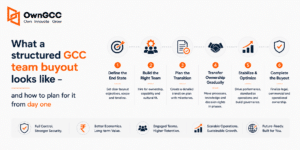
The Build-Operate-Transfer model exists to make that outcome contractual rather than aspirational. OwnGCC builds the entity and the team, runs it to a defined standard, and transfers ownership to you on a pre-agreed timeline at transparent, itemised pricing. If a partner’s revenue is tied to how long you keep paying per seat, the incentive to transfer never arrives. Ours is structured to end.
Frequently asked questions
Can an offshore team handle Fannie Mae and Freddie Mac quality control?
Yes, and a large share of the industry’s QC and post-close work already runs from India. The determining factor is team structure, not geography. Dedicated staff trained on your specific overlays, with a named review hierarchy and documented escalation into your onshore credit leadership, produce different results from a shared pool working off a generic checklist. Ask any potential partner whether the reviewers are exclusive to you, and what happens to that knowledge when the engagement ends.
Who carries repurchase risk if the work is done offshore?
You do — as you do with any vendor, and as you would with your own domestic team. Delegation of work is not delegation of representations and warranties. That is precisely the argument for a captive structure: if the exposure is permanently yours, the capability that manages it should be permanently yours too, not rented from a party with no downstream liability.
How do we handle NPI and data security for US borrower files?
Through the same controls a US operations centre requires, formalised. That means an ISO 27001:2022-certified environment, role-based access, restricted-egress workstations, audited access logs, and contractual alignment with GLBA safeguards and applicable state privacy law. A captive entity gives you direct control over these controls rather than reliance on a vendor’s shared infrastructure.
How long does it take to stand up a GCC team for mortgage operations?
Meaningfully faster than establishing your own foreign entity, and slower than signing a BPO contract. The variable is role seniority — experienced conventional underwriters and QC reviewers take longer to source than processing or data validation staff. The realistic approach is phased: start with data-heavy, well-documented functions where output quality is objectively measurable, and layer judgment-intensive roles as the team’s guide knowledge deepens.
How does the team keep pace with guide changes after go-live?
It has to be an owned function, not an assumption. In a well-built captive, bulletin monitoring is somebody’s named responsibility, with a defined cycle: read, assess impact, update procedures and job aids, retrain affected roles, adjust QC checklists, verify LOS configuration. Most lenders discover this was never formally owned onshore either — it was absorbed by whoever cared most.
What’s the actual difference between BOT and traditional mortgage BPO?
Ownership and incentive. In BPO, the vendor owns the entity, the employment relationship and the process knowledge, and bills you for access to them indefinitely. In Build-Operate-Transfer, those assets are built with the explicit intent of becoming yours, on a defined timeline, at a defined cost. The work may look similar in month three. By year three, in one model you have an operating asset on your balance sheet; in the other you have a renewal negotiation.
The takeaway
Fannie Mae and Freddie Mac will keep publishing. The guides will keep changing. Credit models, appraisal datasets, loan limits and quality frameworks will keep moving, and a conservatorship exit process would accelerate all of it.
None of that is a risk you can eliminate. It is a workload you have to be structurally able to absorb — in the quarters when volume is high and you’re short-staffed, and in the quarters when volume is low and the finance team is looking for cuts.
Lenders who treat that absorption capacity as a fixed, owned capability rather than a variable cost tend to find their defect rates behave differently. That is the whole argument.