
Here is the argument every guide to insurance agency outsourcing makes, in one sentence: your team spends too much time on administrative work, so move that work to a partner, and your people will spend their freed time on revenue-generating activity.
The first half is true. The second half is an assumption, and it is the assumption on which most agency outsourcing programmes quietly underdeliver.
Freed hours are not productivity. They are available capacity. Whether that capacity becomes productivity depends entirely on what happens next — and in most agencies, nobody manages what happens next. The hours get absorbed. Six months later the team is just as busy, the vendor invoice is a permanent line item, and nobody can say what changed.
This article is about closing that gap: where the hours actually go, how to measure whether you gained anything, and which operating structures make the gain durable. If you want the upstream decision of which functions to move and under what model, that’s covered in our pillar on insurance BPO services.
Where the freed hours actually go
When you remove twenty hours a week of administrative work from an account management team, three things compete for those hours. Only one of them is the outcome you paid for.
Absorbed slack. Work expands. An account manager who was processing endorsements between client calls now has longer client calls, more thorough file notes, and a less compressed day. This is not laziness — it is a team that was running above sustainable load returning to sustainable load. It is genuinely valuable. It is also not a productivity gain, and it will not show up in any metric you report to ownership.
Coordination overhead. This is the one nobody budgets. Someone now has to brief the vendor, answer their questions, review their output, manage exceptions, chase escalations, run the monthly performance call, and handle the errors that come back. That work is real, it lands disproportionately on your most experienced people, and it is not free. Under NAIC Insurance Data Security Model Law #668, oversight of third-party service provider arrangements is an explicit component of your own information security programme — so a portion of this overhead is not optional, it is a regulatory obligation.
Redeployment. The hours go into producing, cross-selling, retention outreach, or handling more accounts per person. This is the productivity gain. It only happens if someone decides in advance what the hours are for, and holds the team to it.
The uncomfortable arithmetic: if absorbed slack takes half the freed hours and coordination takes a third, you have redeployed a fraction of what you paid to free up — while paying full price for all of it.
None of this argues against outsourcing. It argues that the business case has to be written against redeployed hours, not freed ones, and that the redeployment has to be planned as deliberately as the transition itself.
Correction 1: The numbers in these case studies do not survive inspection
Guides on this topic are dense with percentage results. Turnaround down 30%. New policy sales up 25%. Manual errors down 40%. Operational costs cut 30%.
Notice what is consistently missing.
| What’s claimed | What you’d need to evaluate it |
|---|---|
| “Reduced turnaround time by 30%” | From what baseline, measured how, over what period, on which process — and was volume constant? |
| “25% increase in new policy sales” | Was the sales team’s time the binding constraint, or did the market move? What was the comparison period? |
| “40% reduced manual errors” | Error rate against what denominator? Self-reported by the vendor doing the work, or independently sampled? |
| “Cut operational costs by 30%” | Gross vendor cost versus prior fully-loaded cost, or net of oversight, transition and rework? |
| Named agency, verifiable | Almost always anonymous — “a mid-sized agency”, “a U.S.-based insurance agency” |
The pattern is consistent across the category: a plausible percentage, an anonymous client, no baseline, no methodology, no timeframe.
We take a deliberate position on this. We don’t publish composite performance figures, because a number without a denominator is decoration, and any provider can generate one. What we will do is tell you which metrics to instrument before you start, so that in twelve months you can produce your own number and defend it.
That is not a rhetorical flourish. It is the practical difference between an outsourcing programme you can evaluate and one you can only feel.
What insurance agency productivity actually means
Productivity is output per unit of input. In an agency, both terms need defining before any of this is measurable.
| Metric people report | What it actually tells you | Better metric |
|---|---|---|
| Turnaround time on a task | Speed of one step, in isolation | End-to-end cycle time from client request to completion, including handoffs and waits |
| Hours saved | Capacity freed, not value created | Hours redeployed into producing, retention or servicing more accounts |
| Cost per transaction | Vendor efficiency | Fully-loaded cost per policy serviced, including oversight and rework |
| Headcount reduced | A one-time event | Revenue per employee, tracked across a full cycle |
| Volume processed | Throughput | First-pass yield — percentage completed correctly without rework |
| Client satisfaction score | Sentiment | Retention rate and account growth by service tier |
The two that matter most, and are least often tracked:
First-pass yield. The percentage of transactions completed correctly the first time, with no rework, correction or clarification loop. This is the single most useful productivity metric in an insurance back office, because rework is invisible in throughput reporting and enormous in practice. A team processing 20% more transactions while reworking 15% of them has not improved.
Revenue per employee, across a cycle. Not in a quarter — across a full soft-and-hard market cycle. Agency productivity that only appears in favourable conditions isn’t productivity, it’s a market.
Correction 2: The compliance frame is wrong, and it matters here
Guides in this category routinely tell US agencies to verify that their outsourcing partner complies with GDPR and HIPAA. For a US retail agency or MGA writing commercial property and casualty business, this misdirects your diligence.
| Framework | Applies to your operation? |
|---|---|
| GLBA + FTC Safeguards Rule | Yes — core. A written information security programme with administrative, technical and physical safeguards for nonpublic personal information. |
| NAIC Insurance Data Security Model Law (#668) | Yes, in adopting states. Applies to insurers, agents and other department licensees — and Section 4.F makes oversight of third-party service providers part of your programme. |
| NYDFS 23 NYCRR Part 500 | Yes, if DFS-licensed. The stricter benchmark, and the framework Model #668 was built from. |
| SOC 1 / SOC 2 report | Not a law — but the most useful single artefact to request from any provider. Read the exceptions, not the cover page. |
| ISO 27001:2022 | Useful evidence of a managed security programme. Complementary, not a substitute. |
| HIPAA | Only where protected health information is genuinely in scope. |
| GDPR | Only if you process EU or UK personal data. |
The productivity relevance is direct. Section 4.F oversight is recurring work performed by senior people, and it scales with the number of vendors you use. Every additional provider adds a control environment you must review, an incident response path you must coordinate, and a sub-processing chain you must map. Three vendors doing three functions is not three times the flexibility — it is three times the oversight load, absorbed by the same compliance and operations leaders you were trying to free up.
Consolidation is a productivity lever. Fragmentation is an anti-lever. Most guides never mention it because they are each selling one more vendor relationship.
Correction 3: The trends list needs updating
Trend sections in this category tend to list the same five items regardless of what is actually happening in the market. Here is a more honest read for 2026.
| Commonly listed trend | Realistic status | What it means for your operations |
|---|---|---|
| AI-driven automation | Real and material, particularly intelligent document processing and intake classification | Changes your skill mix, not your headcount. Fewer people doing data entry, more people capable of handling the exceptions that automation surfaces |
| Predictive analytics | Real, but concentrated on the carrier side — pricing, fraud, reserving | Limited direct application in a retail agency back office; useful in submission triage and renewal prioritisation |
| Blockchain in claims | Largely stalled. Persistent in vendor marketing, thin on production deployments | Not an operational planning input for a mid-market agency |
| Hyper-personalisation | Real as a client expectation, mostly a CRM and data hygiene problem | Depends on clean, complete account data — which is a back-office quality issue, not a technology purchase |
| Cloud-based platforms | Table stakes, not a trend | Assume it. If a provider presents cloud as a differentiator, discount accordingly |
The AI line deserves emphasis because it is routinely sold backwards. Automation handles the clean, structured, high-volume portion of your work. What reaches a human afterwards is the residue — the malformed documents, the ambiguous classifications, the exceptions. Your average file gets harder, not easier. That argues for a more capable, more stable, better-trained team. Anyone presenting automation as a headcount reduction story has not run the second-order effect.
The four levers that actually move productivity
Strip away the category language and there are only four ways an insurance operation gets more productive.
| Lever | What it means | Why it’s hard |
|---|---|---|
| Eliminate rework at source | Fix the upstream cause of defects rather than processing them faster | Requires someone with authority over both the upstream and downstream process |
| Reduce handoffs | Every transfer between people or systems adds wait time and error risk | Outsourcing a mid-process step usually adds a handoff |
| Build compounding knowledge | A reviewer who knows your carriers, overlays and top accounts is materially faster and more accurate in year two | Only compounds if the same people stay on your work |
| Match capacity to cycle | Enough capacity at peak without carrying it through the trough | Genuinely hard; the one lever a flexible vendor pulls well |
Now look at which levers a per-transaction or shared-resource vendor arrangement can actually pull.
Lever four: yes, and this is the real BPO strength. Lever two: usually negative, because inserting an external party into the middle of a workflow adds a handoff rather than removing one. Lever three: no, structurally — in a shared pool, the person who learned your book is on another client’s queue next quarter, so you fund the learning curve repeatedly. Lever one: no, and this is the important one. A provider paid per transaction has no financial reason to eliminate transactions. Your rework is their revenue line.
That is not an accusation of bad faith. It is what the structure rewards, and structures drift toward what they reward over a three-year contract.
What changes with an owned team
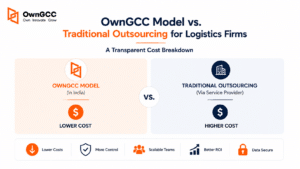
A Global Capability Center is not a different vendor. It is your own operation, located differently. Your entity, your payroll, your management chain, your escalation path into onshore leadership — at a cost base that makes owning the function viable in a way a domestic build never would.
That distinction is what unlocks the first three levers.
Rework elimination becomes possible because every hour the team removes from a process is your margin, not a lost billing opportunity. There is finally an aligned incentive to make the work disappear.
Handoff reduction becomes possible because you can move an entire end-to-end process — submission through to bind, or renewal through to delivery — rather than carving out the specifiable middle slice a vendor will contract for.
Knowledge compounding becomes automatic, because the people stay. A reviewer in year two knows which of your markets values quarterly, which carrier nets subrogation recoveries, which underwriter wants the loss summary formatted a particular way, and which producer’s accounts always need the exposure schedule chased. None of that is in a process document. All of it is worth money, and it accrues to whoever employs the person who knows it.
The fourth lever — cycle flexibility — is the one a captive has to work at, through cross-training and planned surge coverage rather than a vendor’s elastic bench. That’s an honest trade-off, not a hidden one.
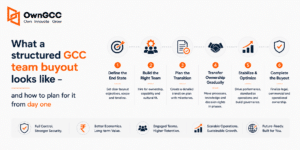
Build-Operate-Transfer is how the structure gets built without you standing up a foreign entity yourself. OwnGCC establishes the entity, recruits and trains the team against insurance-specific criteria, operates it to a defined standard inside an ISO 27001:2022 information security framework with process discipline applied through structured Lean Six Sigma methods, and transfers ownership on a pre-agreed timeline at transparent, itemised pricing.
A productivity baseline you can build in two weeks
Before you change anything, instrument it. Otherwise you will be relying on someone else’s percentage in eighteen months.
- Pick three processes that consume the most time — typically some combination of submission preparation, renewal processing, policy checking, certificate issuance and loss run handling.
- Measure end-to-end cycle time for each, from client or carrier trigger to completion, including waiting time. Not task time. Cycle time.
- Sample first-pass yield. Take thirty completed transactions per process and count how many required any rework, correction or clarification. This number will surprise you.
- Record fully-loaded cost per unit — salary, benefits, systems, supervision, workspace — divided by units completed. This is the number a vendor rate card will be compared against, and the comparison is meaningless if you only count salary.
- Log peak-to-trough volume ratio across the last four quarters, by process. This tells you which processes genuinely need flexibility and which have been treated as seasonal out of habit.
- Establish revenue per employee as of today.
- Write down, in advance, what the freed hours are for — named activity, named owner, expected effect. If you cannot complete this sentence, you are not buying productivity. You are buying relief, which is legitimate but should be called what it is.
Run this before you talk to any provider, including us. It changes what you ask for and it makes every proposal you receive comparable.
Frequently asked questions
Does outsourcing actually improve insurance agency productivity?
It creates the conditions for it. Whether productivity improves depends on whether the freed capacity is deliberately redeployed and whether the arrangement adds handoffs and oversight load that offset the gain. Agencies that plan redeployment in advance and measure first-pass yield generally see real improvement. Agencies that outsource for relief usually get relief — which is worth something, but shouldn’t be reported as a productivity gain.
How do we measure the return on an outsourcing arrangement?
Fully-loaded cost per unit completed, first-pass yield, end-to-end cycle time, and revenue per employee — all baselined before transition and tracked across a full cycle rather than a quarter. Compare vendor cost against your prior fully-loaded internal cost including supervision and systems, not against salary alone, and add the oversight cost the arrangement creates.
Which functions give the fastest productivity gain?
Ones with an objective definition of “correct” and a high current rework rate. If you can verify output without deep review and you’re currently reworking a meaningful share of it, the gain is fast and measurable. Judgment-heavy work delivers a larger gain eventually but only after the team has built context, which takes months.
Will AI reduce the number of people we need in the back office?
It will reduce the number doing structured data work and increase the value of those handling exceptions. Automation resolves the clean portion of volume and concentrates the difficult portion, so your remaining team faces a harder average file. Plan for a skill-mix change rather than a headcount cut.
Is a captive team viable for a mid-sized agency?
It depends on sustained volume rather than agency size. The test is whether you have enough recurring operational work to keep a small dedicated team productive across the full cycle, not only at renewal peaks. Below that threshold, a flexible vendor is the rational answer. Above it, you are funding someone else to accumulate capability you’ll never own.
How do we protect client data if operations move offshore?
With the controls a domestic operation requires, formalised rather than assumed: ISO 27001:2022-certified environment, role-based access, restricted-egress workstations, audited access logs, documented sub-processing, and contractual alignment with the Safeguards Rule and your states’ insurance data security obligations. A captive entity means you control those controls directly rather than inheriting a shared vendor environment you cannot inspect.
The takeaway
The standard guide to improving insurance agency productivity is really a guide to reducing workload. Those are different things, and conflating them is why so many agencies end up with a permanent vendor invoice and a team that is exactly as busy as before.
Productivity is output per fully-loaded dollar of capacity, sustained across a cycle. It comes from eliminating rework, removing handoffs, compounding knowledge, and matching capacity to demand. A flexible vendor pulls the last of those well and the first three poorly, for structural reasons that no amount of relationship management overcomes.
Decide which levers your operation actually needs. Then choose the structure that can pull them.