There is a number that should govern how every mortgage executive thinks about this topic, and it rarely appears in articles about it.
In the first quarter of 2026, independent mortgage banks and the mortgage subsidiaries of chartered banks earned a pre-tax net production profit of $727 per loan. In the same quarter, total loan production expenses averaged $11,898 per loan, according to the Mortgage Bankers Association’s Quarterly Mortgage Bankers Performance Report.
Sit with the ratio. You spend roughly sixteen dollars for every dollar of production profit you keep.
That means fulfilment cost is not a line item on the P&L. It is the line item. A single-digit percentage reduction in cost per loan is not an efficiency gain — arithmetically, it is a transformation of your production profitability. Nothing else available to a mid-market lender moves the number that far that reliably.
This is why “mortgage process outsourcing as a strategic solution” is a fair description, and also why the generic version of that phrase does lenders a disservice. The strategic question was never whether to move work off your domestic cost base. It’s which operating model you use to do it — because the models differ enormously in what they cost you at year three, what they leave you owning, and what happens to your regulatory exposure in the meantime.
The cost picture, in the industry’s own numbers
Production costs are not just high. They have structurally re-based.
| Metric (MBA data) | Figure |
|---|---|
| IMB pre-tax net production profit, Q1 2026 | $727 per loan (16 bps) |
| Total loan production expense, Q1 2026 | $11,898 per loan (336 bps) |
| Total loan production expense, Q4 2025 | $11,102 per loan (323 bps) |
| Long-run average production expense, Q1 2008 to Q1 2026 | $7,903 per loan |
| 2025 production expense — top 20% by net production income | $10,074 per loan |
| 2025 production expense — bottom 20% by net production income | $12,603 per loan |
| Average expense gap, top vs bottom quintile, 2008–2019 | $941 per loan |
| Average expense gap, top vs bottom quintile, 2020–2025 | $2,626 per loan |
| Retail channel cost to originate, depositories, 2025 | $16,320 per loan |
Three things fall out of this table.
Costs rose again in a quarter when volume fell. Per-loan expense climbed roughly $800 quarter over quarter while average loan count per company dropped from 1,973 to 1,729. That is the classic mortgage cost trap: fixed fulfilment capacity divided by fewer units.
The current cost level is not a cyclical blip. At $11,898, per-loan expense sits materially above the long-run average of $7,903 since 2008. Wage levels, technology stacks and compliance overhead have re-based upward and have not come back down.
Cost control now separates winners from losers more than it used to. The expense gap between the top and bottom quintiles averaged $941 per loan across 2008–2019 and $2,626 across 2020–2025 — peaking near $5,000 in 2023. The MBA’s own read is that containing origination costs has become an increasing differentiator between the most and least profitable lenders.
If your cost per loan sits in the bottom quintile, the gap to the top quintile is roughly three times your entire per-loan production profit. That is the strategic case, stated without adjectives.
What actually can and cannot be moved
Most articles on mortgage process outsourcing list functions without qualification. That’s the part that gets lenders into trouble, because the constraints are real and they are not evenly distributed across the loan lifecycle.
The SAFE Act defines a mortgage loan originator by activity — taking a residential mortgage loan application, and offering or negotiating terms of a residential mortgage loan for compensation or gain. Individuals performing clerical or support duties at the direction of and subject to the supervision of a licensed originator are treated differently from those performing origination activity themselves. Separately, consumer-facing and consumer-harm-sensitive decisions carry their own constraints, and in servicing, default decisioning, foreclosure referral and licensed third-party collections do not travel.
| Function | Offshore suitability | The constraint that governs it |
|---|---|---|
| Loan setup, document indexing, stacking | High | Purely clerical; no licensure implication |
| Document collection follow-up and status tracking | High | Keep borrower-facing negotiation onshore |
| Income and asset calculation, VOE/VOA support | High | Support work under licensed supervision |
| Credit and appraisal report review, exception logging | High | Judgment work, not origination activity |
| Underwriting support and conditions clearing | High, with structure | Must operate under your credit authority and supervision framework |
| Final underwriting decision / credit authority | Case by case | Depends on your delegated authority structure and investor requirements |
| Taking the application, offering or negotiating terms | No | SAFE Act licensed originator activity |
| Pre-funding and post-close QC review | High | Ideal fit; knowledge-dense and cumulative |
| Loan delivery data validation (ULDD, UCD, UAD) | High | Data-intensive, objectively measurable |
| Post-close audit, trailing docs, investor conditions | High | Well-suited to structured offshore teams |
| Servicing support: escrow analysis, insurance monitoring, payoffs | High | Standard offshore servicing scope |
| Default decisioning, foreclosure referral, licensed collections | No | Regulatory constraint; stays onshore |
| Borrower complaint handling and loss mitigation decisions | Onshore | Consumer-harm-sensitive |
The useful framing for a COO: offshore capacity is best deployed where the work is knowledge-dense, judgment-bearing, and measurable — not where it’s merely cheap. The functions in the “high” rows are the ones where an experienced reviewer in year two is worth substantially more than a new one in month two. That compounding is the actual asset being created.
Accountability does not transfer with the work
This is the section the vendor-authored articles tend to skip, or worse, invert — presenting outsourcing as something that reduces compliance risk because the provider has a compliance framework.
The regulatory position is close to the opposite. <br>
The CFPB expects supervised banks and non-banks to oversee their business relationships with service providers in a manner that assures compliance with federal consumer financial law and avoids consumer harm — the position set out in Bulletin 2012-03 and reaffirmed in Compliance Bulletin 2016-02. The 2016 update clarified that supervised entities have flexibility to apply risk-appropriate management, but it did not relocate responsibility. Federal financial regulators broadly expect supervised institutions to manage vendor relationships so that compliance is assured, with due diligence commensurate with the risk and complexity of the activity.
Layer on the rest of the stack and the picture is clear:
- GLBA and the FTC Safeguards Rule — a written information security program with administrative, technical and physical safeguards over borrower nonpublic personal information
- GSE seller/servicer obligations — your representations and warranties to Fannie Mae and Freddie Mac are unaffected by who performed the work; a defect found in post-purchase review is yours
- State licensing and examination — state regulators examine you, not your vendor
- TRID, ECOA, and fair lending — process errors produced offshore are your process errors
The operative principle: you can delegate the task and you cannot delegate the answerability. Which means the right way to evaluate any delivery model is to ask what it does to your ability to supervise — not what it does to your ability to disclaim.
That question has an uncomfortable answer for the standard BPO model. A shared-resource vendor gives you an SLA, a quarterly review deck, and limited visibility into who actually touched a file. That is thin material for demonstrating supervision to an examiner or a GSE.
The three delivery models, compared honestly
Mortgage process outsourcing is not one thing. There are three structures in the market, and they produce very different outcomes at year three.
| Transactional BPO | Staff augmentation / EOR | Captive GCC via BOT | |
|---|---|---|---|
| Who employs the team | Vendor | Vendor or employer of record | You, post-transfer |
| Pricing basis | Per loan, per file, or per transaction | Per seat, marked up | Actual cost, itemised |
| Team exclusivity | Usually shared across clients | Usually dedicated | Fully dedicated |
| Speed to first output | Fastest | Fast | Slowest |
| Volume flexibility | Excellent — the genuine strength | Moderate | Requires planning and cross-training |
| Where process knowledge accumulates | With the vendor | Mixed | With you, permanently |
| Supervisory visibility for exams | Limited | Moderate | Direct |
| Cost trajectory over time | Flat or rising with volume | Flat per seat | Falls as productivity compounds |
| Position at year three | Renewal negotiation | Still renting | Owned operating asset |
| Best suited to | Spiky, commoditised, low-judgment volume | Filling defined roles quickly | Sustained core operational capability |
Each column is right for something. Transactional BPO genuinely is the correct answer for spiky, commoditised overflow — that flexibility line is not a concession, it’s a real advantage a captive has to work to match. Staff augmentation is the correct answer when you need six people in named roles by next quarter and don’t want an entity.
The mismatch happens when a model built for commoditised overflow is applied to core operational capability. Underwriting support, QC and investor delivery are not overflow. They are the functions that determine your defect rate, your repurchase exposure and your cost per loan — and they are exactly the functions where a rotating shared pool cannot build the knowledge you need.
There’s a further structural point worth naming plainly. In a per-transaction model, your inefficiency is the provider’s revenue. Every rework loop, every avoidable condition, every re-request bills. Nobody has to act in bad faith for that to shape three years of outcomes. Structures drift toward what they reward.
The counter-argument, addressed directly
You’ll increasingly encounter content arguing that US lenders should rethink captive GCCs in India — that setup timelines run to years, that management overhead is heavy, and that a co-managed offshore model is the pragmatic middle path.
Take the critique seriously, because the underlying observation is fair. A lender attempting a solo captive build — entity incorporation, statutory registrations, transfer pricing structure, facilities, compliance, recruiting a leadership layer from a standing start — is signing up for a long, distracting project that has very little to do with originating loans. Many of those builds do underperform, and some fail.
But notice what that critique argues against: the do-it-yourself build. It does not argue against ownership. The two get merged because the party making the argument sells the alternative.
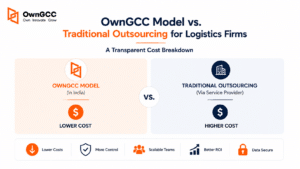
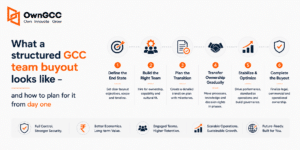
Build-Operate-Transfer exists precisely at that seam. The build risk, the entity setup, the recruiting and the early operating discipline sit with a partner who has done it before. The ownership arrives on a defined timeline. You get the outcome the captive critique says is unreachable, without the project the critique correctly describes as painful.
The honest test to apply to any partner, including us: ask what happens to their revenue when you take ownership. If the answer is that it stops, the transfer is real and it’s priced. If the answer is that the relationship simply continues at a per-seat rate, you are looking at staff augmentation with better vocabulary.
Which model fits your operation
| Your situation | Likely right answer |
|---|---|
| Highly seasonal overflow; no sustained baseline volume | Transactional BPO |
| Need named roles filled in weeks; no appetite for an entity | Staff augmentation or EOR |
| Sustained baseline volume; cost per loan in the bottom quintile | Captive via BOT |
| Repeat defect findings in QC or post-purchase review | Captive via BOT — the fix requires cumulative knowledge |
| Preparing for a GSE or state examination cycle | Captive via BOT — supervisory visibility is the deciding factor |
| Growing servicing portfolio with rising support cost | Captive via BOT, phased from servicing support outward |
| Exploring; want proof before committing to a structure | Start with a defined pilot scope, structured to transfer later |
The threshold question is not company size. It’s whether you have enough sustained, recurring work to keep a dedicated team productive across the cycle rather than only at peaks. Below that line, per-transaction pricing is honestly the better deal. Above it, you are paying a vendor to accumulate knowledge about your business that you will never own.
What a mortgage captive actually runs
- Loan setup, indexing, document management and status follow-up
- Income and asset calculation, verification support, conditions clearing
- Underwriting support operating under your credit authority and supervision structure
- Pre-funding QC sampling and post-close QC against Fannie Mae and Freddie Mac requirements
- Loan delivery data validation across ULDD, UCD and UAD, including edit resolution
- Selling Guide and Seller/Servicer Guide bulletin monitoring, procedure updates, training material maintenance
- Post-close audit, trailing document management, investor condition clearing
- Servicing support: escrow analysis, insurance monitoring, payoff and lien release processing
Whether that team performs depends entirely on how it’s built. A generalist pool with a checklist will not survive a post-purchase review. A dedicated team hired against mortgage-specific criteria, trained on your overlays and investor requirements, operating inside an ISO 27001:2022 information security framework with process discipline applied through structured Lean Six Sigma methods, performs the way a well-run domestic team performs — because it is one, at a cost base that makes ownership viable.
OwnGCC builds the entity and the team, operates it to a defined standard, and transfers ownership on an agreed timeline at transparent, itemised pricing. You can read how the Build-Operate-Transfer model is structured, including what transfers and when.
Frequently asked questions
How much can mortgage process outsourcing actually reduce cost per loan?
We don’t publish a composite percentage, because the honest answer depends on your current cost structure, which functions move, and your volume profile — and any provider quoting a single figure across all lenders is quoting marketing, not analysis. The useful way to frame it is against the MBA benchmarks: with per-loan production expense at $11,898 in Q1 2026 against $727 of production profit, model your own fulfilment cost per loan for the specific functions you’d move, and compare. That calculation is specific to you and it is the only one worth acting on.
What mortgage work legally cannot be performed offshore?
Activity meeting the SAFE Act definition of loan origination — taking the application, offering or negotiating loan terms — requires a licensed originator. In servicing, default decisioning, foreclosure referral and licensed third-party collections stay onshore. Clerical and support work performed under the direction and supervision of licensed staff is treated differently, which is what makes processing, underwriting support, QC and delivery work viable offshore. Confirm the specifics against your state licensing footprint and investor requirements.
Does outsourcing reduce our compliance risk?
No. It redistributes where the work happens and leaves responsibility exactly where it was. The CFPB expects supervised banks and non-banks to oversee service provider relationships so that compliance with federal consumer financial law is assured. Your GSE reps and warrants are unaffected by who performed the work. The relevant question is which model best supports your ability to demonstrate supervision — and direct visibility into a team you own answers that better than a vendor SLA does.
How long does a captive take to stand up?
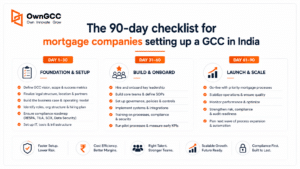
Longer than signing a BPO contract, considerably shorter than a solo entity build. The variable is role seniority — experienced underwriters and QC reviewers take longer to source than processing or data validation staff. The realistic sequence is phased: begin with well-documented functions where output quality is objectively measurable, then layer judgment-intensive roles as the team’s guide knowledge deepens.
How do we protect borrower NPI offshore?
Through the controls a domestic operation already requires, formalised: an ISO 27001:2022-certified environment, role-based access, restricted-egress workstations, audited access logs, and contractual alignment with GLBA and Safeguards Rule obligations that already apply to you. A captive entity means you control those controls directly rather than depending on a shared vendor environment.
Can we start with a BPO and convert to a captive later?
Sometimes, but understand what you’re negotiating for. Under a standard BPO contract the vendor owns the entity, the employment relationships and the accumulated process knowledge — so conversion means buying back something you funded but never owned, from a counterparty with every reason to price it high. If ownership is where you want to end up, structuring for transfer at the outset is materially cheaper than negotiating for it later.
The takeaway
The framing that mortgage process outsourcing is a “strategic solution” is right, and the reason has nothing to do with focusing on core competencies.
It’s that at $11,898 of production expense against $727 of production profit, cost per loan is your strategy. And with the expense gap between the best and worst performing quintiles now averaging over $2,600 per loan, the way you build fulfilment capacity is one of the few decisions large enough to move you between them.
The choice that follows isn’t outsource or don’t. It’s whether, three years from now, you own the capability you spent three years paying for.