
Introduction
Healthcare systems face a compounding set of operational failures that traditional management approaches struggle to fix. According to the WHO, roughly 1 in 10 patients experiences harm during care, with over 3 million deaths annually linked to unsafe care — more than half of it preventable. A JAMA analysis puts annual US healthcare waste at $760 billion to $935 billion, driven largely by administrative complexity and process failures.
Both problems share a root cause: broken processes. Lean Six Sigma (LSS) consultants address this directly. Unlike general management consultants, they apply the DMAIC methodology — a data-driven framework built to identify and eliminate root causes of defects, delays, and waste, not paper over them.
This article covers what LSS consultants do in healthcare settings, where they deliver the strongest results, case studies with documented outcomes, and a practical framework for choosing the right consulting partner.
Key Takeaways
- LSS consultants combine Lean's waste-elimination principles with Six Sigma's statistical rigor to produce measurable clinical and operational improvements.
- Healthcare organizations have used LSS to reduce medication errors, cut ED wait times, lower infection rates, and recover revenue from billing defects.
- External consultants accelerate timelines on complex initiatives; strong ones build internal capability, not ongoing dependency.
- Healthcare-specific experience is non-negotiable — a consultant unfamiliar with clinical workflows and HIPAA will slow progress, not accelerate it.
What Does a Lean Six Sigma Consultant Do in Healthcare?
The Core Role and How It Differs
An LSS consultant is a structured process improvement expert — not a general strategy advisor. The distinction matters. Where a management consultant might recommend organizational changes based on benchmarking or interviews, an LSS consultant deploys statistical tools and formal frameworks to measure process performance, identify root causes, and validate that improvements actually hold.
In healthcare, this typically means leading cross-functional teams through projects targeting measurable defects: delayed discharges, medication errors, high denial rates, or laboratory turnaround times.
The DMAIC Framework in Practice
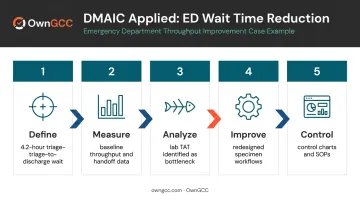
The DMAIC process — Define, Measure, Analyze, Improve, Control — is the primary methodology consultants apply. Here's what it looks like in a real healthcare context, using emergency department wait time reduction as an example:
- Define — Scope the problem: "Patients are waiting an average of 4.2 hours from triage to discharge"
- Measure — Collect baseline data on current throughput, arrival patterns, and handoff times
- Analyze — Identify root causes using tools like fishbone diagrams and process maps; perhaps lab turnaround time is the primary bottleneck
- Improve — Redesign specimen collection workflows and implement parallel processing where possible
- Control — Install control charts and standard operating procedures to sustain the improvement
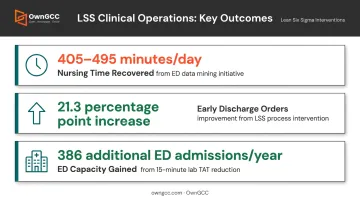
Research supports this approach: one study found that a 15-minute reduction in lab turnaround time could enable 386 additional ED admissions annually at a single site.
Belt Levels and What They Mean for Your Engagement
LSS consultants typically operate at Black Belt or Master Black Belt level:
- Green Belts lead smaller, focused improvement projects within departments
- Black Belts manage high-complexity, cross-functional projects and require demonstrated project completion (ASQ requires at least one completed project with affidavit)
- Master Black Belts operate at a strategic level — mentoring project teams, deploying enterprise-wide programs, and building internal capability
When hiring externally, organizations should expect Black Belt or Master Black Belt-level expertise. A Green Belt alone isn't equipped to lead a complex, organization-wide initiative.
Beyond the Tools: Change Management in Clinical Settings
Managing physician resistance is where many LSS projects succeed or fail. Clinical teams are often skeptical of process standardization, viewing it as a threat to clinical judgment — and that skepticism won't resolve itself through data alone.
Experienced healthcare LSS consultants address this through deliberate engagement strategies:
- Involve physicians early in project scoping, not just during rollout
- Frame improvements in patient safety and outcomes terms, not efficiency metrics
- Use data to surface problems clinicians already recognize but can't easily quantify
- Build physicians into improvement teams so they co-own the solution
Where Lean Six Sigma Consultants Make the Most Impact in Healthcare
Clinical Operations: Patient Flow and Wait Times
LSS consultants map patient journeys across emergency departments, surgical units, and outpatient clinics to find where time is lost. The tools — value stream maps, spaghetti diagrams, time-motion studies — reveal bottlenecks that aren't visible from administrative reports alone.
Documented results from published research include:
- Nursing time freed from manual ED data mining: 405–495 minutes per day after LSS-driven access improvements
- Early discharge orders increased by 21.3 percentage points following an LSS quality improvement project at a Joint Commission Journal-published study
- Lab TAT reductions with direct downstream effects on ED length of stay and capacity
Revenue Cycle and Administrative Operations
Healthcare administrative waste is enormous. The 2023 CAQH Index tracked $89 billion in administrative transaction costs, with $18.3 billion in potential savings from process improvements alone. Insurance claim denials cost health systems an estimated 3–5% of net revenue annually.
LSS consultants address this by:
- Mapping claims workflows to identify where incomplete data or coding errors cause denials
- Applying FMEA to prior authorization and eligibility verification steps
- Reducing rework loops in billing and AR follow-up
In one documented pediatric hospital project, an LSS initiative reduced missing or incomplete insurance information fields by 67%, directly improving clean-claim rates and revenue recovery.
Patient Safety and Clinical Quality
This is where the stakes are highest. The CDC estimates that on any given day, 1 in 31 hospital patients has at least one healthcare-associated infection. Adverse drug events cause roughly 700,000 emergency department visits and 100,000 hospitalizations annually, according to AHRQ.
LSS consultants address patient safety using:
- Root cause analysis to trace defects back to system failures (not individual blame)
- FMEA to proactively identify failure modes before harm occurs
- Control charts to detect process drift before it results in adverse events
A published LSS intervention at an Italian university hospital reduced sentinel bacteria colonization rates from 0.37% to 0.21% in surgical departments, while mean hospitalization days dropped from 45 to 36.
Laboratory and Diagnostic Services
Labs are high-volume, low-tolerance-for-error environments, making them well-suited for LSS intervention. A published study applying LSS to laboratory workflows found:
- Stat sample turnaround time reduced from 68 to 59 minutes
- 3 hours and 22.5 minutes of non-value-added work eliminated daily
- Steps prone to errors or biological hazards reduced from 30% to just 3%
Faster, more accurate results improve clinical decision-making, shorten ED length of stay, and move patients through the system more efficiently.
Supply Chain and Pharmacy Operations
A 2024 systematic review of hospital pharmacy Lean and Six Sigma interventions documented measurable gains across cost and efficiency metrics:
- 26% of reviewed studies reported decreased medication turnaround time
- 81.7% reduction in parenteral antimicrobial expenses in one cited example
- 54.2% decrease in antimicrobial use in another documented case
LSS consultants also help standardize procurement workflows, reduce expired medication waste, and improve dispensing accuracy. These are areas where small process failures compound into significant cost and safety risks.
Real-World Results: What Healthcare Organizations Have Achieved
Stanford Hospital — Cardiac Surgery
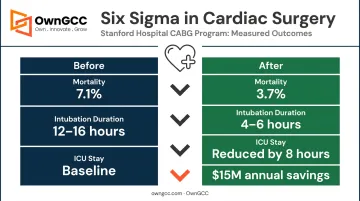
Stanford applied Six Sigma to coronary artery bypass graft (CABG) procedures with documented results that remain among the most cited in healthcare LSS literature:
- Mortality rate reduced from 7.1% to 3.7%
- Post-surgical intubation time cut from 12–16 hours to 4–6 hours
- ICU time reduced by 8 hours
- Estimated $15 million in annual savings from the CABG program alone, with an additional $25 million from other Six Sigma projects across the hospital
Yale New Haven Medical Center — ICU Infection Reduction
Yale New Haven's surgical ICU applied Six Sigma to catheter-related bloodstream infections. Published in the Journal of the American College of Surgeons, the results were clear:
- Infection rate dropped from 11 per 1,000 catheter days to 1.7 per 1,000 catheter days
- Catheters placed between infections increased from 27 to 175
Cleveland Clinic — Continuous Improvement at Scale
Cleveland Clinic built a dedicated Continuous Improvement Department staffed with Lean, Six Sigma, and project management professionals. Their model incorporates tiered daily huddles, visual management boards, safety checklists, and a structured framework called the Cleveland Clinic Improvement Model.
This moves LSS beyond isolated projects — frontline caregivers use it to initiate and sustain improvements on their own, making it an operating discipline rather than a periodic initiative.
In-House LSS Training vs. Hiring a Consultant
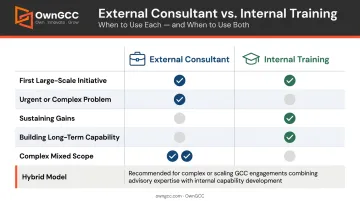
Most healthcare organizations face a practical choice: develop internal capability or engage external experts. The right answer depends on where you are in your improvement journey.
| Situation | Better Approach |
|---|---|
| First large-scale initiative | External consultant |
| Urgent or politically complex problem | External consultant |
| Sustaining gains from completed projects | Internal Green Belts |
| Building long-term capability | Internal training + coaching |
| Complex clinical + administrative scope | Hybrid model |
The hidden costs of going internal-only:
- ASQ Black Belt certification requires significant time investment (exam alone covers 150+ scored questions), plus years of project experience to qualify
- Clinical staff pulled into improvement projects represent real opportunity costs in care settings already stretched thin
- Without dedicated expertise, improvement initiatives often lose momentum after the initial push
For most healthcare organizations, a hybrid approach works best. Engage an external consultant to lead the first wave of projects, train and certify internal Green Belts during the engagement, then gradually transfer ownership. The best consultants measure success by how quickly the client no longer needs them.
What to Look for When Hiring a Lean Six Sigma Consultant for Healthcare
Healthcare Domain Expertise Is Non-Negotiable
An LSS consultant with manufacturing or financial services experience may be highly skilled in DMAIC tools but completely unprepared for clinical workflows, CMS Conditions of Participation, HIPAA Privacy and Security Rule requirements, or Joint Commission standards. The regulatory and cultural context of healthcare is genuinely different.
Questions to ask when assessing domain expertise:
- "Can you describe a specific project you led in a clinical or healthcare administrative setting — what was the problem, what tools did you use, and what did the data show?"
- "How do you engage physician stakeholders who are skeptical of process standardization?"
- "How do you ensure your improvement work stays compliant with CMS QAPI requirements and HIPAA data handling rules?"
A consultant who can't answer these questions concretely — with real examples — should be treated with caution regardless of their Belt level.
Track Record, Transparency, and Accountability
The right LSS consultant demonstrates measurable ROI from past engagements and delivers structured project scoping, milestone reporting, and outcome documentation — not vague promises about culture change.
Before committing, ask for concrete evidence from previous healthcare engagements:
- Documented before/after metrics tied to specific process changes
- Project charters showing defined scope, goals, and timelines
- Control plans demonstrating how gains were sustained post-project
- HIPAA-compliant data handling protocols used during the engagement
OwnGCC's healthcare practice is built on this same standard: HIPAA-compliant workflows, ISO 27001:2022-certified data governance, and SOP-driven delivery with transparent milestone tracking.
Build Capability, Not Dependency
The engagement should end with:
- Trained internal Green Belt practitioners
- Documented standard operating procedures
- Control mechanisms (control charts, audit schedules, review cadences)
- A clear roadmap for continuing improvement independently
If a consultant's engagement model doesn't include a formal knowledge transfer and capability-building phase, find one that does.
Frequently Asked Questions
Is Six Sigma used in healthcare?
Yes. Six Sigma is widely used across hospitals, clinical laboratories, and administrative operations. Published research shows consistent growth in healthcare LSS adoption since the early 2000s, with a particular concentration in patient safety, hospital quality improvement, and revenue cycle applications.
Is Six Sigma still relevant in healthcare in 2026?
Yes — and its relevance is growing. LSS now integrates directly with AI-driven analytics, machine learning, and digital health tools, including applications in radiation oncology QA and clinical laboratory optimization. That makes it more powerful than ever for healthcare systems facing simultaneous cost and quality pressures.
What is a Six Sigma consultant?
A Six Sigma consultant is a certified process improvement expert (typically Black Belt or higher) who helps organizations apply DMAIC frameworks to identify inefficiencies and achieve measurable improvements in quality, speed, and cost. Most operate across multiple departments or client engagements simultaneously, managing projects from scoping through the control phase.
Which Six Sigma certification is best for healthcare?
Green Belt is the most common entry point for healthcare professionals leading department-level projects. Black Belt certification suits those managing large-scale, organization-wide initiatives. Some certification bodies also offer healthcare-specific LSS credentials tailored to clinical and administrative contexts.
What are common Lean Six Sigma projects in healthcare?
The most common project types include: reducing emergency department wait times, decreasing medication errors, improving laboratory turnaround time, reducing hospital-acquired infection rates, and streamlining insurance claims processing and denial management.
How long does a Lean Six Sigma consulting engagement typically take in healthcare?
Most DMAIC projects run 3 to 6 months from scoping to control phase. Larger organization-wide programs — particularly those involving multiple departments or care settings — typically span 12 to 18 months, often structured as phased rollouts.