Managed GCCs have emerged as a direct answer to this frustration. India's GCC market reached $64.6 billion in FY2024 and is projected to hit $99–105 billion by 2030, according to Nasscom-Zinnov — a signal that enterprises are moving decisively toward ownership-based delivery models.
This guide breaks down exactly what separates a Managed GCC from traditional outsourcing, where each model works best, and how to evaluate which one fits your strategic direction.
Key Takeaways
- A Managed GCC gives you a dedicated offshore team you direct, with a specialist partner handling operations and infrastructure
- Traditional outsourcing is vendor-owned and SLA-driven; effective for transactional work, limiting for anything strategic
- Managed GCCs use transparent, per-seat pricing; outsourcing bundles costs into vendor margins that compound at scale
- The progressive GCC model lets you start with an outsourcing-style engagement and transition into full team ownership over time
- Compliance-heavy sectors like mortgage, insurance, fintech, and healthcare increasingly favor the GCC model for data governance and regulatory accountability
Managed GCC vs Outsourcing: At a Glance
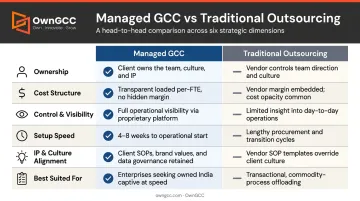
Here's how the two models compare across the six dimensions that matter most to enterprise decision-makers.
| Dimension | Managed GCC | Traditional Outsourcing |
|---|---|---|
| Ownership | Team is built for and owned by the client | Team is vendor-owned, serves multiple clients |
| Cost Structure | Transparent, OpEx-based management fee | Contract-based, often bundled and opaque |
| Control & Visibility | Client sets direction, culture, and processes | Vendor controls delivery methodology |
| Setup Speed | Faster to stand up with a specialist partner | Can deploy in weeks for standard processes |
| IP & Culture Alignment | Knowledge and culture stay inside the enterprise | Vendor retains process knowledge |
| Best Suited For | Strategic, high-value, compliance-heavy functions | Transactional, commoditized work |
What Is a Managed GCC?
A Managed GCC (sometimes called GCC-as-a-Service) is an offshore or nearshore capability center set up and operated by a specialist partner on behalf of the parent company. The team works exclusively for the client, under the client's brand, culture, and strategic direction. This is the critical distinction from outsourcing: the talent belongs to the enterprise, not the vendor.
Core Features That Define the Model
- Staff hired exclusively for your organization, aligned to your processes and culture
- Per-seat or subscription-style fees with no hidden vendor margin
- Compliance, payroll, facilities, and HR managed by the specialist partner
- Client can transition to full captive ownership over time, or retain the managed model indefinitely
This structure eliminates heavy upfront capital expenditure while still building a long-term organizational asset. Enterprises get GCC outcomes without the 12–18 month setup burden of building a captive from scratch.
The Progressive GCC Model
Rather than choosing between full captive ownership on day one or permanent vendor dependency, enterprises can start with a managed engagement and gradually assume ownership of the team, processes, and governance.
OwnGCC's GCC-as-a-Service model is built around this progression. Clients start with a subscription-based Virtual Staffing engagement (operational in 4–8 weeks, no legal entity required), then move toward Managed Teams, Build-Operate-Transfer, or a fully client-owned India captive as scale develops. The ownership trajectory is built in from the start.
Two Common Delivery Sub-Models
Build-Operate-Transfer (BOT): The partner builds and operates the center through a defined period, then transfers the legal entity, team, and infrastructure to full client ownership once scale stabilizes.
Ongoing Managed Model: The client retains operational oversight and work direction indefinitely through the partner relationship, without taking on entity or HR complexity.
Where Managed GCCs Deliver the Most Value
Managed GCCs are strongest in high-complexity, process-intensive, and compliance-heavy functions — areas where institutional knowledge and cultural alignment are genuinely competitive advantages:
- Mortgage processing, QC/QA, and post-closing operations
- Financial reporting and back-office finance
- Insurance claims, underwriting support, and policy administration
- Healthcare operations under HIPAA-governed frameworks
- Analytics, data engineering, and customer support
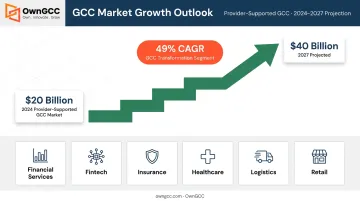
The industries gaining the most traction with this model are financial services, fintech, insurance, healthcare, logistics, and retail — sectors where team ownership and data governance aren't optional extras. According to Everest Group, the provider-supported GCC market is projected to double from roughly $20 billion in 2024 to $40 billion by 2027, with the GCC transformation segment growing at a 49% CAGR over the same period.
What Is Traditional Outsourcing?
Traditional outsourcing is a contractual arrangement where a company assigns specific business processes to a third-party vendor, who delivers those services using their own staff, systems, and management structures. The vendor owns the team and is accountable for meeting defined SLAs — not for building enterprise capability.
Core Characteristics
- Staff serve multiple clients at once — loyalty runs to the vendor, not your organization
- Client control is limited: hiring decisions, team culture, and process design stay with the vendor
- Pricing ties to contract terms with vendor margin embedded throughout, making true cost visibility difficult
- During volume surges, your account competes with other clients for the vendor's attention
Where Outsourcing Still Makes Sense
Outsourcing works well for high-volume, well-defined, commoditized processes where speed of deployment outweighs team ownership. Think basic helpdesk support, data entry, standard application maintenance, or short-term capacity gaps where building proprietary capability isn't the goal.
Where Outsourcing Shows Its Limits
As enterprises scale, the structural weaknesses of outsourcing become harder to ignore:
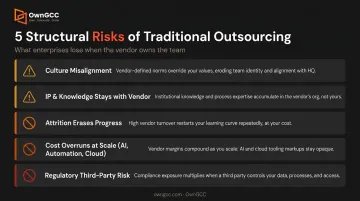
- Vendor staff follow vendor norms — your culture never takes root
- Process IP and institutional knowledge accumulate with the vendor, not inside your organization
- Attrition erases progress: Everest Group identified attrition as the single biggest obstacle enterprises face with technology service providers — every departure takes process memory with it
- Cost control breaks down at scale when vendors manage embedded AI, automation, and cloud environments — a pattern KPMG flags as a leading source of service and licensing cost overruns
- In regulated industries, running business-critical functions through shared vendor infrastructure creates third-party risk that regulators actively scrutinize
Managed GCC vs Outsourcing: Which Is the Better Fit?
The right answer comes down to five factors: strategic intent, desired ownership level, budget flexibility, function type, and compliance sensitivity.
Choose a Managed GCC If:
- You want to own and shape the team delivering your work
- You operate in compliance-heavy sectors — mortgage, insurance, fintech, healthcare — where data governance is a regulatory requirement, not a preference
- You need cost transparency without hidden vendor margin
- You view offshore capability as a long-term strategic asset, not a temporary cost fix
- You want the option to transition to full captive ownership as the team and processes mature
Choose Traditional Outsourcing If:
- You need immediate capacity for a well-defined, transactional process
- The function has no strategic sensitivity — no IP exposure, no compliance complexity
- You have no intention of building proprietary capability in this function
- Short-term flexibility and low initial friction outweigh long-term ownership concerns
The Middle Ground: Progressive GCC
For enterprises that want speed now but ownership later, the progressive GCC model resolves the false choice. You engage with outsourcing-level speed and simplicity, with a structured path to team ownership built into the contract from day one.
The financial case for this shift is well documented. As outsourcing contracts grow, so do vendor margins, coordination overhead, and switching costs. Deloitte's 2024 Global Outsourcing Survey of 500+ executives found only 25% were seeing vendor cost reductions or meaningful service-quality improvements — a clear signal that outsourcing outcomes erode as vendor dependencies deepen.
Making the Switch: A Real-World Scenario
Consider a mid-sized US-based mortgage lender that had been outsourcing loan processing, compliance documentation, and reporting to a third-party BPO for several years.
The problem that developed:
- Fee structures became difficult to audit — costs kept rising without clear justification
- Vendor-side attrition was creating repeated knowledge loss; new staff kept relearning the same loan types and compliance requirements
- Regulators began asking tighter questions about third-party oversight, data access, and process accountability — an increasingly real concern given CFPB guidance requiring supervised institutions to maintain direct oversight of service-provider compliance
The trigger: A volume spike required rapid scaling. The vendor offered to flex capacity — at a significant cost increase that included margin on every additional seat. Leadership also realized they had no institutional ownership over the people doing the work or the processes they followed. When the vendor relationship ended, everything would leave with it.
The decision: The lender transitioned to a Managed GCC model. A specialist partner set up a dedicated offshore team — exclusively serving the lender, trained on their SOPs, embedded in their reporting structure, and operating under their compliance frameworks.
The team processed conventional, FHA, VA, and Non-QM files; handled pre-funding and post-closing QC; and managed investor reporting for Fannie Mae and Freddie Mac.
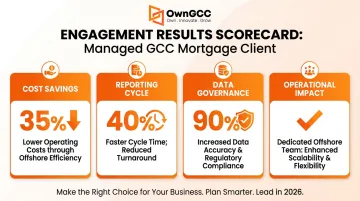
Consistent with benchmarks across OwnGCC's mortgage engagements, the results were measurable:
- 40–60% loaded-cost reduction compared to equivalent domestic capacity
- Faster reporting cycle times through a dedicated, always-available team
- Stronger data governance via client-controlled infrastructure the lender owned outright
The team belonged to the lender. The process IP stayed inside the organization.
The takeaway: For enterprises in compliance-intensive industries, the shift from outsourcing to a Managed GCC isn't only a cost decision — it's a strategic repositioning. If you're evaluating a similar transition, OwnGCC's progressive GCC model offers a clear progression from managed engagement to full captive ownership, without requiring a heavy upfront commitment.
Conclusion
Neither model is universally better. Outsourcing still serves a purpose for transactional, non-strategic functions where speed and simplicity matter more than ownership. But for knowledge-intensive, compliance-driven operations — mortgage processing, insurance claims, financial reporting, healthcare back-office — the logic has shifted toward the GCC model.
The right decision isn't just about today's cost. It's about where you need to be in three to five years. Two questions cut through the noise:
- Do you want the people doing your most critical work to belong to you or to a vendor?
- Do you want process IP that compounds inside your organization, or one that walks out the door when a contract ends?
OwnGCC's progressive ownership path — from Managed Teams to Build-Operate-Transfer to a fully client-owned captive — gives you the speed to start in 4–8 weeks and the structure to own what you build over time.
Frequently Asked Questions
What is the difference between a GCC and managed services?
A GCC (Global Capability Center) is the organizational structure — a dedicated offshore or nearshore team built for a single enterprise. Managed services refers to how that center is operated, typically by a specialist partner on the client's behalf. A Managed GCC brings these together: the enterprise retains the dedicated team structure while a specialist partner handles day-to-day operations.
Is a Managed GCC the same as outsourcing?
No. In outsourcing, the vendor owns and manages the team. In a Managed GCC, the team is dedicated exclusively to you, works under your brand and direction, and follows your processes — even if a partner handles the operational setup. Intellectual property, accumulated process knowledge, and cultural alignment stay with the enterprise.
How long does it take to set up a Managed GCC?
A self-built captive center typically requires 12–18 months or more. With a specialist partner managing incorporation, hiring, and infrastructure, a Managed GCC can be operational in as little as 4–8 weeks for lighter engagement models, with more complex builds taking longer depending on scope.
What business functions are best suited for a Managed GCC?
High-value, knowledge-intensive, and compliance-sensitive functions are the strongest fit: mortgage processing and QC/QA, financial reporting, insurance claims and underwriting support, healthcare back-office operations, analytics, and customer support — areas where team ownership and process continuity directly affect business outcomes.
Can a company transition from outsourcing to a Managed GCC?
Yes, and it's a common path. Many enterprises start with outsourcing to reduce upfront risk, then move to a Managed or Build-Operate-Transfer model once they're ready to own their team — with ownership transferring in defined phases rather than all at once.
What is the difference between a GCC and an MNC?
An MNC (multinational company) is a corporation that operates in multiple countries. A GCC is a specific type of offshore or nearshore operational unit that a company establishes to deliver business functions from a lower-cost, high-talent geography — most commonly India — as one component of an MNC's global operating model.