
But here's the problem most enterprises discover too late: the consulting partner you choose to build that GCC largely determines whether you end up with a genuine strategic asset or an expensive, vendor-dependent liability.
Most GCC consulting partners are optimized for their own retention — vendor-owned teams, opaque cost structures, and limited knowledge transfer keep you coming back. This guide gives US enterprise leaders a practical framework to evaluate GCC consulting partners before committing.
Key Takeaways
- The right GCC consulting partner ensures you own the outcome, not just the invoice
- Evaluate partners on ownership model, domain depth, compliance posture, and cost transparency
- The wrong partner creates vendor lock-in, cultural misalignment, and a center that never evolves beyond cost arbitrage
- Flexible models (Build-Operate-Transfer, GCC-as-a-Service) let enterprises start lean and move toward full ownership progressively
- Vertical-specific expertise in mortgage, insurance, fintech, or healthcare cuts 6–12 months off your ramp time
What Is a GCC Consulting Partner?
A GCC consulting partner is a specialized firm that helps enterprises plan, build, staff, and operate Global Capability Centers in talent-rich geographies. This goes well beyond staffing or real estate — it covers strategy, compliance, governance, and ongoing operations.
In a GCC model, the enterprise owns or controls the team, the IP, and the processes. The consulting partner provides infrastructure, expertise, and operational support — not a managed service where the vendor retains control. These centers also go by other names — Global In-House Centers (GICs) or captive centers — but the ownership principle is consistent across all of them.
What GCC Partners Typically Cover
A full-scope GCC consulting partner should provide:
- Location strategy, operating model design, and business case development before launch
- Legal entity formation, infrastructure setup, and talent acquisition during setup
- Governance frameworks, compliance management, and scaling support once operational
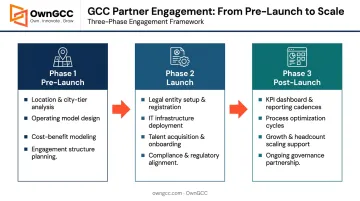
Partners who only cover part of this spectrum — say, location selection and entity setup — create dangerous handoff gaps at the exact moment execution momentum matters most.
Why the Right GCC Partner Is a Make-or-Break Decision
Choosing the wrong GCC partner creates structural problems that compound over years — and unwinding them costs far more than the original setup ever did.
Everest Group's 2025 analysis found that fewer than 10% of GCCs had reached the highest maturity tier, and more than 60% of approximately 800 analyzed GCCs had not sufficiently standardized their processes. The root cause is rarely technology. It's a partner-selection and governance problem.
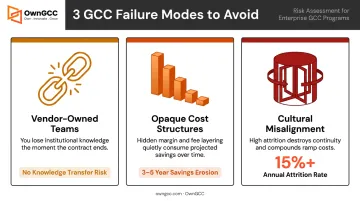
Three Failure Modes US Enterprises Encounter
1. Vendor-owned teams with no knowledge transfer When the consulting partner controls the employment relationship, institutional knowledge stays with the vendor. At contract exit, the enterprise inherits a gap — not a capability.
2. Opaque cost structures that erode projected savings Everest Group specifically identified real estate, compliance, and cybersecurity as underestimated GCC operating expenses that can erode cost advantages within 3–5 years. The headline rate rarely reflects what you actually pay.
3. Cultural misalignment driving attrition and disengagement Annual attrition in GCC tech roles can exceed 15%, with higher rates in operations roles — and cultural disconnects combined with weak local leadership pipelines make this worse. A partner who doesn't invest in local culture and career pathways hands you a revolving door.
Each of these failure modes is preventable — but only if the partner you select is accountable for outcomes, not just delivery. The right partner compresses setup timelines, absorbs regulatory complexity, and builds the internal capability that lets the center evolve beyond cost reduction into a strategic asset.
Key Factors to Evaluate When Choosing a GCC Consulting Partner
Not all GCC partners are built the same. Some excel at advisory but struggle with execution. Others set up the center and disappear post-launch. The six factors below connect partner capability to measurable enterprise outcomes.
End-to-End Enablement Scope
The transition from strategy to operations is where most GCC programs lose momentum. Partners who only cover part of the journey — entity setup, for example, but not governance design or scaling support — create handoff gaps that become expensive to close after launch.
Ask any prospective partner to walk you through exactly what they own at each phase:
- Pre-launch: Location analysis, operating model design, cost-benefit modeling
- Launch: Legal entity, IT infrastructure, talent acquisition, compliance setup
- Post-launch: KPI frameworks, reporting cadences, process optimization, growth support
Any phase with a vague answer is a phase where your risk is unmanaged.
Engagement Model and Ownership Structure
This is the single most consequential factor. The engagement model determines whether you're building equity in your own capability or renting someone else's infrastructure permanently.
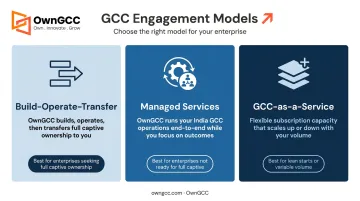
The models worth understanding:
| Model | What It Means | Best For |
|---|---|---|
| Build-Operate-Transfer (BOT) | Partner builds and operates; transfers ownership at defined milestones | Enterprises wanting eventual full captive ownership |
| Managed Services | Partner handles operations ongoing; client retains strategic direction | Enterprises not ready for full captive |
| GCC-as-a-Service | Subscription-based, flexible capacity, no heavy upfront investment | Enterprises starting lean or managing volume variability |
The key question: at what point do you achieve complete operational independence, and does the contract actually support that? Watch for multi-year lock-ins, penalties for scaling down, and arrangements where the partner controls the employment relationship.
A well-structured contract accelerates your path to ownership rather than tethering you to the partner's revenue model.
Domain Expertise in Your Industry Vertical
Generic GCC partners apply one-size-fits-all playbooks. The problem: mortgage operations, healthcare data workflows, and insurance underwriting support have completely different compliance requirements, talent profiles, and process complexity. A partner who's never navigated RESPA, HIPAA, or NAIC requirements will learn on your time and your budget.
A partner with deep vertical experience already knows:
- The right compliance architecture for your regulatory environment
- The specific talent archetypes that perform in those functions
- The process pitfalls that trip up new GCC operations in your sector
Require case studies that show specific functions built, measurable outcomes achieved, and client references in your industry. General GCC credentials are the baseline requirement. Vertical-specific track records are what actually differentiate partners.
Location Strategy and Access to Global Talent
Location isn't just about cost. It's about talent density, infrastructure quality, regulatory stability, and whether the partner has actual on-the-ground relationships in those markets — that last factor matters more than most enterprises realize.
A few data points worth knowing:
- Tier II and III Indian cities offer 25–30% cost reductions versus Tier I cities and already host 215+ GCC units, per Zinnov-NASSCOM 2024 data
- India's GCC ecosystem includes 500+ centers with AI/ML capabilities and 120,000+ AI professionals
- Partners with presence only in Tier-1 cities may miss meaningful cost and talent advantages

The location decision directly affects time-to-hire, fully-loaded talent cost, attrition rate, and your ability to scale without quality degradation. A partner with multi-geography reach gives you flexibility to adapt your strategy rather than locking you into a single market.
Compliance, Data Security, and Governance Posture
US enterprises in financial services, healthcare, and insurance operate under strict data governance requirements. Your GCC partner's compliance posture directly affects your own regulatory standing.
Look for:
- ISO 27001 certification — the international benchmark for information security management
- HIPAA and SOX alignment for relevant functions
- Cross-border data transfer protocols compliant with India's Digital Personal Data Protection (DPDP) Act 2023 and applicable US frameworks
- Governance design from day one — KPIs, reporting cadences, and operating model controls established at launch, not retrofitted at month 18
Governance gaps are rarely visible at contract signing. They surface when something goes wrong. Push them specifically on how governance is structured at launch, and who holds accountability for compliance monitoring as the center scales.
Cost Transparency and Contractual Flexibility
Quoted rates in GCC engagements typically exclude infrastructure overhead, HR administration, compliance costs, and vendor margins layered into team costs. Real estate, compliance, and cybersecurity are categories where cost underestimation is common and where projected cost advantages erode fastest.
Require fully-loaded cost models broken down by component from any partner — not a headline per-FTE rate.
On contractual flexibility, evaluate:
- Are you locked into multi-year contracts with penalties for scaling down?
- Does the contract include defined ownership-transfer provisions?
- Are contract terms aligned to your growth trajectory or to the partner's retention goals?
The right partner structures contracts around your milestones, not their margin.
How OwnGCC Helps US Enterprises Build GCCs They Truly Own
OwnGCC was built around a principle that the traditional outsourcing industry resists: the enterprise should own its team, its culture, and its outcomes — not remain permanently dependent on a vendor. With over 29 years of combined experience building and scaling GCCs across major enterprises, the model was specifically designed to eliminate the structural flaws of conventional outsourcing.
The core philosophy: you own your team, you shape the culture, OwnGCC drives the operational outcomes.
What this looks like in practice:
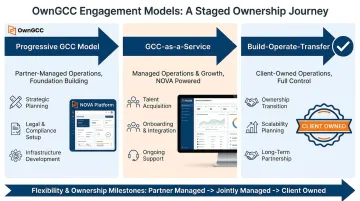
- Progressive GCC Model: Start with a managed arrangement and evolve into full captive ownership without rebuilding from scratch — removing the "big bet" risk while keeping the ownership trajectory intact
- GCC-as-a-Service: Subscription-based access with no heavy upfront capital, flexible capacity for volume spikes, and 30–50% cost optimization vs. traditional outsourced operations
- Build-Operate-Transfer: A phased path from partner-operated to client-owned, with defined milestones at each stage
OwnGCC's domain depth is particularly relevant for US enterprises in regulated industries. The firm brings 15+ years of mortgage industry experience across 100+ lenders — origination support, underwriting, servicing, and post-closing QC.
For insurance clients, coverage spans claims processing, underwriting support, policy administration, actuarial services, and NAIC/state DOI compliance. Documented loaded-cost reductions for insurance engagements run 30–50%.
Beyond mortgage and insurance, OwnGCC serves:
- Fintech: payments, compliance, and risk analytics operations
- Healthcare: HIPAA-compliant workflows and claims processing
- Manufacturing & Logistics: supply chain support, ERP integration, and process automation
Each engagement is calibrated for industry-specific compliance, talent, and workflow requirements — not adapted from a generic template.
On compliance and security, OwnGCC holds ISO 27001:2022 certification and SOC compliance, with operational experience across HIPAA, FEMA, RBI, India's DPDP Act, transfer pricing requirements, and NAIC/state DOI frameworks.
The NOVA GCC operating platform adds a further layer: governance visibility and operational transparency, powered by automation and data analytics.
India delivery currently operates across Bangalore, Hyderabad, Pune, and Chennai, with expansion roadmaps covering Tier-2 and Tier-3 city access for additional cost and talent optimization — plus emerging reach into the Philippines, Vietnam, and South America.
Conclusion
The right GCC consulting partner is the one whose engagement model, domain depth, and governance approach give your enterprise real ownership, operational control, and a clear path to building internal capability — not just a cheaper delivery arrangement.
This decision compounds over time. A partner that works for a 20-person team in year one may need to be renegotiated — or replaced — when you're at 150 people in year three. Revisit these six evaluation criteria as your GCC evolves:
- Scope of services — does the partner still cover what you actually need?
- Ownership model — are you gaining independence or deepening dependency?
- Domain expertise — does their depth match your current operational complexity?
- Location and talent access — can they scale in the right cities?
- Compliance coverage — does it keep pace with regulatory changes in your industry?
- Cost transparency — are you still getting the structure you agreed to?
Start by evaluating partners against these criteria — then revisit them every 12–18 months as the GCC scales. The firms worth working with will welcome that conversation.
Frequently Asked Questions
Which companies come under GCC?
GCCs are fully owned offshore subsidiaries of the parent enterprise — JPMorgan Chase, Citi, Google, and hundreds of mid-market US firms operate them, primarily in India. The "GCC" label refers to the ownership model (enterprise-owned captive), not a specific sector. Any company can establish one.
What is the difference between a GCC consulting partner and a traditional outsourcing vendor?
A GCC consulting partner helps the enterprise build and own its offshore capability. A traditional outsourcing vendor retains control of the team and processes. The key distinctions are IP ownership, team loyalty, and contractual path to operational independence.
How long does it typically take to set up a GCC with a consulting partner?
Timelines depend on model complexity. A GCC-as-a-Service or BOT arrangement can achieve operational readiness in 3–6 months; a full captive center setup typically takes 9–18 months. Partners with pre-built infrastructure and active talent pipelines can cut that range by several months on either end.
What are the biggest risks of choosing the wrong GCC consulting partner?
Three primary risk categories to watch:
- Operational: Delayed setup and governance gaps that surface after launch
- Financial: Hidden costs that erode projected savings within 3–5 years
- Strategic: Vendor dependency that prevents the GCC from evolving into a true capability hub
What engagement models do GCC consulting partners offer, and which is best for US enterprises?
The main models are Build-Operate-Transfer, Managed Services, and GCC-as-a-Service. The right choice depends on risk appetite and ownership timeline. Enterprises new to GCCs often benefit from GCC-as-a-Service first, transitioning toward captive ownership as the center matures.
How do I evaluate a GCC partner's domain expertise for my industry?
Ask for client references in your specific vertical, and review case studies showing measurable outcomes — not just setup activities. Assess whether their talent acquisition playbook reflects industry-specific role profiles and compliance requirements. A partner who has placed actuaries, underwriters, or loan processors in your sector will move faster and make fewer costly mistakes than a generalist.