The vendor invoice for your logistics back office is clean. One line, fixed monthly fee, easy to put in front of a CFO. That cleanliness is exactly the problem — a single line item is not a cost structure, it’s a number with everything that produces it hidden behind it.
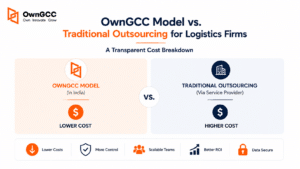
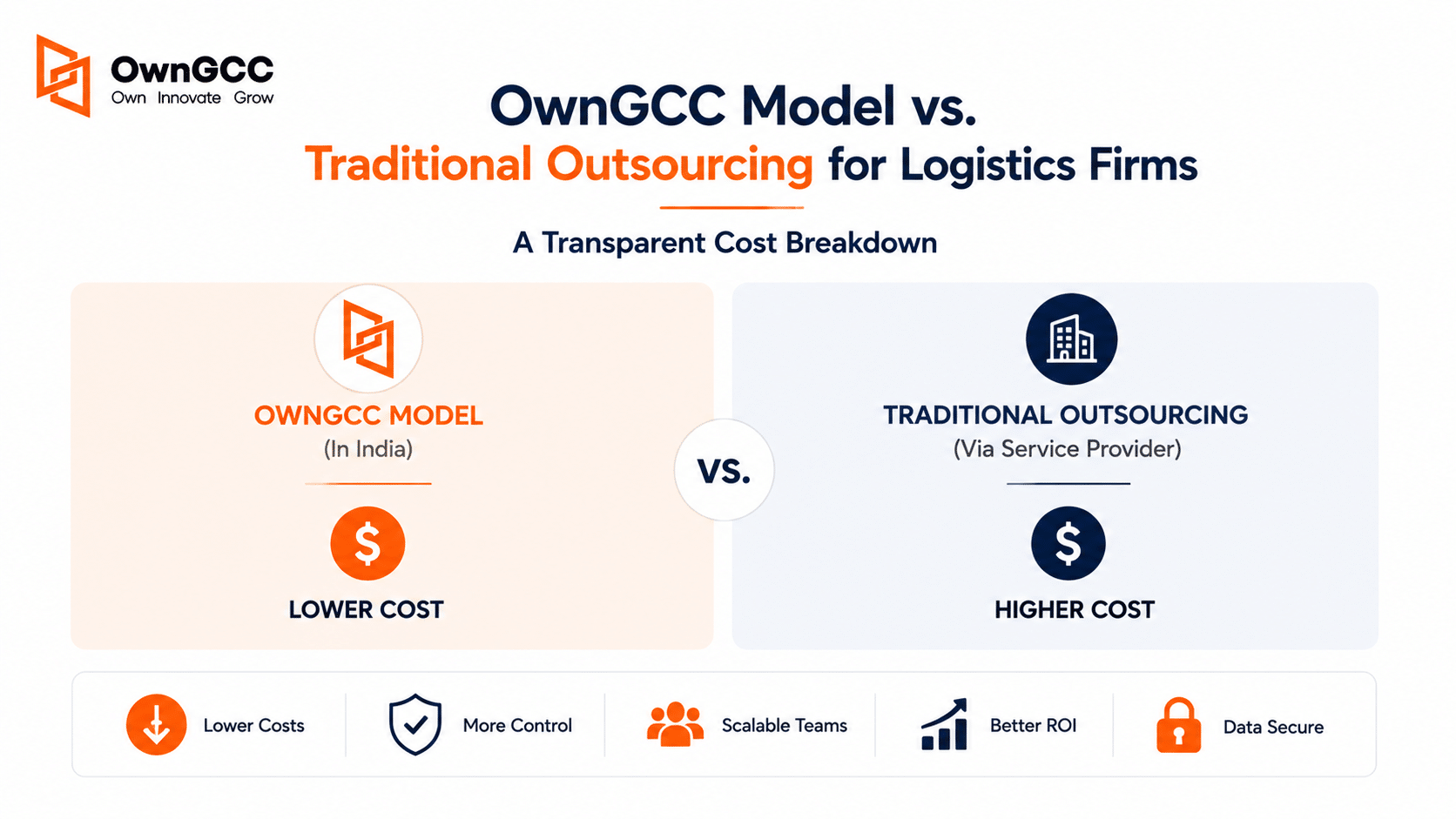
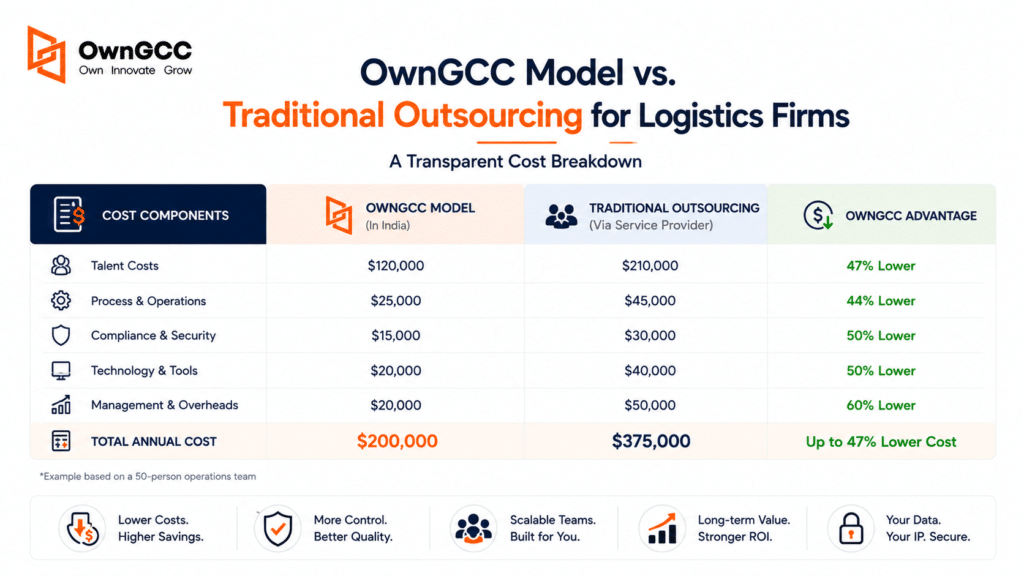
Freight is a margin business, and margin businesses can’t afford to be vague about where money actually goes. This is a line-by-line comparison of what a traditional logistics outsourcing vendor’s invoice is actually built from, set against what a transparent Build-Operate-Transfer engagement looks like for the same work — built to be forwarded to a CFO, not just read once and closed.
What’s Actually Inside a Traditional Outsourcing Invoice
A vendor billing rate for freight audit, track-and-trace, or documentation talent in India isn’t the resource’s cost — it’s the resource’s cost plus every layer the vendor needs to stack on top to run their business at scale. That stack typically includes:
The talent markup. Experienced logistics back-office talent — freight audit specialists, track-and-trace analysts, carrier compliance coordinators — is fully loaded at a fraction of what vendors bill for the same profile. The gap between what the vendor pays the person and what they bill you is the vendor’s margin, not a reflection of the work’s actual cost.
Productivity loss behind SLA reporting. A vendor can report that 98% of freight invoices were audited within SLA while never disclosing how many discrepancies slipped through, how many accessorial disputes your team had to chase after the fact, or how much of your US ops team’s time went into catching what the vendor’s QA should have caught. The SLA metric and your actual throughput are not the same number.
Attrition you’re paying for without seeing it. High-volume logistics back-office roles — track-and-trace, documentation — see meaningful annual attrition in vendor environments, where career paths are limited and the work is repetitive. Every departure triggers a 30-to-90-day ramp for the replacement, during which error rates rise and your team absorbs the gap. The invoice doesn’t move. Your operational cost does.
Data and fraud exposure. Freight fraud, identity theft, and double-brokering are active operational risks in US trucking, and a vendor’s multi-tenant environment — where your carrier compliance data sits alongside other clients’, sometimes your competitors’ — is a structurally weaker place to run fraud screening and carrier vetting than an environment you control directly.
The exit tax. Most outsourcing contracts carry 90-to-180-day notice periods, during which you’re paying full rates for a team that already knows it’s being wound down. Add data extraction friction and a replacement ramp on whatever comes next, and exiting a vendor relationship routinely costs six to seven figures in disruption alone — a cost the sales deck never mentions.
The Line-Item Comparison
| Cost Component | Traditional Outsourcing Vendor | OwnGCC (Build-Operate-Transfer) |
|---|---|---|
| What You’re Billed | Vendor’s marked-up hourly rate with limited visibility into the underlying cost structure. | Transparent breakdown of salary, infrastructure, and management costs from Day One. |
| Talent Ownership | The vendor employs the team, so institutional knowledge and employee relationships remain with them. | The team is hired directly into a dedicated entity created exclusively for your business. |
| Attrition Cost | Hidden within repeated hiring, training cycles, and operational errors, with limited vendor incentive to reduce turnover. | Lower through a captive team model where attrition costs are visible, measurable, and actively managed. |
| Data & Fraud Control | Multi-tenant infrastructure where operational and customer data coexist with other clients. | Dedicated environment protected by ISO 27001:2022-aligned controls and designed exclusively for your operation. |
| Exit Cost | Often significant due to notice periods, data extraction challenges, knowledge transfer, and replacement ramp-up. | No exit tax—the BOT model is designed for ownership transfer rather than long-term vendor dependence. |
| Long-Term Cost Trajectory | Billing rates typically increase at contract renewals, with little opportunity for cost reduction. | Costs decrease as the engagement progresses from Build to Operate to Transfer and vendor markup is eliminated. |
| What You Own at the End | Nothing beyond the service delivered—the team, processes, and expertise remain with the vendor. | Full ownership of the legal entity, team, operational knowledge, and intellectual property. |
An Illustrative Cost Trajectory
Consider a 30-person logistics back-office team — combining freight audit, track-and-trace, and documentation and billing support — currently running through a traditional outsourcing vendor at a typical mid-market billing rate. Annual vendor cost for a team of this size and function mix commonly lands in the $1.8–2.3 million range.
Modeled instead as a captive team built through a transparent BOT engagement:
| Phase | Timeframe | What’s Happening | Illustrative Annual Cost |
|---|---|---|---|
| Build | Year 1 | Entity formation, team hiring, training, and infrastructure setup. Overall costs remain close to those of an outsourced vendor during the initial launch. | Roughly comparable to the previous vendor cost for the same operating period. |
| Operate | Year 2 | The team stabilizes, attrition declines, and operational quality exceeds typical vendor benchmarks. | Meaningfully lower than vendor costs as markup is removed and productivity improves. |
| Transfer | Year 3 Onward | Ownership of the legal entity, team, operational processes, and data is fully transferred to your organization. | The lowest point in the cost curve—logistics GCCs built through OwnGCC typically operate at approximately 40–60% of the equivalent in-house or outsourced operating cost. |
The numbers above are illustrative, scaled from real cost patterns documented across mid-market outsourcing-to-captive transitions — not a specific client’s figures — but the shape of the curve holds consistently: Year 1 is close to a wash, and the savings compound structurally from Year 2 forward, the same trajectory documented in OwnGCC’s broader analysis of hidden outsourcing costs.
Why This Is Structurally Different, Not Just Cheaper Marketing
The reason a BOT-built logistics team can be transparent about cost where a vendor can’t isn’t a pricing philosophy — it’s a structural one. A vendor’s business model depends on the spread between what they pay talent and what they bill you; disclosing that spread would undercut their own margin. A dedicated entity built for eventual transfer has no equivalent spread to protect — the salary, infrastructure, and management costs you see are the real costs, because in a BOT model, you’re the one who eventually owns them directly.
That’s also why the comparison holds up under scrutiny in a way vendor pricing rarely does: there’s no incentive to hide the underlying cost structure when the entire model is designed around handing that structure to you.
Building the Internal Business Case
For ops and finance leaders taking this comparison into an internal build-versus-buy decision, three numbers matter most:
Current vendor cost, fully loaded — not just the invoice, but the estimated cost of rework, escalations, and onshore hours spent compensating for offshore gaps, which typically adds 20–40% on top of the stated vendor bill.
Year 1 cost parity — a properly structured BOT build should land close to your current vendor cost in the first year, which is the number that most effectively rebuts the assumption that ownership costs significantly more upfront.
Multi-year trajectory — the compounding savings from Year 2 onward, set against a vendor relationship where billing rates typically escalate at renewal rather than decline. Over a five-year horizon, this is usually the single largest number in the business case.
A team assessing this shift is also operating in a broader GCC market where more mid-market operators — not just enterprise players — are making the same calculation and reaching the same conclusion about ownership economics.
FAQs
Is building a captive team actually cheaper than outsourcing in Year 1, or just eventually?
Year 1 cost for a well-structured BOT build is typically close to what you’re already paying a vendor for equivalent work — not dramatically higher, and not dramatically lower. The real cost advantage shows up from Year 2 forward, once the team stabilizes and the vendor markup that no longer exists compounds into visible savings.
How do we know OwnGCC’s pricing is actually transparent and not just a different sales pitch?
The structural test is whether the model has an incentive to hide costs. A vendor’s margin depends on the spread between what they pay talent and what they bill you — disclosing it undercuts their business. A BOT engagement is built around eventual ownership transfer, so there’s no equivalent spread to protect; the cost structure you’re shown is the one you’ll eventually own directly.
What’s the biggest hidden cost in our current outsourcing relationship that we’re probably not tracking?
For most logistics operators, it’s the onshore hours spent compensating for offshore gaps — correcting freight audit discrepancies, chasing documentation the vendor team should have caught, managing escalations the vendor’s SLA metric doesn’t reflect. This cost is real, substantial, and almost never shows up as a line item anywhere.
Does a captive model reduce our freight fraud and data exposure risk, or just our cost?
Both. A dedicated, ISO 27001:2022-certified environment built specifically for your operation removes the multi-tenant exposure inherent in vendor environments, where your carrier and shipment data shares infrastructure with other clients — a meaningful consideration given how central carrier vetting and fraud screening have become to logistics operations.
How large does our logistics operation need to be to make this comparison worth running?
The BOT model is viable for logistics operators with roughly 20 or more offshore-ready back-office roles across functions like freight audit, track-and-trace, dispatch, and documentation — a threshold that includes a broad range of mid-market brokerages, 3PLs, and carriers, not just enterprise-scale operators.