You’ve narrowed your India GCC shortlist to two cities. Chennai and Pune keep showing up in every consultant deck, every peer conversation, every RFP response from Indian real estate advisors. Both are credible. Both have real infrastructure. Both have universities producing engineers and MBAs at scale.
But you’re not building a generic technology center. You’re building a Global Capability Center for logistics and supply chain — and that specificity changes the answer entirely.
At OwnGCC, we help global companies make this call with data, not geography folklore. This piece gives you the honest, function-by-function comparison that the generic GCC location guides won’t. By the end, you’ll know which city is right for your specific supply chain mandate — and why the wrong choice at this stage costs you two to three years of talent recovery time.
Why City Selection Is a Supply Chain Decision, Not Just a Real Estate Decision
Most GCC location decisions get made by finance teams optimizing for real estate cost per square foot and HR teams looking at average salary data. Those inputs matter, but for a logistics GCC, they are secondary to a question that rarely appears in selection frameworks: where does the supply chain talent ecosystem actually live?
Supply chain for a global GCC is not generic operations work. You need people who understand freight forwarding and carrier rate negotiation. People who can run S&OP cycles, own demand planning models, manage third-party logistics relationships, and interpret customs and trade compliance requirements. People who can speak the language of your control tower, your TMS, and your WMS — often simultaneously.
That talent is not evenly distributed across India. It clusters around specific industries, specific educational institutions, and specific employer ecosystems that created it over decades. Chennai and Pune both have supply chain talent. But they have very different kinds of it, and that distinction matters enormously for what your GCC needs to do on day one.
Chennai: The Industrial Backbone City
What Built Chennai’s Supply Chain Talent Pool
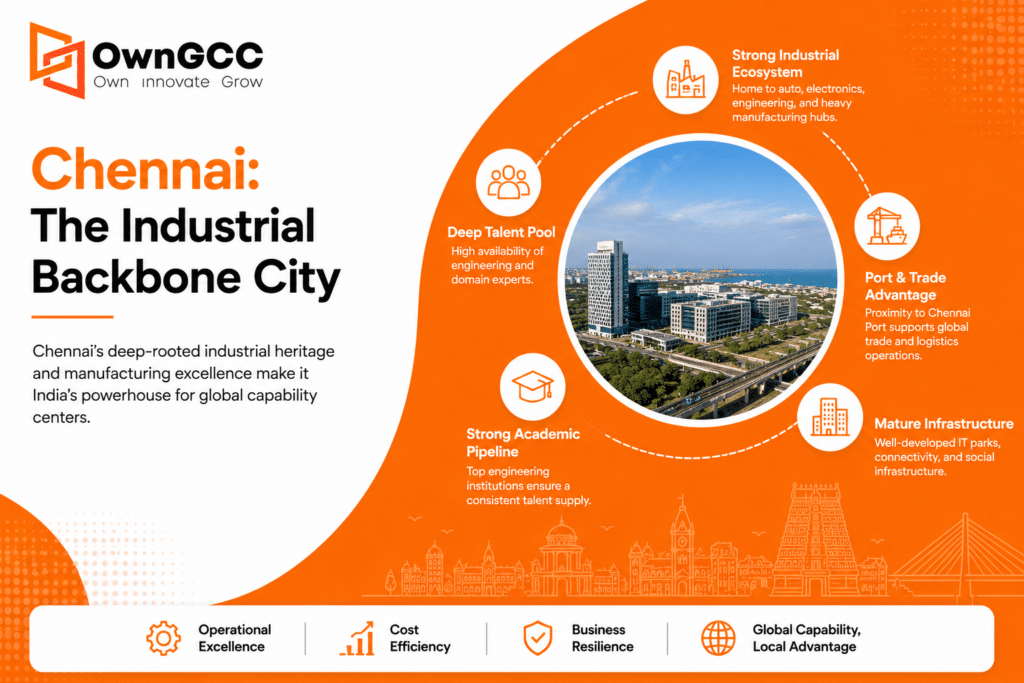
Chennai did not become a supply chain talent hub by accident. It became one because of what was built around it — and what was built around it is among the densest concentrations of manufacturing, port infrastructure, and industrial activity in South Asia.
The Chennai Port is one of India’s oldest and largest major ports, handling significant container volumes and serving as a critical gateway for automotive exports, general cargo, and break-bulk freight. Ennore Port (now Kamarajar Port) handles bulk cargo and petroleum products. Between them, they have created a generation of logistics professionals who have grown up working in proximity to real port operations, freight forwarding activity, and international trade flows.
The automotive cluster centered on Chennai — often called the Detroit of Asia — has been producing supply chain professionals for decades. Hyundai, Ford (now restructured), Renault-Nissan, BMW, and hundreds of tier-1 and tier-2 auto component suppliers have all operated large-scale supply chain functions from Chennai. This means Chennai has a bench of professionals who understand just-in-time manufacturing supply chains, vendor-managed inventory, inbound logistics coordination, and export compliance at a level of operational depth that is difficult to replicate in cities without comparable manufacturing density.
Add the electronics manufacturing cluster in Sriperumbudur — where Foxconn, Pegatron, Samsung, and others operate — and you have a second high-complexity supply chain ecosystem running in parallel.
Chennai’s Talent Strengths for Logistics GCCs
Port and freight operations expertise. Chennai produces professionals who understand multimodal freight, customs clearance, documentation workflows, and carrier management from firsthand industry exposure. For GCCs with significant freight spend management, ocean freight analytics, or customs and trade compliance functions, this is a genuine differentiator.
Automotive and manufacturing supply chain depth. JIT, lean supply chain, supplier quality management, production planning — these are skills that come from working inside or adjacent to automotive and electronics manufacturing. Chennai has the highest concentration of professionals with this background among India’s major GCC cities.
Operational stability and retention. Chennai has historically shown lower attrition rates in operations and supply chain roles compared to Bengaluru and Pune. For a GCC building institutional knowledge in complex supply chain functions, this stability matters.
Tamil Nadu’s engineering university ecosystem. Anna University and its affiliated colleges, IIT Madras, NIT Trichy (within reasonable recruitment distance), and a network of private engineering and management colleges produce large numbers of graduates with engineering and operations backgrounds. For supply chain analytics, network optimization, and engineering-adjacent roles, the pipeline is strong.
Cost competitiveness. At mid-to-senior supply chain roles, Chennai’s compensation benchmarks remain competitive relative to Pune and significantly more competitive than Bengaluru. For a GCC planning to scale to 200-plus people in supply chain operations, the compensation delta compounds meaningfully.
Chennai’s Honest Limitations
Chennai’s talent pool is deep in hard-core operations and freight-oriented supply chain. It is comparatively thinner in the strategic and technology-facing supply chain functions that many global GCCs are increasingly prioritizing — digital supply chain transformation, advanced demand planning using ML-driven tools, supply chain finance analytics, and sustainability-linked logistics metrics.
The city’s GCC ecosystem, while growing, remains more manufacturing-and-IT oriented than Pune’s more diversified MNC presence. If your mandate requires building a center of excellence that blends supply chain operations with digital transformation capability from day one, Chennai’s available talent requires more deliberate investment in upskilling.
Language dynamics are also worth noting practically. Chennai is a Tamil-speaking city, and while English proficiency among professionals is high, the cultural and linguistic environment is more homogeneous than Pune’s. For roles that require significant internal stakeholder management with global teams, this is a minor consideration but worth surfacing.
Pune: The MNC Ecosystem City
What Built Pune’s Supply Chain Talent Pool
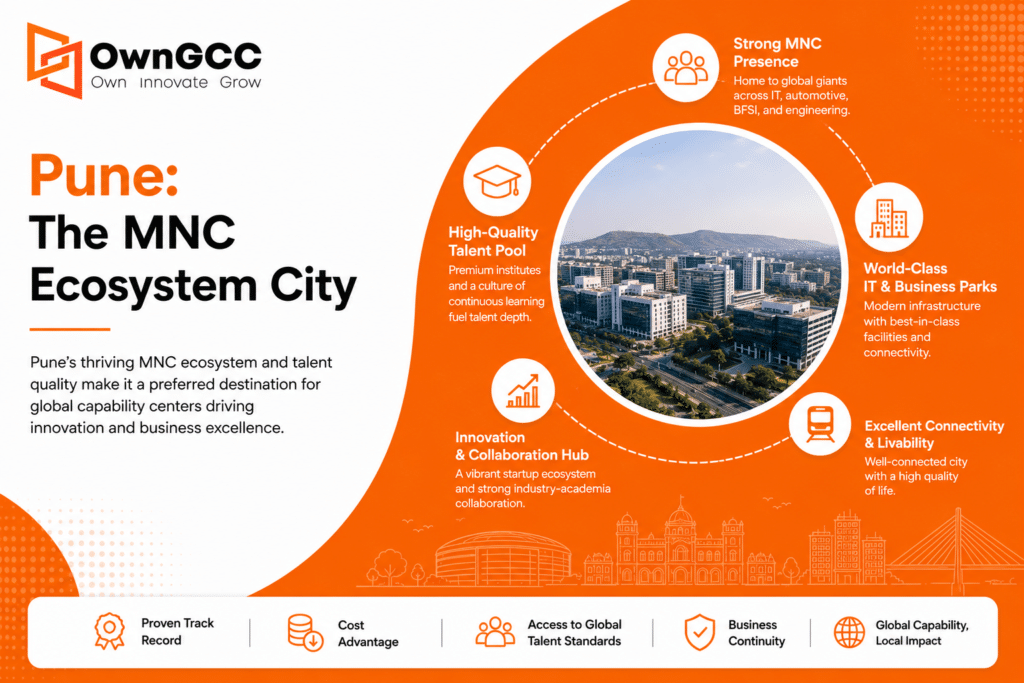
Pune’s talent story is different from Chennai’s. Where Chennai was shaped by industry clusters and port geography, Pune was shaped by MNC penetration and the proximity effect of a large, diversified university ecosystem feeding into a high concentration of global companies.
Pune has, for three decades, been one of India’s most attractive cities for multinational companies establishing Indian operations. The list of MNCs with significant Pune presence reads like a Fortune 500 index: Mercedes-Benz, Volkswagen, Bajaj Auto, Tata Motors, Bosch, Cummins, Honeywell, Emerson, Eaton, Piramal, and dozens of others. This MNC density has created something specific: a talent pool that has been trained to global standards, has worked inside global process frameworks, and is fluent in the language — operational and literal — of working for international organizations.
For a GCC building supply chain functions that will interact daily with global procurement teams, regional logistics leads, and C-suite stakeholders in North America or Europe, this matters. Pune professionals are more likely to have been inside global SAP S/4HANA implementations, to have worked with global 3PL management frameworks, and to have participated in global S&OP processes at the India node.
Pune also benefits from one of India’s strongest management education ecosystems. SIBM (Symbiosis Institute of Business Management), SCMHRD (Symbiosis Centre for Management and Human Resource Development — which has a dedicated logistics and supply chain specialization), and the Symbiosis group more broadly produce a consistent stream of supply chain management graduates who enter the workforce with functional knowledge that Chennai’s engineering-dominant pipeline does not always provide.
SCMHRD specifically deserves attention. It is one of very few Indian business schools with a supply chain management specialization that produces graduates recruited directly into global supply chain roles. Pune’s ability to recruit from this pipeline is a tangible talent advantage for GCCs building planning, analytics, and supply chain strategy functions.
Pune’s Talent Strengths for Logistics GCCs
MNC-trained supply chain professionals. Pune’s talent pool has disproportionately high exposure to global process standards, ERP environments, and international stakeholder management. This reduces onboarding time and cultural adjustment for GCC roles that interface with global operations.
Strategic and digital supply chain capability. Demand planning, supply chain analytics, S&OP, IBP (integrated business planning), and procurement analytics talent is more available and more experienced in Pune than in Chennai. For GCCs with mandates that extend beyond transaction processing into supply chain decision support, Pune offers a stronger ready-now talent bench.
Automotive and engineering supply chain — a parallel to Chennai. Pune has its own automotive cluster — Bajaj, Tata Motors, Mercedes-Benz, Volkswagen, and their supplier ecosystems — which means engineering and automotive supply chain expertise is available here too, though somewhat less concentrated than Chennai.
Technology integration talent. Pune’s large IT services presence (Infosys, Wipro, Cognizant, TCS all have major Pune operations) means the city produces professionals comfortable at the intersection of supply chain and technology. For GCCs deploying supply chain control towers, TMS implementations, or advanced analytics platforms, Pune offers a talent profile that bridges operational supply chain knowledge and technology deployment capability.
Quality of life driving retention at senior levels. Pune consistently ranks among India’s most livable cities. For GCCs trying to attract experienced supply chain leaders — people at the 10-to-15-year experience level who have choices — Pune’s quality of life is a meaningful retention lever.
Pune’s Honest Limitations
Pune’s attractiveness to MNCs is also a talent competition problem. The city has a high concentration of companies competing for the same supply chain talent, which translates to higher compensation benchmarks, faster compensation escalation, and attrition driven by lateral moves within the same city. A Pune-based supply chain analyst has more within-city options than their Chennai counterpart, which creates a structural attrition pressure that your GCC will need to actively manage.
Real estate costs in Pune’s primary GCC corridors — Hinjewadi, Kharadi, Magarpatta — have escalated significantly over the last five years. For a GCC planning for a large operational footprint, the per-seat cost in Pune is meaningfully higher than Chennai.
Pune also does not have Chennai’s proximity to port infrastructure. For GCCs whose mandate includes freight analytics, trade lane management, or customs and compliance functions that benefit from proximity to actual port activity, Pune’s inland location is a limitation.
The Function-by-Function Verdict
Rather than a generic city recommendation, here is how the decision should flow based on what your GCC is actually being asked to do:
Freight and trade lane management, customs compliance, ocean freight analytics: Chennai wins. The port proximity, freight forwarding ecosystem, and operational depth in trade documentation make Chennai the stronger choice for these functions. Chennai professionals have grown up around this activity in ways that Pune has not replicated.
Demand planning, S&OP, and IBP: Pune wins. The management school pipeline — particularly SCMHRD — and the MNC ecosystem have produced a disproportionate number of experienced demand planning and S&OP professionals. If your GCC is running supply chain planning cycles that interface with global teams, Pune’s talent profile is better matched.
Procurement analytics and strategic sourcing support: Pune wins, narrowly. The MNC training environment and the higher frequency of exposure to global procurement processes give Pune professionals an edge in roles that require mature stakeholder management and strategic framing. Chennai has procurement talent, but it skews more transactional.
Supply chain control tower and TMS operations: Chennai wins for operational scale, Pune wins for technology integration. If your control tower is primarily operational and requires significant headcount, Chennai’s cost structure and operational depth make it more efficient. If your control tower is technology-intensive and requires people who can configure, run, and optimize the platform, Pune’s supply chain-plus-technology talent profile is stronger.
Automotive supply chain and JIT operations support: Narrow Chennai win, though Pune is a genuine competitor here. Both cities have automotive ecosystems. Chennai’s is larger and more export-oriented, giving it an edge in international automotive supply chain roles.
Logistics finance and supply chain analytics: Pune wins. The intersection of finance-trained MBAs and supply chain exposure is more available in Pune. If your GCC mandate includes freight spend analytics, carrier benchmarking, or supply chain P&L management, Pune’s talent profile is better suited.
Large-scale operational processing at cost: Chennai wins clearly. The compensation benchmarks, attrition dynamics, and operational talent depth make Chennai a more efficient choice for GCCs planning to build headcount at scale in operational roles.
The Hybrid City Strategy: What OwnGCC Recommends for Complex Mandates
For GCCs with supply chain mandates that span both operational depth and strategic capability — which describes most of the clients we work with at OwnGCC — the honest answer is that neither city is singularly optimal across every function.
The GCC leaders who get this right are building a deliberate hybrid architecture: anchoring their operational supply chain functions (freight ops, customs compliance, transaction processing, control tower operations) in Chennai, while housing their strategic and technology-facing supply chain functions (demand planning, procurement analytics, supply chain finance, digital supply chain transformation) in Pune.
This is not the same as spreading your GCC thin across two cities with no clear logic. It is designing with intentionality — putting each function in the city where the talent ecosystem is strongest for that function, and building an operating model that connects both centers into a coherent capability.
The inter-city operating model does add coordination complexity. But the talent advantage — access to Chennai’s operational depth and Pune’s strategic capability simultaneously — consistently outperforms the single-city compromise.
Five Questions to Finalize Your City Decision
Before you commit to a city, these five questions should be answered with data specific to your organization:
What is the precise function mix of your GCC at launch and at Year 3? If you are launching primarily with operational supply chain functions and adding strategic capability later, Chennai’s cost economics and talent availability make it the right launch city — with Pune as a planned second location. If your launch is immediately strategic, Pune may be the right anchor.
What ERP and supply chain technology environment are you deploying? SAP S/4HANA experienced talent is available in both cities, but Pune’s MNC density means more available professionals with large-scale global SAP implementation experience. Oracle SCM Cloud talent is present in both cities. Your technology stack should influence your city selection.
What is your target compensation band for senior supply chain roles? If your benchmarks are below market for Pune at the senior level, you will face attrition within 18 months. If you are prepared to compete on compensation in Pune, the talent is there. If not, Chennai offers more senior talent within a competitive budget.
What does your global operating rhythm look like? If your GCC will operate in significant overlap with US Eastern or Central time, both Chennai and Pune present roughly equivalent time-zone coverage. If you have significant Europe overlap requirements, neither is ideal, but both are workable.
What is your attrition tolerance? If you are building a center where institutional knowledge is a core asset — complex freight relationships, deep customer supply chain integrations, institutional process knowledge — Chennai’s attrition dynamics are more favorable. If you are building a center where role skill is more portable and turnover is manageable, Pune’s higher-velocity talent market is an acceptable trade.
How OwnGCC Helps You Make This Decision with Confidence
Location selection for a supply chain GCC is not a one-time event. It is the first in a sequence of talent, real estate, legal entity, and operating model decisions that compound over years. Getting the city right does not guarantee GCC success. Getting it wrong creates structural headwinds that are expensive and time-consuming to correct.
At OwnGCC, we bring location intelligence that goes beyond real estate benchmarks and salary surveys. We map the actual talent ecosystem in each city against your specific function requirements. We model the three-year talent acquisition trajectory under different city scenarios. We identify the employer competitive set you will be fighting against for the talent profiles you need. And we help you design an operating model — single-city or multi-city — that is matched to what you are actually trying to build.
The right GCC city is not the most popular GCC city. It is the city where the talent for your specific supply chain mandate already exists.
If you are in the process of making this decision, we’d like to be part of it before the shortlist becomes final.
OwnGCC specializes in GCC strategy, location advisory, and operating model design for global companies entering or expanding in India. Our supply chain practice works with logistics companies, 3PLs, manufacturing firms, and retail organizations building supply chain centers of excellence in India.
Ready to run a talent feasibility assessment for your supply chain GCC? Talk to an OwnGCC advisor.