Introduction: The Invoice Looks Clean. The Reality Isn’t.
Your outsourcing vendor sends a tidy monthly invoice. Fixed fee. No surprises. It feels like a controlled cost — predictable, auditable, easy to defend to the CFO.
But behind that single line item is a cost structure you’ve never been shown.
Margins stacked on margins. Talent you don’t own. Processes you can’t see. Data flowing through infrastructure you didn’t vet. And an exit clause that makes walking away more expensive than staying.
This isn’t speculation. It’s the business model. Vendors aren’t built to save you money indefinitely — they’re built to maximize revenue per client. Your “savings” are their product.
The companies that figured this out aren’t renegotiating vendor contracts. They’re building their own captive teams in India — and the numbers are forcing CFOs to pay attention.
Here’s what the invoice doesn’t show you.
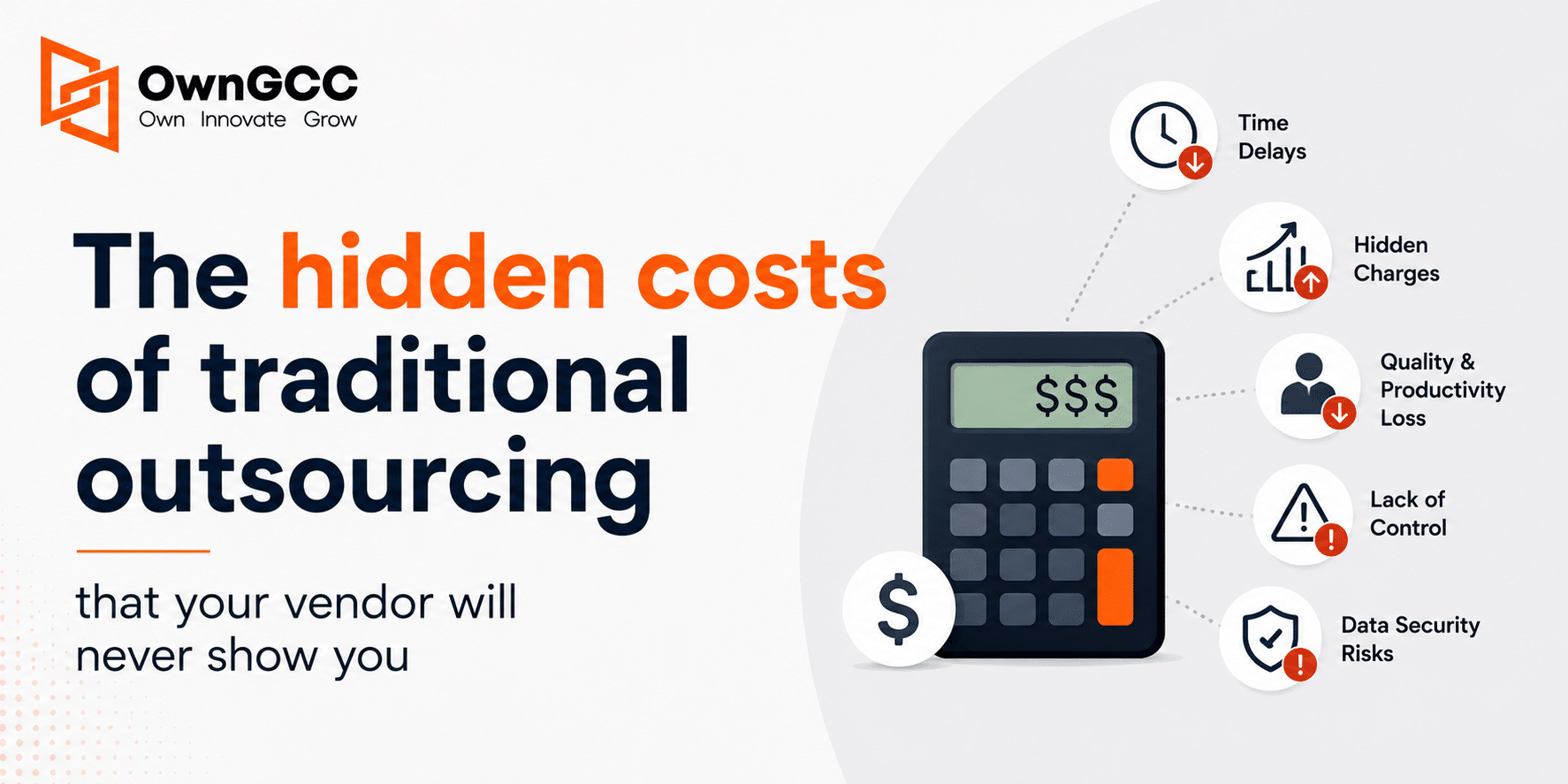
1. The Markup You’re Paying on Every Resource
Let’s start with the most straightforward hidden cost: the markup on talent.
When you hire through a traditional outsourcing vendor, you’re paying the vendor’s billing rate — not the resource’s actual cost. In the Indian market, experienced talent in mortgage operations, insurance processing, or healthcare administration earns anywhere from $8,000 to $18,000 per year depending on role and seniority.
Vendor billing rates for the same profile to a US client? Typically $28 to $55 per hour, depending on the engagement and the SLA packaging.
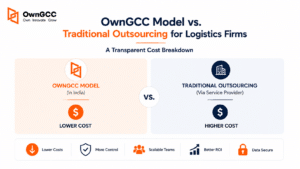
Do the math on a 40-person team at $35/hour over 2,000 annual hours. That’s $2.8 million billed annually. The vendor’s fully loaded cost on those 40 people, in India, is closer to $700,000 to $900,000.
The rest — between $1.9M and $2.1M — is the vendor’s gross margin.
You are the product. The talent is their raw material. And you’re paying for the packaging.
When you build a captive team through a transparent Build-Operate-Transfer model, you see the actual salary structure, the benefits costs, the facility costs, and the management layer. There’s no black box. What you pay in Year 1 is close to what you’d pay if you owned the operation outright — because in a BOT model, you will.
2. Productivity Loss Hidden Behind SLA Theater
Vendors report on SLAs. They rarely report on actual productivity.
Here’s the gap: an SLA can confirm that 98% of mortgage loan files were processed within 24 hours. What it doesn’t tell you is how many resources were deployed to hit that number, what the error rate was before rework, how many supervisory escalations happened, or how much your onshore team spent correcting offshore output.
The vendor is incentivized to maintain the SLA metric, not to optimize your actual throughput.
In mortgage operations, this shows up as processing teams that technically meet turn-time commitments but quietly depend on your US processors to catch and fix errors. In insurance, it’s claims handlers who pass files along the chain rather than resolving exceptions — because resolution would require authority they don’t have and training the vendor never invested in.
The hidden cost here isn’t a line item. It’s the time your US team spends compensating for offshore gaps. It’s the rework cycles. It’s the senior US employee who should be managing relationships but is instead reviewing files that should have been clean.
Studies in operations management consistently show that companies with captive offshore teams report 25–40% better productivity outcomes than equivalent outsourced teams within 18 months of stabilization — because they can invest in training, process design, and accountability in ways a vendor never will.
Your vendor’s productivity is optimized for their margin. Your captive team’s productivity is optimized for your outcome.
3. Talent Attrition — and Why You’re Paying for It Without Knowing
One of the most expensive and least visible costs in outsourcing is talent attrition — and it’s structured so that you bear most of the true cost while the vendor’s invoice stays flat.
In many Indian outsourcing operations, annual attrition runs between 25% and 45%. In high-volume processing environments — exactly the kind of work mortgage servicers, insurance carriers, and logistics companies send offshore — attrition rates at the bottom of the pyramid can push even higher.
Every time a trained resource leaves, your vendor has to hire and train a replacement. During that ramp — typically 30 to 90 days for any complex process — error rates spike. Output drops. Your onshore team absorbs the gap. The SLA might hold because the vendor throws bodies at the problem temporarily.
But you’ve still paid for it. You’ve paid in rework. In QC time. In onshore supervision hours. In delayed cycle times that don’t show up in the vendor’s dashboard but absolutely show up in your operations.
And here’s the most counterintuitive part: your vendor is not incentivized to solve attrition. Attrition creates a steady demand for their recruiting bench. High turnover in offshore teams is, for some vendors, a feature — not a bug. It’s how they maintain control over institutional knowledge that should belong to you.
Captive teams have different dynamics. When the team works in your name, reports to your org chart, and sees a career path within your structure, attrition drops dramatically. Companies that transition from outsourced to captive models consistently see attrition fall to 10–15% within two years. That’s not a small saving — on a 40-person team, the difference between 35% and 12% annual attrition represents millions of dollars in avoided ramp costs and productivity loss over a five-year period.
4. Data Risk: What Flows Through Your Vendor’s Infrastructure
This is the cost that doesn’t show up until it becomes a headline.
When you outsource mortgage processing, you are sending borrower PII — names, Social Security numbers, income data, property addresses, loan amounts — through a vendor’s systems. When you outsource insurance operations, you’re sending claims data, health records, policy details, and beneficiary information through infrastructure you did not build, did not audit, and cannot fully control.
Most outsourcing contracts include data security provisions. They list frameworks, certifications, and audit rights. But “audit rights” is not the same as “actual audit.” And a certification like ISO 27001 on the vendor’s letterhead doesn’t mean your data environment — your files, your workflows, your integrations — is what was certified.
Traditional outsourcing vendors serve multiple clients. Your data sits in a multi-tenant environment. The controls that protect your mortgage borrowers’ PII are the same controls protecting another company’s customer data — and in some cases, that other company is your competitor.
With a captive GCC, you control the data environment. You specify the infrastructure. You choose the cloud architecture, the access controls, the logging, the incident response protocols. ISO 27001:2022 certification on a captive environment means something categorically different from a vendor’s umbrella certification — because it’s your environment being certified.
The probability of a vendor-related data event is not zero. The regulatory and reputational cost of a breach involving borrower PII or insurance claimant data is not zero either. Your outsourcing invoice doesn’t carry a line item for that risk. It should.
5. Process Lock-In: The Exit Tax Your Vendor Built In
Ask your vendor what it would take to exit the engagement. Then read the contract carefully.
Most outsourcing agreements create a structural lock-in that isn’t called “lock-in” anywhere in the document. It shows up as:
Knowledge concentration. Your vendor’s team knows your process. The documentation lives in their systems. The institutional memory is in their people. When you exit, you’re not just losing resources — you’re losing the operational blueprint that took years to build.
Transition minimums. Most contracts require 90 to 180 days of notice. During that period, you’re paying full rates for a team that knows they’re being wound down. Productivity, already fragile, deteriorates.
Data extraction friction. Getting your data, your files, and your process documentation out of a vendor’s system is rarely as simple as a download. Expect weeks of negotiation and technical work — sometimes at additional charge.
Replacement ramp. Whatever team you bring the work to next — in-house, different vendor, or captive — needs time to ramp. You’re paying double for months.
The exit tax on a mid-sized outsourcing engagement routinely runs to six or seven figures when you account for all of these factors together. Vendors don’t advertise this in the sales process. They count on inertia to keep the contract renewing.
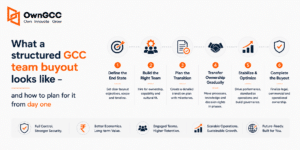
The Build-Operate-Transfer model is engineered specifically to eliminate this dynamic. Under a BOT structure, the team is built for transfer from Day 1. The documentation, the processes, the reporting, the team relationships — all of it is structured to move to your ownership on a defined timeline. There is no exit tax because exit was always the plan.
6. The Opportunity Cost of Vendor-Controlled Talent
Here’s a cost that almost never appears in any analysis: the opportunity cost of talent you don’t own.
When your outsourcing vendor manages your offshore team, that team cannot evolve into strategic capability for your company. They can execute the process you defined three years ago. They cannot contribute to process improvement, product development, technology implementation, or competitive differentiation — because those decisions don’t live in their scope.
Meanwhile, companies building captive GCCs are using the same Indian talent market to build underwriting analysts who contribute to model development, technology teams who build proprietary automation, and operations leads who redesign workflows and drive Lean Six Sigma improvements.
The difference isn’t in the talent pool. India’s financial services, insurance, and technology talent is exceptionally deep. The difference is in the structure. A vendor team is built to execute your current state. A captive team can build your future state.
Every month you remain in a vendor relationship is a month that talent capability is not accruing to your organization. That’s not a cost you’ll find on an invoice. But over five years, it’s arguably the most expensive line item of all.
What the Math Looks Like at Scale
Consider a mid-market mortgage servicer running a 50-person offshore team through a traditional vendor at $38/hour. Annual cost: approximately $3.8 million.
Now model a captive GCC for the same team, built through a transparent BOT model:
Year 1 (Build): Fully loaded cost including setup, hiring, training, and management layer — approximately $1.8 to $2.1 million.
Year 2 (Operate): Team stabilized, attrition lower, productivity improving — approximately $1.4 to $1.6 million annually.
Year 3 (Transfer): Full operational ownership transfers to client. Ongoing cost: $1.2 to $1.4 million annually.
By Year 3, the same 50-person team costs roughly one-third of what the vendor was billing — and it’s your team, your process, your data, your institutional knowledge.
The savings over a five-year horizon typically land between $6 million and $10 million for a team of that size. And that’s before accounting for productivity gains, attrition reduction, data risk reduction, and the strategic capability value of owning the team.
The Moment of Urgency
Here’s the uncomfortable truth: every month in a vendor relationship is a month of compounding disadvantage.
The markup compounds. The productivity gap compounds. The attrition cycles compound. The process lock-in deepens. The strategic talent capability accrues to your vendor, not to you.
The companies now running efficient, high-performing captive GCCs in India didn’t act after the perfect moment presented itself. They acted because they ran the numbers and couldn’t justify waiting.
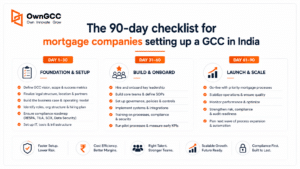
The good news is that the build timeline for a purpose-built GCC through a BOT model is shorter than most assume. Structured correctly, a team can be operational in 90 to 120 days. The transfer timeline is typically 12 to 24 months. And the savings start on Day 1 of the Operate phase.
The question isn’t whether a captive model makes financial sense. The question is how much longer you’re willing to pay vendor margins while that becomes more obvious.
Frequently Asked Questions
Q: How do I calculate the true cost of my outsourcing engagement?
Start with your vendor’s annual billing total. Then estimate the following costs not included in that invoice: the time your US team spends on rework and QA of offshore output (convert to salary cost), the productivity dip during each attrition-driven ramp cycle, any compliance or audit costs associated with vendor data reviews, and the estimated transition cost if you needed to exit today. In most mid-market engagements, these additional costs add 20–40% to the stated vendor cost.
Q: Isn’t setting up a captive team in India complicated and risky?
The complexity is real but manageable with the right structure. A Build-Operate-Transfer model addresses the primary risks: entity setup, compliance, HR, infrastructure, and process transition are handled by an experienced operator, and the team transfers to your ownership on a defined timeline with full documentation. The risk of doing it wrong is why choosing a partner with a proven BOT methodology matters — but the risk of staying in a vendor relationship indefinitely is demonstrably higher for most companies running teams of 20 or more.
Q: How long does it take to see savings with a captive GCC model?
Typically, cost parity with a vendor model is reached between months 9 and 14, depending on team size and setup costs. Material net savings — meaningful outperformance versus the vendor baseline — usually appear in Year 2. By Year 3, most companies are operating at 55–65% of their prior vendor cost for equivalent headcount and output.
Q: What happens to data security when I build my own captive team?
Data security in a captive model is structurally superior to multi-tenant vendor environments because you control the architecture. A properly set up GCC operates on dedicated infrastructure, under your security policies, with certifications applied to your environment specifically — not a vendor’s blanket umbrella. For mortgage and insurance companies subject to GLBA, state privacy regulations, and carrier security requirements, this is not a minor distinction.
Q: Is a captive GCC only for large enterprises?
No. The traditional assumption that only large banks or Fortune 500 insurers could justify a captive offshore team is outdated. Today, a well-structured BOT model is viable for companies with 20 or more offshore-ready headcount. Mid-market mortgage servicers, regional insurance carriers, and specialty logistics firms are actively building captive teams — and achieving the same financial and operational advantages that used to be reserved for enterprise players.
Q: What does “Build-Operate-Transfer” actually mean in practice?
It means your captive team is built by an experienced operator who handles all entity setup, hiring, infrastructure, and process design in India. They run the team on your behalf — with full transparency into costs, people, and performance — for a defined period, typically 12 to 24 months. At the transfer point, the entire operation — team, contracts, processes, documentation, relationships — moves to your direct ownership. You end up with a team you control entirely, with no vendor dependency, no markup, and full institutional knowledge intact.
Q: How is OwnGCC different from a traditional outsourcing vendor?
OwnGCC doesn’t build teams to keep them. The entire model is designed around ownership transfer — the team we build becomes your team. Pricing is transparent, not margin-stacked. And because we specialize in verticals like mortgage and insurance where we have deep operational expertise, the ramp to productivity is faster and the risk of process gaps is materially lower than a generalist outsourcing vendor who treats your domain as one of dozens they serve.
Ready to see what your vendor relationship is actually costing you?
OwnGCC works with mid-market mortgage servicers, insurance carriers, and financial services companies to model the true cost of their current outsourcing engagement — and build a captive team designed for ownership, not dependency.