Back office outsourcing solves this by delegating non-customer-facing administrative and operational functions to a specialized partner. Think accounting, claims processing, document management, and HR administration, handled by a dedicated team rather than your core staff.
This article covers what back office outsourcing actually includes, real service examples, the benefits worth quantifying, the outsourcing models available (including the emerging GCC approach), and how to pick a partner who won't lock you into an opaque contract.
Key Takeaways
- Back office outsourcing offloads rules-based, high-volume admin work while keeping customer-facing operations in-house.
- The global BPO market is projected to reach $525.23 billion by 2030.
- Cost savings of 30-50% are achievable, but vendor-owned vs. client-owned models determine your control level.
- GCC-as-a-Service lets you start small and scale into full ownership without a heavy upfront investment.
What Is Back Office Outsourcing?
Back office outsourcing means handing off administrative, operational, and support functions, the work that never touches a customer, to a third-party or dedicated offshore team. It's distinct from front-office outsourcing, which covers customer support, sales, and anything client-facing.
Back-office work tends to share three traits:
- Rules-based: governed by defined procedures, not judgment calls
- Repetitive: the same transaction type, processed at volume
- High-volume: hundreds or thousands of instances per month
That combination makes it a natural fit for a dedicated external team. The global business process outsourcing market reflects just how widespread this has become: it was valued at $302.62 billion in 2024 and is projected to reach $525.23 billion by 2030, growing at a 9.8% CAGR. Back-office functions like finance, HR, and data processing make up a substantial slice of that number.
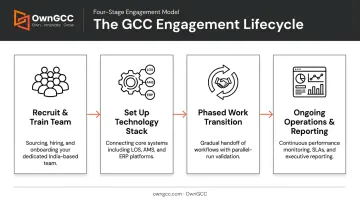
A typical engagement follows a lifecycle: the provider recruits and trains a team against your specific processes, then sets up the technology stack, often integrating directly with your existing LOS, AMS, or ERP. Work transitions in phases, and ongoing operations run with reporting built in. How long that takes and how much control you retain depends on the model.
Traditional Outsourcing vs. Modern Ownership Models
There are two ends of the spectrum here. On one side sits fully vendor-owned outsourcing, where a BPO firm hires, manages, and directs the team, and you simply receive output. On the other sits the captive Global Capability Center (GCC), where you own the entity, the team, and the culture outright.
Most companies land somewhere in between, and that middle ground is where the newer models get interesting. We'll unpack this further below.
Key Back Office Services & Examples
Back office outsourcing covers several distinct functions, each with its own volume patterns and compliance requirements.
Finance and accounting is the most commonly outsourced back-office function:
- Accounts payable and accounts receivable
- Bookkeeping and general ledger maintenance
- Invoicing and monthly close processes
- Payroll processing, including statutory compliance items like PF, ESI, and TDS
Data entry, document processing, and data management covers the digital housekeeping most companies underestimate:
- CRM and ERP record updates
- Document digitization and forms processing
- Catalog management for retail and e-commerce operations
Claims processing and insurance verification is a specialized, high-volume function common in healthcare and insurance. Eligibility and benefit verification alone represents 54% of medical administrative transactions, and Medicare's contractors process over a billion claims annually.
That volume is exactly why insurers and healthcare organizations lean on dedicated back-office teams for FNOL intake, adjudication support, and subrogation workflows.
HR administration rounds out the list:
- Employee onboarding and offboarding
- Benefits administration
- Compliance documentation
- Recruitment support
Industry-specific work goes even deeper. In mortgage lending, back-office teams handle loan processing, underwriting support, post-closing QC, and investor reporting across conventional, FHA, VA, and non-QM loan types.
OwnGCC's teams, for example, have redesigned underwriting workflows that cut file touches from seven down to three, while AI-assisted document classification has reduced indexing time by 65% in real engagements.
Benefits of Back Office Outsourcing
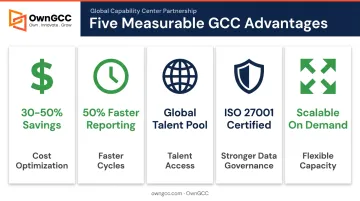
The case for outsourcing back-office work rests on five measurable advantages:
- Cost optimization: Loaded-cost reductions of 30-50% versus traditional outsourcing, driven by lean execution plus automation, not labor arbitrage alone. Mortgage clients often see 40-60%; insurance clients see 30-50%, reflecting more judgment-intensive underwriting work.
- Faster cycles: Automation and standardized workflows compress reporting timelines, delivering 50% faster reporting for business teams once processes move to a dedicated offshore model with built-in dashboards.
- Access to talent without headcount bloat: Tap into skilled global talent pools, finance professionals, compliance specialists, mortgage underwriters, without expanding fixed internal headcount or office space.
- Stronger data governance: Centralized, standardized processes paired with certifications like ISO 27001 create an audit trail and consistency that ad hoc internal processes rarely match.
- Flexible capacity: Volume spikes, whether seasonal, regulatory, or growth-driven, get absorbed without carrying fixed overhead year-round.
This flexibility reflects a broader shift in why companies outsource. Deloitte's 2025 Global Business Services survey found that 55% of organizations with a global GBS leader achieved more than 20% average savings, with agility now ranking alongside cost as a top driver.
Back Office Outsourcing Models: Traditional Outsourcing vs. GCC-as-a-Service
Traditional vendor-owned outsourcing has a well-documented playbook, and it has persistent problems too:
- Opaque cost structures — bundled pricing hides where your money actually goes
- Culture misalignment — the vendor manages the team, not you, so priorities drift
- Limited transparency — you get output, not visibility into how it's produced
These issues aren't new complaints. They're structural. Vendors are incentivized toward bigger teams and longer contracts, not necessarily better outcomes for you.
GCC-as-a-Service is the evolution built to fix this. You own the team, the culture, and the outcomes. The partner provides infrastructure, domain expertise, and operational excellence to make it run.
It's the model OwnGCC was built around, with a mission the founders describe simply as cutting the fat from outsourcing.
India remains the anchor market for this shift. The country hosts more than 1,700 GCCs generating $64.6 billion in revenue and employing over 1.9 million professionals as of FY2024, a scale that reflects how mature the captive-center ecosystem has become.
What makes this approach practical rather than theoretical is the progressive path. You don't need the heavy upfront investment of a captive center on day one.
OwnGCC structures four engagement models around this progression, so commitment scales with the relationship:
- Virtual Staffing — subscription-based, no legal entity required, 4-8 week start
- Managed Teams — dedicated India FTE pods from 10 to 100+, fully loaded per FTE
- Build-Operate-Transfer — phased setup with a transfer milestone once volume stabilizes
- Full GCC — advisory and setup support for a fully client-owned captive
How to Choose the Right Back Office Outsourcing Partner
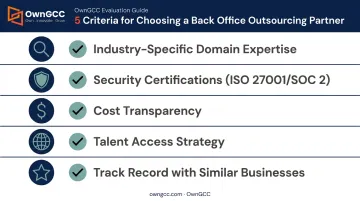
Not every provider is built the same way, and the wrong fit shows up fast in cost overruns or compliance gaps. Evaluate on these criteria:
- Industry-specific domain expertise. A generalist BPO won't understand mortgage QC nuances or IRDAI compliance the way a mortgage-and-insurance-focused partner will.
- Security certifications. Look for ISO 27001 and SOC 2 at minimum. ISO 27001 certifies the security management system; SOC 2 reports on specific controls around security and confidentiality. Verify both, including scope and validity dates.
- Cost transparency. Ask for a clear, usage-aligned cost breakdown, not a bundled fee that hides vendor margin. Contract flexibility matters too. Deloitte found 67% of outsourcing relationships now use outcome-based structures rather than rigid fixed-fee arrangements.
- Talent access strategy. Established hubs like Bangalore, Hyderabad, Pune, and Chennai remain strong, but providers expanding into Philippines, Vietnam, and South America signal a longer-term talent strategy rather than single-city dependency.
- Track record with similar businesses. Ask for references from companies your size and regulatory profile, ideally in mortgage, insurance, or another compliance-heavy vertical.
A quick due-diligence checklist:
- Request the actual ISO 27001 or SOC 2 certificate, not a marketing claim
- Ask how pricing changes at different volume tiers
- Confirm who owns the data, the IP, and the institutional knowledge if the contract ends
- Get specifics on transition timelines for onboarding your workflows
Frequently Asked Questions
What is back office outsourcing?
Back office outsourcing means delegating non-customer-facing administrative and operational tasks, like accounting or data entry, to an external or dedicated offshore team. It excludes sales, marketing, and direct customer support.
What are back office services examples?
Common examples include accounts payable/receivable, data entry, claims processing, HR administration, document management, and payroll processing. Industry-specific examples include mortgage underwriting support and insurance policy administration.
What is the difference between front office and back office outsourcing?
Front office outsourcing covers customer-facing work like sales and support, while back office outsourcing covers internal, process-driven functions that customers never see directly.
How much does back office outsourcing typically cost?
Pricing varies by scope, complexity, and delivery location. Transparent providers offer clear, usage-aligned cost structures instead of opaque bundled fees, and savings of 30-50% over traditional in-house or vendor-owned operations are common.
Is back office outsourcing secure for handling sensitive data?
Reputable providers hold certifications like ISO 27001 and follow strict data governance protocols. Always verify the certificate's scope and ask about supplementary controls like SOC 2 before signing.
How is a GCC-as-a-Service model different from traditional back office outsourcing?
In a GCC model, you own and direct the team and culture while the provider supplies infrastructure and operational support. Traditional outsourcing keeps the vendor in control of the team and its priorities.